
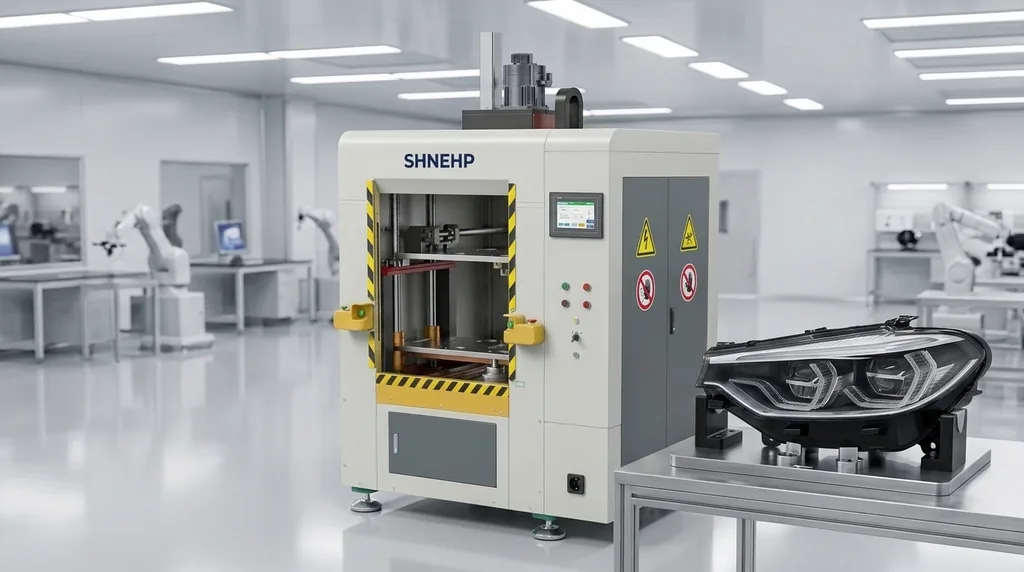
Adaptive matrix LED headlamps, laser-projector headlights, and sleek wrap-around EV front light assemblies pack high-value optical projectors, stepper aiming actuators, and thermal heat sinks directly behind a crystal-clear hard-coated polycarbonate (PC) outer lens. Traditional polyurethane hot-melt adhesive dispensing requires messy glue tracks, robot nozzle upkeep, and curing buffers, while contact hot plates struggle with PC's high melt temperature exceeding PTFE coating limits. Adopting non-contact hot plate welding headlamps melts PC lenses and PP-T40, PBT, or PC/PBT headlamp housings radiatively across a 1–2 mm air gap—delivering permanent, glue-free IP67 / IP69K sealing with strictly zero platen contact and zero stringing.
The part and its welding challenges
Front headlamp assemblies are among the largest and most optically demanding thermoplastic weldments on modern vehicles, presenting five engineering challenges:
- Polycarbonate melt temperature exceeds PTFE coating limits: Optical-grade PC requires elevated surface melt temperatures (often 280–315 °C in contact setups) that rapidly blister fluoropolymer anti-stick coatings above ~270 °C, causing sticky residue, dark carbon specks, and angel-hair strands.
- Large 3D aerodynamic sweep and deep Z-axis contour: Front fender-to-grille headlamps routinely span 500–850 mm with steep compound curves, requiring 5-axis machined contoured infrared emitters that track every height transition at a uniform standoff gap.
- Zero-particulate optical cleanroom standards: High-intensity LED projectors amplify even a 0.2 mm speck of dust or flash sitting on the inside of the hard-coated PC lens; zero contact eliminates mechanical shedding completely.
- Protecting hard-coated outer lenses and internal electronic modules: UV-cured anti-scratch hard coats crack under excessive clamp distortion, while delicate projector shrouds and LED PCBs sit millimeters away from the perimeter flange.
- High-temperature engine-bay durability and condensation control: Headlamps endure -40 °C winter cold soak to +110 °C under-hood heat alongside pressure-wash sprays, requiring stress-free, bubble-free joints free of moisture outgassing.
Why non-contact hot plate welding (vs. alternatives)
| Process | Fit for matrix LED & EV headlamps | Consumables & particulate control | Typical cycle time | Engineering boundary |
|---|---|---|---|---|
| Non-contact infrared hot plate welding (XNS6-B / XNS8-B / XNS9-B + IR) | Premier weld-only choice for PC-to-PBT, PC-to-PC/ABS, or compatible modified-housing headlamp assemblies | Zero adhesive consumables, zero PTFE wear, zero stringing, and cleanroom-grade optical cavities | ~22–38 s | Requires weld-compatible lens/housing polymer pairing (note: incompatible PC lens + unmodified PP-T40 housing still requires glue or mechanical/laser-assisted hybrid track) |
| Polyurethane / butyl hot-melt glue dispensing | Dissimilar incompatible pairs (standard PC lens + PP-T40 housing) | High ongoing adhesive cost, purge scrap, and cure staging space | ~30–60 s + cure | Required when chemical incompatibility prevents direct polymer-to-polymer fusion |
| Contact hot plate welding | Compatible medium-temp headlamp housings | Lower heater build cost | ~24–40 s | PC melt temperatures exceed ~270 °C PTFE ceiling, causing heavy maintenance and stringing rejects |
| Laser transmission welding | Premium low-height LED headlamps with IR-transparent PC lens + laser-absorbent PBT/PC housing | Zero flash and localized heat input | ~8–18 s | Demands very tight molding tolerances across 700 mm spans and significant laser optic capital |
Typical process window (industry ranges)
Non-contact infrared headlamp sealing follows DVS 2215 radiative control guidelines. Note that direct thermal welding requires chemically compatible lens and housing polymers (e.g., PC + PC/PBT, PC + PC/ABS, or PC + compatibilized housing); incompatible PC + unmodified PP-T40 combinations cannot melt-bond directly. Exact parameters are established during a SHNEHP trial.
| Parameter | Typical industry range (PC + PC/PBT / PC-ABS) | Engineering guidance |
|---|---|---|
| Mandatory pre-weld drying | PC / PBT / PC-ABS: 100–120 °C | Removes absorbed moisture to prevent interface micro-voids and internal fogging |
| Contoured IR emitter temp | 320–500 °C (multi-zone closed-loop IR panels) | Separately balances transparent PC lens absorption against black housing heat intake |
| Radiant standoff gap | 1.0–2.0 mm precision air gap | 3-axis servo Z-positioning holds uniform gap across steep 3D headlamp contours |
| Radiant soak duration | 8–18 s | Localized infrared absorption melts the weld rib cleanly while shielding projector shrouds |
| Servo changeover time | ≤1.5–2.2 s | Heavy-duty servo platen retraction closes the joint before PC viscosity spikes |
| Joining & hold phase | 0.18–0.30 N/mm² to closed-loop servo hard stop (1.2–2.2 mm collapse); hold 8–15 s | Controls headlamp mounting-point geometry within OEM body-in-white fit tolerances |
Recommended SHNEHP machine and fixture setup
SHNEHP builds heavy-frame 3-axis servo hot plate welding machines engineered specifically for wide automotive headlamp tooling (+60 mm platen clearance margin around fixtures):
- Compact & mid-size passenger headlamps: XNS6-B and XNS8-B servo platforms provide wide parallel tie-bar guidance, multi-zone non-contact IR radiant heating modules, and precise closed-loop joining force profiles.
- Large SUV / pickup / dual-headlamp L+R lines: XNS9-B extra-wide servo hot plate welders accommodate mirrored left/right headlamp tooling with quick-change rolling fixture carts for rapid OEM model changeovers.
- Optical-safe headlamp tooling: Custom welding and testing fixtures integrate floating datum pins, vacuum soft-touch cradles for hard-coated PC lenses, reflective internal bezel heat shields, and robotic load/unload readiness via customized machines.
Quality and leak testing
Headlamp assembly lines combine 100% leak verification with strict geometric and photometric checks:
- 100% IP67 differential leak testing: Automated fixtures seal the breather-patch opening and run 10–30 kPa pressure-decay tests to a 0.1–0.5 mL/min limit (1 Pa differential resolution, 3–5 s stabilization) before breathable ePTFE membranes are applied.
- Optical, aiming & environmental validation: Routine audits verify lens hard-coat integrity under polarized stress inspection, projector aiming datum accuracy on CMM fixtures, and thermal-shock humidity cycling (-40 °C to +90 °C).
FAQ
Can non-contact IR hot plate welding directly join a PC headlamp lens to an unmodified PP-T40 housing? No—polycarbonate (PC) and polypropylene (PP) are chemically incompatible and will not form a structural molecular weld regardless of heating method. Non-contact IR welding applies to compatible pairs such as PC + PC/PBT, PC + PC/ABS, or PC + specially compatibilized housing resins.
Why is non-contact IR preferred over contact hot plate welding for polycarbonate headlamps? Polycarbonate requires melt temperatures that push past the ~270 °C operating ceiling of standard PTFE anti-stick coatings. Non-contact IR operates at 300–500 °C across a 1–2 mm air gap, completely eliminating PTFE wear, sticking, and cosmetic stringing.
How does SHNEHP prevent lens warpage or hard-coat cracking on large curved headlamps? SHNEHP uses soft-touch contoured vacuum nests that support the full 3D lens perimeter evenly, paired with servo-controlled gentle touch-down and closed-loop displacement hard stops so clamping loads never overstress the UV hard coat.
Can non-contact IR headlamp welding integrate with 6-axis robots and inline leak testing? Yes. SHNEHP supplies turnkey robotic headlamp cells linking plasma/de-ionizing prep, XNS8-B / XNS9-B non-contact IR welding, automated 10–30 kPa differential leak testing, and breathable vent-patch application.
What engineering information do you need for a headlamp non-contact IR evaluation? Send 3D STEP/X_T headlamp assemblies, exact lens and housing resin grades, overall L×W×H envelope, target cycle time (single or L/R pair), and your OEM IP67 test spec.
Get a free weld trial
Share your automotive headlamp CAD models with SHNEHP engineering to confirm lens/housing polymer compatibility, contoured IR emitter layout, and cycle-time targets:
- 3D STEP / X_T / IGES models of outer lens, inner shroud, and headlamp housing
- Exact resin grades (PC, PC/PBT, PC/ABS, PBT) and hard-coat details
- Annual volume & L/R target UPH plus OEM IP67 criteria
Email yy@nbxiaoneng.com or connect through our contact page.
Request a Technical Consultation & Free Weld Trial
Send your 3D STEP/X_T drawing, resin grade, target cycle time, and leak-test specification. Our engineers will evaluate the joint and recommend a practical SHNEHP machine and fixture setup.