
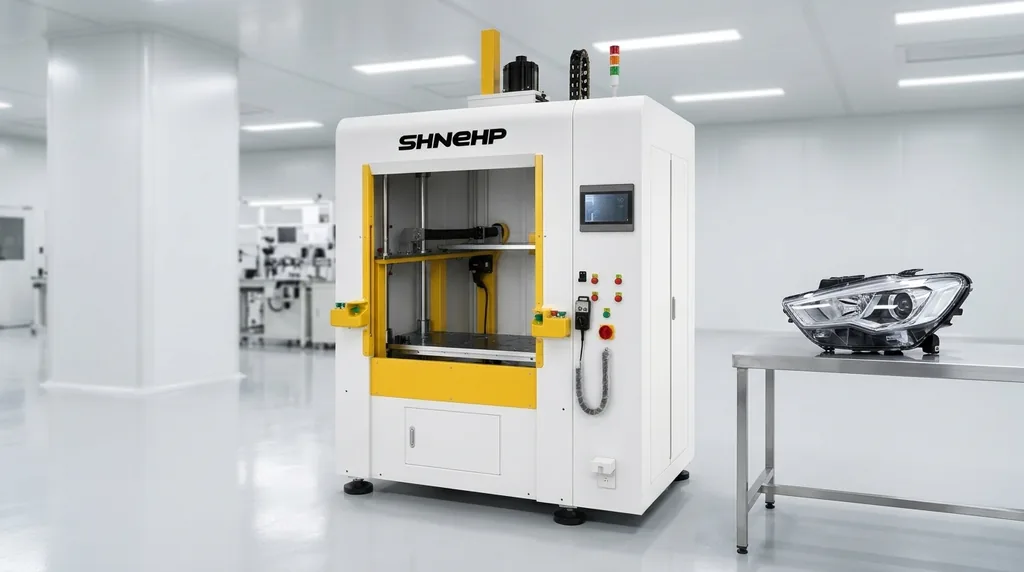
Automotive lighting Tier-1 suppliers rely on hot plate welding automotive headlamps when joining polycarbonate (PC) lenses to compatible PC or PC/ABS housings along large, three-dimensional wrap-around perimeters. Unlike traditional adhesive bonding that requires long curing ovens and consumable glues, servo-controlled hot plate welding creates an instant, hermetic, clean seam that passes water-ingress and thermal-cycling tests. SHNEHP builds 3-axis servo hot plate platforms (XNS6-B, XNS8-B, XNS9-B) with multi-zone temperature control and precision lighting fixtures designed to DVS 2215 standards.
The part and its welding challenges
Modern LED and projector headlamps feature sweeping 3D styling contours, thin optical lenses, and tight cosmetic tolerances. Direct thermal welding applies to compatible thermoplastic pairings such as PC lens to PC or PC/ABS housing (whereas incompatible pairings like PC lens to PP housing are typically joined with hot-melt adhesives or mechanical retention rather than direct fusion).
Headlamp-specific welding challenges include:
- 3D contoured perimeter seals: Wrap-around headlamp flanges rise and fall significantly in Z-height, demanding precision CNC-contoured heating blocks that follow the exact 3D weld profile.
- Moisture sensitivity and yellowing in PC: Polycarbonate is hygroscopic and thermally sensitive. Insufficient pre-drying causes bubbles and silver streaking; excessive platen heat or slow changeover degrades PC and causes yellowing.
- Zero-particulate optical zone: Any loose stringing, flash dust, or smoke trapped inside the lamp cavity ruins optical appearance and triggers immediate cosmetic rejection.
- Class-A lens surface protection: Outer polycarbonate lenses often carry hardcoats or anti-fog treatments; fixtures must locate and clamp the lens without scratching or inducing stress-whitening near mounting clips.
- Independent upper/lower thermal control: Even when joining compatible PC to PC/ABS, the transparent lens and opaque filled housing absorb heat differently and require separately controlled temperature zones.
Why hot plate welding (vs. alternatives)
| Process | Fit for automotive headlamps | 3D contour & cosmetic control | Typical cycle time | Engineering boundary |
|---|---|---|---|---|
| Servo hot plate (contact / non-contact IR) | Strong for large 3D-contoured PC-to-PC or PC/ABS headlamps | Handles steep 3D wrap-around contours; separate upper/lower temp zones; IR eliminates contact stringing | ~25–45 s total | Contact PTFE tops out ~270 °C; non-contact IR preferred for high-temp PC/PC-ABS cosmetic clarity |
| Linear vibration friction | Good for flatter lamp flanges with thick walls | Limited on steep 3D curves; risk of dust inside optical cavity | ~5–15 s total | Requires ≥2.5–3.0 mm motion clearance and dust-trap joint design |
| Laser welding | High cosmetic clarity on compatible pairings | Very clean, minimal flash | ~5–20 s | Higher equipment capex; requires tight part-to-part clamping tolerances |
| Ultrasonic welding | Internal brackets, reflectors, and clips only | Near-field small joints | ~0.1–1.5 s | Cannot seal full-size curved headlamp perimeters in a single weld |
| Adhesive / hot-melt sealing | Required for dissimilar PC-lens-to-PP-housing designs | Works across dissimilar polymers | Longer cure/handling | Ongoing consumable cost, dispensing maintenance, and cure space |
Typical process window (industry ranges)
The parameters below reflect DVS 2215 five-stage control and conservative industry baselines for PC and PC/ABS headlamp assemblies. Exact settings depend on resin grade, coating, and flange geometry, and are validated during a SHNEHP weld trial.
| Parameter | Typical industry range (PC / PC-ABS) | Engineering guidance |
|---|---|---|
| Pre-drying (PC / PC-ABS) | 100–120 °C prior to molding/welding | Prevents moisture bubbles, haze, and silver streaking in the weld zone |
| Heating mode & temperature | Contact tooling face ~275–310 °C; non-contact IR ~300–500 °C | Above ~270 °C contact PTFE wears rapidly; non-contact IR avoids sticking and stringing on clear PC |
| Melt / soak time | 6–20 s (depending on flange thickness) | Minimize dwell time to prevent PC thermal yellowing |
| Changeover (platen out) | ≤1.5–1.8 s | Ultra-fast servo retraction prevents amorphous PC melt from skinning |
| Joining collapse (meltdown) | 1.5–2.5 mm to closed-loop servo stop | Balanced with molded flash traps to hide bead from optical view |
| Hold / cooling time | 6–15 s | Prevents spring-back and lens warp near retention clips |
| Total machine cycle | ~25–45 s | Dual-cavity left/right tooling boosts output on wide platforms |
Recommended SHNEHP machine and fixture setup
SHNEHP applies our +60 mm window rule (machine platen ≥ part L×W + 60 mm) and vertical fixture ergonomics for automotive lighting lines (hot plate welding machine):
- Single-lamp or compact LED headlamps: XNS6-B 3-axis servo hot plate welder with closed-loop displacement accuracy and independent upper/lower PID temperature zones.
- Large wrap-around or dual-cavity (LH + RH) headlamps: XNS8-B or XNS9-B (up to 850×800 mm platen window) for simultaneous left/right production.
- Non-contact infrared heating option: Recommended when welding high-temperature PC or cosmetic lenses where zero stringing and zero platen contact are mandatory.
- Lighting-grade fixtures: Custom welding and testing fixtures feature polyurethane/soft-touch lens nests, vacuum holding cups to protect Class-A surfaces, precision dowel pins, and enclosed light-curtain safety.
- Turnkey lighting cells: Integrate internal bracket ultrasonic welding, boss hot staking, and inline leak testing via customized machines.
Quality and leak testing
Headlamps must pass both stringent cosmetic inspection and IP-rated environmental sealing:
- Inline pressure-decay or differential leak testing: Typical lighting leak tests use low positive or vacuum pressure (commonly 10–30 kPa depending on OEM spec, with a 2–5 s stabilization window to account for thin lens flex) to catch micro-leaks without stressing clips.
- Optical & cosmetic inspection: Verification of weld-line uniformity, absence of haze, bubbles, yellowing, or visible stringing inside the lens cavity.
- Environmental qualification: Thermal shock cycling, car-wash spray / immersion testing, and road-vibration endurance confirm long-term seal integrity.
- Traceability: Full per-cycle logging of zone temperatures, changeover time, melt depth, and join force for OEM PPAP audits.
FAQ
Can hot plate welding join a polycarbonate headlamp lens to a polypropylene housing? No—polycarbonate (PC) and polypropylene (PP) are chemically incompatible polymer families and cannot be directly fused by thermal welding. Hot plate welding is used for compatible lighting combinations such as PC-to-PC or PC-to-PC/ABS.
Contact hot plate vs. non-contact infrared—which is better for clear PC headlamp lenses? Because PC requires elevated melt temperatures (~275–310 °C) near or above the ~270 °C limit of PTFE anti-stick coatings, non-contact infrared (IR) heating is strongly preferred for cosmetic headlamps to eliminate sticking, stringing, and particulate contamination.
How do you keep PC headlamp lenses from yellowing or bubbling during welding? Ensure parts are properly dried (100–120 °C), use independent temperature zones for lens and housing, keep heating dwell as short as possible, and maintain rapid servo changeover (≤1.8 s).
Can one SHNEHP welder produce left-hand and right-hand headlamps together? Yes. Large-window platforms like XNS8-B and XNS9-B support dual-cavity (LH + RH) tooling or quick-change fixtures with stored PLC/HMI recipes for rapid model switching.
What files should I send for a headlamp weld evaluation? Send frozen 3D STEP/X_T files of both housing and lens, exact resin grades and coatings, target hourly volume (LH/RH), and your OEM leak-test specification.
Get a free weld trial
Evaluate whether contact or non-contact servo hot plate welding fits your headlamp program by sending:
- Frozen 3D STEP / X_T / IGES models of the headlamp lens and housing
- Resin grades (e.g., PC, PC/ABS) and any hardcoat / anti-fog coatings
- Target output (UPH) and OEM leak / optical acceptance criteria
Email yy@nbxiaoneng.com or contact our applications engineers on our contact page.
Request a Technical Consultation & Free Weld Trial
Send your 3D STEP/X_T drawing, resin grade, target cycle time, and leak-test specification. Our engineers will evaluate the joint and recommend a practical SHNEHP machine and fixture setup.