
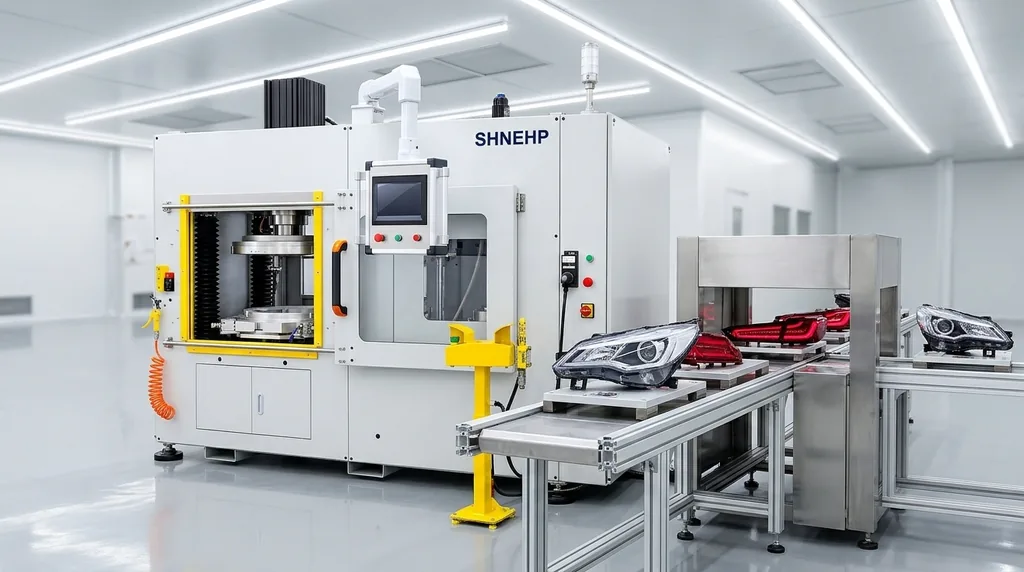
Modern Tier-1 automotive lighting plants run multi-variant LED headlamp, full-width light-bar tail lamp, and DRL programs under aggressive vehicle-launch schedules and zero-defect OEM quality agreements. Relying on disconnected standalone presses with manual operator transfers between bezel staking, lens cleaning, perimeter welding, leak testing, and breathable vent-patch application creates handling scratches, cycle bottlenecks, and broken serial traceability. Deploying custom automation automotive lighting welding unifies every thermal, ultrasonic, vision, and airtightness step inside a cleanroom-grade robotic or rotary-indexing cell. SHNEHP delivers turnkey customized machines built around our servo hot plate, non-contact infrared, vibration, and ultrasonic welding core platforms.
The part and its welding challenges
Automating Class-A optical lighting assemblies requires solving five coordinated mechanical, optical, and data-management challenges simultaneously:
- Eliminating operator handling scratches on Class-A lenses: Hard-coated polycarbonate headlamp lenses and smoked PMMA tail light lenses pick up micro-scratches and fingerprints during manual tray transfers; robotic vacuum end-of-arm tooling (EOAT) and dedicated pallet carriers keep lenses contactless from molding to final pack-out.
- Integrating dissimilar joining processes in one balanced takt: A single LED lamp often requires 20–35 kHz ultrasonic or hot-air staking for internal bezels/DRLs, de-ionizing air blow-off, non-contact IR or servo hot plate welding (or linear vibration welding) for outer lens sealing, and inline 10–30 kPa leak testing—all balanced to a unified line takt time.
- Rapid multi-model quick changeover (SMED): Tier-1 lighting suppliers frequently run 4 to 8 vehicle derivatives or L/R pairs on shared floor space; rolling quick-change fixture carts, auto-coupled pneumatic/electrical manifolds, and RFID recipe recognition keep changeovers under 10–15 minutes.
- Thermal cooling buffer between welding and leak testing: Freshly welded lamps need controlled ambient stabilization before differential pressure-decay testing so residual weld heat does not trigger false leak alarms.
- 100% serialized OEM MES traceability: Global automakers require every lamp's 2D DataMatrix code to link its sub-component lot scans, welding displacement/temperature/energy curves, exact IP67 leak-test value, and ePTFE membrane vision confirmation.
Why turnkey lighting automation (vs. alternatives)
| Architecture | Fit for Tier-1 automotive lighting plants | Quality consistency & labor efficiency | Typical line takt | Engineering boundary |
|---|---|---|---|---|
| SHNEHP turnkey robotic / multi-station lighting cell | Optimal choice for medium-to-high-volume LED headlamps, tail lights, and light bars (100k–1M+ units/year) | Single-vendor responsibility across welder, robot EOAT, vision, leak tester, and MES; eliminates scratch scrap and manual bottlenecking | ~15–32 s/lamp (or L+R pair) | Requires upfront CAD freeze on datum features and standard quick-change pallet interface |
| Rotary indexing welding & testing cell | Compact signal lamps, fog lamps, CHMSL brake lights, and DRL sub-assemblies | Ultra-compact footprint with overlapping load, weld, cool, and leak-test stations | ~8–18 s/cycle | Best suited to smaller/medium lamps rather than 1.5 m full-width SUV light bars |
| Standalone manual welders + offline leak benches | Low-volume aftermarket lamps, pilot builds, or early prototype launches | Lower initial capital investment | ~35–70 s/part | High operator labor count, inconsistent cosmetic handling, and fragmented QC records |
| Multi-vendor piecemeal integration | Legacy plant retrofits | Reuses existing presses | Variable | Finger-pointing between welder OEM, robot integrator, and leak-test vendor during launch ramp-up |
Typical process window (industry ranges)
Turnkey lighting cells synchronize multiple DVS 2215 / DVS 2217 welding stations with automated optical and hermetic checks. Exact station count and cycle split are engineered around your lamp CAD and annual volume during SHNEHP proposal design.
| Cell Station | Standard Automated Operations | Engineering Control Standard |
|---|---|---|
| Station 1: Load, Scan & De-Ionize | 2D DataMatrix scan, vision presence check of internal LED PCB/clips, ionized air blow-off | Poka-yoke locks out missing internal bezels or wrong L/R lens pairing |
| Station 2: Internal Sub-Assembly | Multi-head 20–35 kHz ultrasonic or hot-air cold staking of bezels & DRL guides | Zero-vibration hot-air option directly beside fragile ceramic LEDs |
| Station 3: Outer Lens Sealing | XNS5-B / XNS6-B / XNS8-B servo hot plate, non-contact IR (300–500 °C), or XN-55/70 vibration welding | Full temperature, pressure, changeover (≤1.5–2.2 s), and closed-loop collapse logging |
| Station 4: Cooling & IP67 Leak Test | Controlled cooling transfer + 10–30 kPa / 0.1–0.5 mL/min differential test (1 Pa, 3–5 s stabilize) | Automatic port-blockage check and poka-yoke reject chute |
| Station 5: Vent Patch & Laser Mark | Automated ePTFE breathable membrane placement + vision confirmation + pass laser mark / MES upload | Closed-loop database record per serialized lamp |
Recommended SHNEHP machine and fixture setup
SHNEHP engineers complete customized machines in-house—building both the core welding presses and the surrounding automation under one roof:
- Core welding platforms: Seamless integration of XNS5-B / XNS6-B / XNS8-B / XNS9-B 3-axis servo & non-contact IR hot plate welding machines, XN-55 / XN-70 vibration friction welding machines, XNC-400 / XN-5 ultrasonic welding machines, and multi-point hot staking machines.
- Cleanroom robotic cells & conveyor palettes: 6-axis robotic loading/unloading with soft-touch vacuum EOAT, Class-10k-ready aluminum framing, HEPA laminar-flow hood options, and RFID-coded quick-change welding and testing fixtures.
- Unified PLC & MES architecture: Standardized Siemens/Mitsubishi PLC line control with centralized HMI recipe management, real-time OEE dashboards, and direct OPC-UA / REST / SQL upload to plant MES.
Quality and leak testing
Turnkey lighting cells enforce zero-escape quality gates across every serialized assembly:
- End-to-end parameter gating: Every ultrasonic stake, hot-plate/IR weld curve, and 10–30 kPa differential leak result must pass inside tight recipe limits before the robot moves the lamp to the breathable vent-patch and final pass-label station.
- Automated shift calibration & audit mode: Dedicated HMI routines prompt operators through golden-master leak checks and pull-sample extractions without stopping overall line traceability.
FAQ
What processes can SHNEHP combine inside one automated automotive lighting welding cell? SHNEHP integrates ionized dust blow-off, vision component verification, internal bezel ultrasonic/hot-air staking, outer lens servo hot plate / non-contact IR / vibration welding, cooling transfer, 10–30 kPa IP67 differential leak testing, automated ePTFE vent patching, and MES barcode serialization.
How does a turnkey cell handle both left-hand and right-hand lighting variants? Cells can run mirrored L+R pairs simultaneously inside dual-cavity machines (XNS6-B / XNS8-B / XNS9-B) or use RFID-identified quick-change tooling carts and multi-grip robot EOAT to switch smoothly between models.
Why buy a turnkey lighting line from SHNEHP instead of integrating separate welder and leak-test vendors? Because SHNEHP builds the hot plate, IR, vibration, ultrasonic, and staking machines plus the custom leak-test fixtures in-house, one engineering team owns cycle takt, fixture datums, thermal cooling compensation, and FAT sign-off.
How long does factory acceptance testing (FAT) take for a custom automotive lighting cell? Every SHNEHP automated cell undergoes full dry-run, Gage R&R leak verification, and continuous production run-off using customer molded parts at our Ningbo facility prior to shipment and on-site commissioning.
What inputs do you need to quote a custom automotive lighting automation line? Share 3D STEP/X_T models of all lamp variants, lens/housing resin pairings, required annual volume and shift schedule (target takt time), floor-space footprint, and OEM leak/MES requirements.
Get a free weld trial
Share your upcoming automotive headlamp, tail light, or DRL launch requirements with SHNEHP automation engineers to receive a 3D cell layout, cycle-time balance chart, and sample weld validation:
- 3D STEP / X_T / IGES assemblies for all target lamp models (L & R)
- Process scope (internal staking, outer IR/hot plate/vibration weld, IP67 leak test, vent patch)
- Target annual volume, takt time, and MES protocol
Email yy@nbxiaoneng.com or request a turnkey proposal on our contact page.
Request a Technical Consultation & Free Weld Trial
Send your 3D STEP/X_T drawing, resin grade, target cycle time, and leak-test specification. Our engineers will evaluate the joint and recommend a practical SHNEHP machine and fixture setup.