
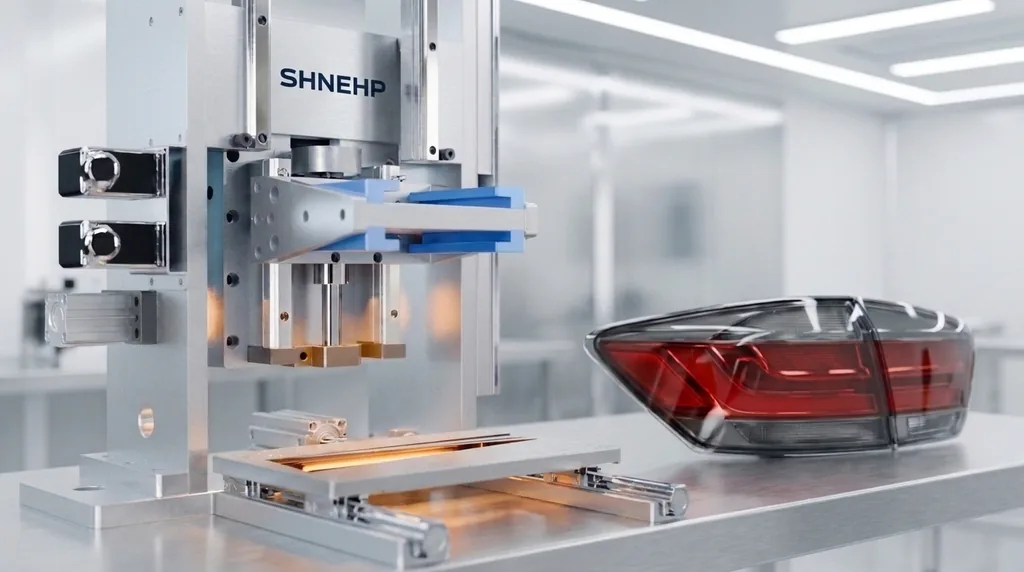
Modern full-width LED light-bar tail lights, OLED rear combination lamps, and smoked multi-chamber brake lamps demand spotless optical cavities where even a microscopic plastic string, charred flake, or cosmetic weld blush triggers immediate Tier-1 scrap. Using non-contact hot plate welding tail lights replaces physical platen contact with precision-contoured infrared (IR) radiant heating at a controlled 1–2 mm air gap, melting PMMA (acrylic) or PC lenses and ABS, ASA, or PC/ABS housings cleanly without ever touching the molten polymer. SHNEHP integrates non-contact IR radiant modules directly onto our 3-axis servo hot plate platforms (XNS5-B, XNS6-B, XNS8-B).
The part and its welding challenges
Automotive rear combination lamps combine sweeping wrap-around 3D curves, crystal-clear or smoked outer lenses, and dense internal LED light guides. High-appearance tail light programs face five recurring manufacturing obstacles:
- Eliminating resin stringing and angel-hair contamination: Contact hot plates inevitably pull fine polymer strands from PMMA, PC, or ASA weld ribs as coatings age; inside a clear-lens LED light-bar tail lamp, a single loose strand ruins photometric inspection.
- Zero PTFE coating degradation and downtime: Standard fluoropolymer (PTFE) anti-stick platens degrade rapidly above ~270 °C and require periodic stripping and recoating, disrupting 24/7 automotive JIT lighting schedules.
- High-gloss and smoked lens cosmetic fidelity: Smoked PMMA and transparent red polycarbonate lenses magnify stress marks or uneven flash extrusion along the perimeter styling groove.
- Deep 3D wrap-around fender curvature: Modern tail lamps curve sharply around rear quarter panels, creating significant Z-axis height variations that require contoured radiant emitters maintaining uniform 1–2 mm standoff distance across every millimeter of the seam.
- Strict IP67/IP69K condensation immunity: Rear hatch washdown and trunk moisture cycling demand void-free molecular fusion across the entire perimeter flange without thermal distortion of mounting studs.
Why non-contact hot plate welding (vs. alternatives)
| Process | Fit for premium LED & light-bar tail lights | Cavity cleanliness & maintenance | Typical cycle time | Engineering boundary |
|---|---|---|---|---|
| Non-contact infrared hot plate welding (XNS5-B / XNS6-B / XNS8-B + IR) | Ideal high-cosmetic choice for clear/smoked PMMA or PC lenses joined to ABS, ASA, PC/ABS, or PBT | Zero platen contact: zero resin stringing, zero PTFE recoating downtime, and ultra-smooth minimal flash beads | ~18–32 s | Requires precision 3D contoured radiant emitter machining and uniform 1–2 mm standoff gap control |
| Contact servo hot plate welding | Standard cost-effective tail lights running below ~270 °C (PMMA + ABS/ASA) | Good weld strength and lower emitter cost, but requires periodic PTFE recoating and wiping | ~20–35 s | Risk of stringing or carbonized specks as PTFE wears, especially on PC/PBT grades |
| Linear vibration welding (XN-55 / XN-70) | High-volume flatter multi-chamber rear lamps (PMMA + ABS) | Fast 2–5 s weld cycle with zero thermal warm-up | ~8–15 s total | Generates fine friction particulates that must be trapped, and struggles with steep 3D wrap-around slopes |
| Laser transmission welding | Ultra-slim OLED/LED rear lamps with specialized IR-compatible resin formulations | Nearly invisible cosmetic weld line | ~5–14 s | Narrow resin/pigment compatibility (many smoked/red dyes block or scatter laser wavelengths) and high tooling/optic cost |
Typical process window (industry ranges)
Non-contact radiant sealing follows DVS 2215 principles adapted for radiative heat transfer across a precision air gap. Exact emitter power, standoff spacing, and servo join speed are tuned during a SHNEHP trial on molded production lamps.
| Parameter | Typical industry range (PMMA / PC + ABS / ASA / PBT) | Engineering guidance |
|---|---|---|
| Pre-weld drying | PC / PBT / PC-ABS: 100–120 °C; PMMA / ABS: 75–85 °C | Essential to stop radiant-surface micro-blistering and hazy seam bubbles |
| Radiant emitter temperature | 300–500 °C (metal-foil, ceramic, or contoured IR emitters) | Independent upper (lens) and lower (housing) intensity zones match dissimilar polymer absorption rates |
| Air-gap standoff distance | 1.0–2.0 mm uniform contoured clearance | Servo Z-axis positions weld ribs precisely without touching molten plastic |
| Radiant heating time | 6–16 s | Rapid surface melt absorption builds a clean 0.6–1.1 mm melt layer with minimal heat-affected zone |
| Changeover time | ≤1.4–2.0 s | Fast 3-axis servo retraction preserves full melt fluidity prior to contact |
| Joining & hold phase | 0.15–0.28 N/mm² to closed-loop servo hard stop (1.0–1.8 mm meltdown); hold 6–12 s | Produces clean, small symmetric weld beads tucked neatly inside optical flash traps |
Recommended SHNEHP machine and fixture setup
SHNEHP equips our mid-to-large 3-axis servo hot plate welding machines with dedicated non-contact infrared radiant packages sized using our +60 mm tooling envelope margin:
- Standard compact & quarter-panel tail lamps: XNS5-B and XNS6-B 3-axis servo welders deliver micron-level standoff repeatability, rapid servo changeover, and multi-zone IR power regulation.
- Full-width light-bar & SUV rear combination lamps: XNS8-B and XNS9-B wide-bed servo platforms handle elongated trunk-lid light bars up to 1.6+ meters with balanced dual-servo parallel joining.
- Zero-scratch optical fixtures: Custom welding and testing fixtures pair vacuum-cupped soft-touch lens nests with precision reflective shields protecting internal LED drivers, sequential diffusers, and chrome trim.
Quality and leak testing
Every non-contact welded tail light undergoes strict optical and hermetic validation before leaving the production cell:
- 100% IP67 differential leak testing: Automated fixtures test through the breathable vent port at 10–30 kPa against a 0.1–0.5 mL/min limit (1 Pa differential sensor, 3–5 s stabilization period) to confirm continuous hermetic sealing around sharp 3D corners.
- Optical & destructive qualification: Visual light-tunnel inspection confirms zero internal strings or dust, while periodic pull-apart tests and environmental thermal-shock chambers (-40 °C to +85 °C, 95% RH) verify weld cohesion and anti-fog durability.
FAQ
How does non-contact infrared hot plate welding prevent resin stringing inside LED tail lights? Because the contoured IR emitter hovers 1–2 mm away from the lens and housing weld ribs without ever touching the molten polymer, no plastic sticks to the heater—eliminating stringing, angel hair, and PTFE flaking entirely.
Can non-contact IR hot plate welding join clear PMMA lenses to black ABS or ASA housings? Yes. Independent upper and lower IR radiant emitter zones adjust radiant flux separately for the transparent PMMA/PC lens and dark ABS/ASA housing so both weld ribs reach ideal joining viscosity simultaneously.
Is non-contact infrared heating slower than traditional contact hot plate welding? No. Because IR emitters operate at 300–500 °C, radiant energy transfers rapidly into the weld rib surface, keeping total cycle times comparable to or faster than contact hot plates (~18–32 seconds) while eliminating cleaning stops.
Can a SHNEHP servo hot plate machine run both contact and non-contact IR tooling? Yes. SHNEHP XNS5-B, XNS6-B, and XNS8-B servo platforms support modular quick-change tooling cartridges, allowing lighting suppliers to deploy contact platens on legacy programs and non-contact IR modules on flagship LED lamps.
What should we send to start a non-contact tail light weld trial? Share 3D STEP/X_T models of the lens and housing, resin grades and tint/color specs, maximum Z-axis contour drop, target cycle time, and your OEM IP67 leak-test criteria.
Get a free weld trial
Send your tail light CAD assemblies to SHNEHP engineering to evaluate contoured non-contact infrared tooling, standoff clearances, and optical-cleanroom cycle times:
- 3D STEP / X_T / IGES models of outer lens, inner bezel, and housing
- Lens & housing materials (PMMA, PC, ABS, ASA, PC/ABS, PBT)
- Target output (UPH) and OEM IP67 / cosmetic standards
Email yy@nbxiaoneng.com or request an evaluation on our contact page.
Request a Technical Consultation & Free Weld Trial
Send your 3D STEP/X_T drawing, resin grade, target cycle time, and leak-test specification. Our engineers will evaluate the joint and recommend a practical SHNEHP machine and fixture setup.