
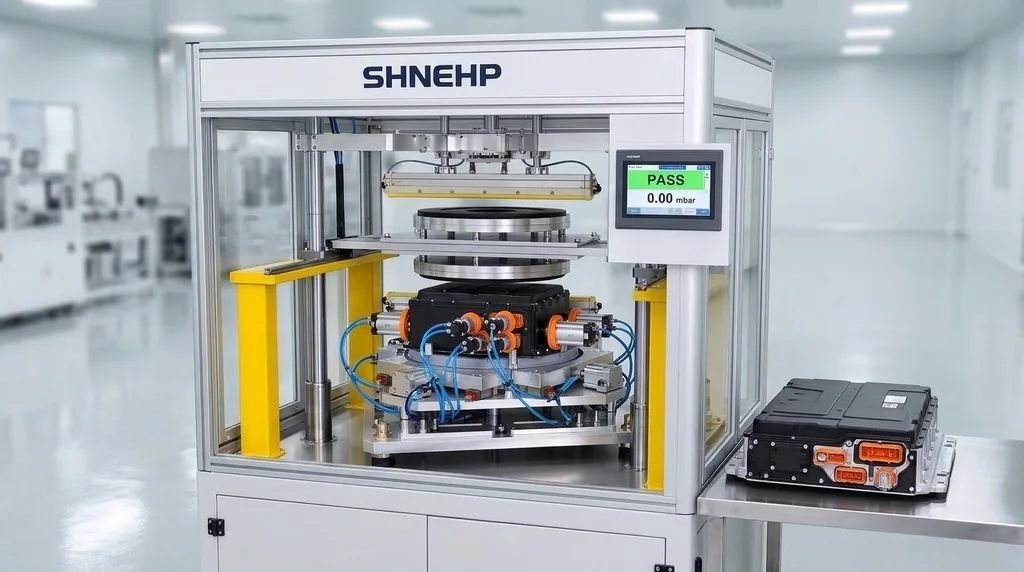
Underbody EV lithium-ion battery module housings, high-voltage battery disconnect unit (BDU) junction boxes, BMS controller enclosures, liquid-cooling manifold trays, and e-mobility 48V–72V removable battery cases operate inches above flooded roads, winter road salt, and high-pressure underbody wash jets. A single pinhole along a hot-plate, non-contact IR, or vibration weld seam lets conductive moisture penetrate high-voltage busbars—triggering catastrophic insulation faults (ISO 6469) or thermal-runaway events. Dedicated leak testing fixture ev battery housings stations verify 100% of welded battery enclosures inline using clean, dry differential pressure decay at 10–30 kPa (for IP67/IP68 air-tight housings) or 100–300 kPa (for integrated glycol cooling channels)—zero water immersion hazards near live or high-voltage hardware. SHNEHP engineers turnkey pneumatic welding and testing fixtures built for Tier-1 EV battery and energy-storage plants.
The part and its welding challenges
Welded plastic EV battery housings, BDU enclosures, and integrated thermal-management cooling trays present five specialized leak-testing challenges:
- Testing large-volume enclosures quickly with 1 Pa resolution: Mid-to-large EV battery module boxes and 48V–72V swappable packs hold 5 to 40+ liters of internal air; rapid high-flow fill manifolds paired with sensitive 1 Pa differential pressure transducers (or laminar mass-flow instruments) keep cycle times practical without sacrificing 0.1–0.5 mL/min micro-leak detection.
- Anti-ballooning structural backing on flat flame-retardant walls: Thin-walled UL94 V-0 PP-GF30, PA66-GF30, or PC/ABS battery lids bow slightly when pressurized to 10–30 kPa; contoured external support blocks restrict elastic wall creep during the 3–5 s stabilization phase so structural flexing never triggers false failures.
- Multi-port HV connector, breather-valve, and coolant-spigot sealing: Battery housings integrate orange high-voltage connector cutouts, explosion-proof breather-valve bosses, and sometimes dual glycol cooling ports—requiring insulated ESD-safe pneumatic radial seals that protect connector pins and test air-side (10–30 kPa) and coolant-side (100–300 kPa) independently in one clamping station.
- Non-destructive testing of fully sealed, port-free BMS & battery boxes: Fully enclosed welded BMS cases and potted modules with zero open breather ports require a custom minimal-dead-volume sealed external chamber to verify IP67/IP68 integrity cleanly.
- Zero-escape EV safety traceability (MES & master-leak checks): Automotive battery safety regulations mandate 100% serialized QR/DataMatrix binding of every pack's weld curves and exact leak rate, backed by shift-start calibrated master-leak verification.
Why custom dry-air leak testing fixtures (vs. alternatives)
| Method | Fit for welded EV battery housings, BDUs & cooling trays | HV safety, sensitivity & cycle speed | Typical cycle time | Engineering boundary |
|---|---|---|---|---|
| SHNEHP dry-air differential pressure-decay / mass-flow fixture | Standard OEM inline choice for 100% IP67/IP68 testing of EV battery module housings, BDUs, BMS boxes, and cooling channels | 100% dry & oil-free (zero HV moisture hazard); 1 Pa resolution; quantitative 0.1–0.5 mL/min MES logging | ~15–35 s (scaled to pack volume) | Large thin-walled enclosures (>15 L) require rigid anti-ballooning pads and post-weld thermal stabilization |
| External minimal-dead-volume chamber testing | Fully sealed port-free BMS enclosures and small e-mobility battery packs | 100% non-destructive inline check without modifying enclosure design | ~14–25 s | Chamber contour must closely hug housing geometry to keep pressure sensitivity high |
| Helium / forming-gas tracer sniffing | Ultra-tight prismatic cell cans or pack leaks below 0.05 mL/min | Extreme sub-0.01 mL/min leak sensitivity + exact leak localization | ~30–90 s | Higher consumable gas cost; reserved for cell-level or ultra-tight specialty specs |
| Water submersion tank | Offline root-cause troubleshooting of rejected empty plastic shells only | Visually locates gross bubbles | ~90–180 s + oven dry | Strictly prohibited for populated battery packs or high-voltage BDU/BMS assemblies |
Typical process window (industry ranges)
EV battery housing leak testing differentiates cleanly between IP67/IP68 air-enclosure protection and pressurized liquid-coolant channel integrity. Exact parameters and certified master leak orifices are commissioned during SHNEHP fixture FAT.
| EV Battery Component | Typical Test Pressure | Typical Leak-Rate Limit | Key Fixture Engineering Standard |
|---|---|---|---|
| EV battery module housings, BDU & BMS enclosures (IP67/IP68) | 10–30 kPa (0.10–0.30 bar) | 0.1–0.5 mL/min | 1 Pa differential transducer, 3–5 s stabilization, ESD-safe HV connector plugs, anti-ballooning wall pads |
| Port-free sealed BMS / sensor packs | 10–30 kPa (external chamber) | 0.1–0.5 mL/min | Form-fitting CNC minimal-dead-volume sealed test chamber |
| Integrated plastic EV battery cooling plates / coolant trays | 100–300 kPa (1.0–3.0 bar) | 1–5 mL/min | Dual-circuit manifold separating high-pressure glycol loop from low-pressure air cavity |
| Ultra-tight specialty / pack-level trace specs | 10–35 kPa or vacuum | <0.05 mL/min | Optional helium tracer sniffer / vacuum chamber integration |
Recommended SHNEHP machine and fixture setup
SHNEHP designs heavy-duty, ESD-safe welding and testing fixtures standalone or directly integrated with our battery housing welders:
- Dual-circuit air + coolant EV test benches: Test both the outer IP67/IP68 air housing (10–30 kPa) and internal glycol cooling channels (100–300 kPa) sequentially or in parallel within one clamped fixture—catching cross-wall leaks between coolant and live battery bays automatically.
- Insulated HV-safe pneumatic clamping & port plugs: Non-conductive PEEK/Delrin contact pads, soft silicone radial seals for HV connectors and breather ports, and automatic port-blockage sensing prevent false passes.
- Turnkey automation & MES binding: Direct conveyor/robotic integration with SHNEHP XNS6-B / XNS8-B / XNS9-B hot plate/IR or XN-70 / XN-100 vibration welders inside customized machines, linking barcode serialization, FIFO cooling buffers, and automatic reject segregation.
Quality and leak testing
EV battery safety lines enforce strict self-audit and Gage R&R discipline on every shift:
- Onboard certified master leak & Gage R&R validation: Every SHNEHP station includes a permanently plumbed certified leak standard (e.g., 0.3 mL/min orifice) for automated shift-start verification and full automotive Gage R&R qualification prior to shipment.
- Zero-escape poka-yoke lockout: Any housing exceeding its mL/min limit—or exhibiting a clogged breather port—remains physically locked until supervisor acknowledgement and is never laser-marked PASS.
FAQ
What pressure and leak-rate limits are standard for IP67/IP68 welded plastic EV battery housings? Air-tight EV battery module housings, BDU junction boxes, and BMS enclosures are typically leak-tested dry at 10–30 kPa against a 0.1–0.5 mL/min threshold using a 1 Pa differential pressure sensor and a 3–5 second stabilization stage.
Can one SHNEHP leak fixture test both the IP67 battery enclosure and its integrated liquid-cooling channels? Yes. Dual-circuit SHNEHP fixtures independently pressurize the glycol cooling channels at 100–300 kPa and the main battery enclosure at 10–30 kPa in one automated setup, detecting external leaks as well as dangerous internal coolant-to-battery cross-leaks.
How do you avoid false leak alarms caused by large plastic battery housings flexing under pressure? Fixtures incorporate rigid contoured anti-ballooning support blocks against large flat housing panels, paired with a tuned stabilization stage and matched reference volume to cancel elastic creep and ambient drift.
How do you leak-test a freshly hot-plate-welded EV battery box without thermal drift? Inline cells place a compact FIFO cooling buffer between the hot plate welder and the leak-testing fixture so internal air temperature stabilizes before testing, ensuring repeatable 0.1–0.5 mL/min Gage R&R.
What CAD data should we send for an EV battery housing leak-testing fixture quote? Provide 3D STEP/X_T models of the welded battery housing (showing HV connectors, vent ports, and coolant nipples), internal air volume (liters), OEM IP67/IP68 test limits, and target hourly volume.
Get a free weld trial
Share your EV battery housing, BDU box, or cooling-tray CAD models with SHNEHP engineering to design an ESD-safe, Gage-R&R-verified dry-air leak-testing fixture paired seamlessly with your welding line:
- 3D STEP / X_T / IGES models of battery enclosure, ports, and cooling loops
- OEM IP67/IP68 & coolant leak specs (kPa, mL/min, stabilization rules)
- Target hourly output (UPH) and MES barcode serialization requirements
Email yy@nbxiaoneng.com or connect through our contact page.
Request a Technical Consultation & Free Weld Trial
Send your 3D STEP/X_T drawing, resin grade, target cycle time, and leak-test specification. Our engineers will evaluate the joint and recommend a practical SHNEHP machine and fixture setup.