
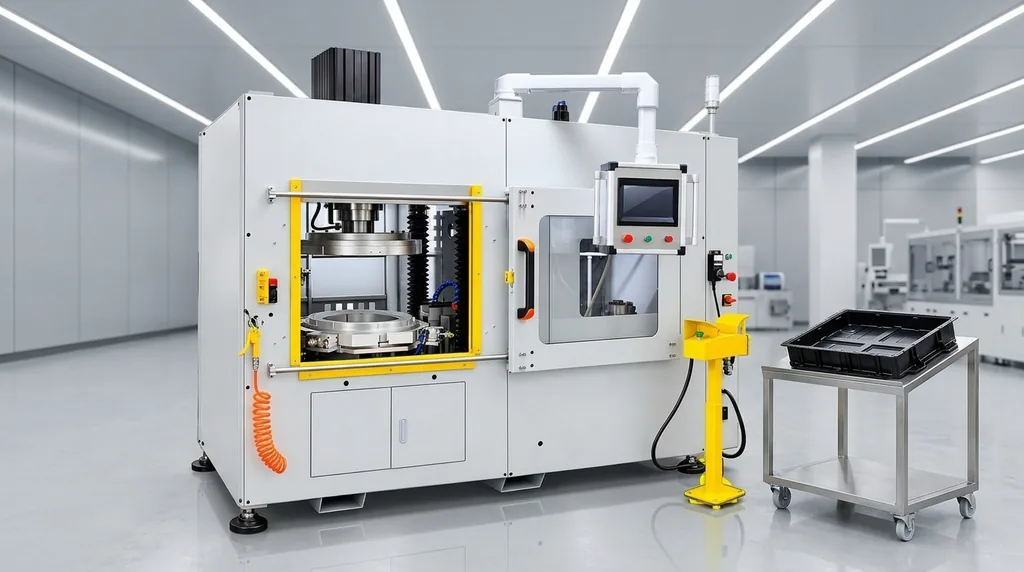
Electric-vehicle battery modules, auxiliary junction enclosures, and thermoplastic liquid-cooling manifold plates require hermetic seals that block moisture ingress (IP67/IP68) and withstand thermal-management coolant pressures over the vehicle's life. Selecting hot plate welding ev battery housings enables OEMs and Tier-1 pack builders to fuse large 3D-contoured thermoplastic covers, internal partitions, and multi-channel fluid paths in a single closed-loop cycle. SHNEHP engineers 3-axis servo hot plate platforms (XNS6-B, XNS8-B, XNS9-B) and non-contact infrared (IR) options built around DVS 2215 displacement control.
The part and its welding challenges
Thermoplastic EV battery enclosures, module housings, and battery thermal-management flow plates are typically molded from flame-retardant PP (PP-FR / PP-GF20–30), PA6/PA66-GF30–40, PBT, or PC/ABS. Compared to metal stampings, welded polymer housings cut weight and eliminate adhesive curing lines, but demand tight thermal and dimensional discipline:
- High glass-fiber and flame-retardant loading (GF30–40%+): Flame-retardant additives narrow the thermal processing window, while glass-fiber levels at or above 40% (GF40+) rapidly wear PTFE anti-stick coatings on contact platens and cause heavy melt stringing.
- Internal coolant channel flatness: On EV battery cooling flow plates (runner boards), internal dividing ribs must seal simultaneously with the outer perimeter without flash blocking narrow fluid passages.
- Strict IP67 / IP68 sealing and cleanliness: Any loose weld flash or cold-weld micro-channel compromises high-voltage dielectric protection or leaks dielectric/glycol coolant inside the battery pack.
- Large part warpage: Broad, thin-walled battery covers frequently exhibit molding warp; without controlled DVS 2215 bead-up leveling and rigid vacuum clamping, perimeter contact becomes uneven.
- Pre-drying discipline: Hygroscopic engineering plastics such as PA6/PA66-GF and PC/ABS must be dried properly before welding (80–90 °C for PA, 100–120 °C for PC/ABS) to avoid steam porosity in the seam.
Why hot plate welding (vs. alternatives)
| Process | Fit for EV battery housings & cooling plates | Geometry & cleanliness | Typical cycle time | Engineering boundary |
|---|---|---|---|---|
| Servo hot plate (contact / non-contact IR) | Primary choice for large 3D-contoured housings and complex multi-channel cooling flow plates | Seals outer perimeter + internal ribs simultaneously; non-contact IR eliminates PTFE sticking on GF40+/PA-GF | ~25–45 s total | Contact PTFE tops out ~270 °C; switch to non-contact IR above 270–300 °C or GF≥40% |
| Linear vibration friction | Strong for large planar structural trays and battery covers | High joint strength on PA-GF and PP trays | ~5–15 s total | Requires ≥2.5–3.0 mm in-plane clearance; particulate flash must be trapped away from cells/channels |
| Ultrasonic welding | Busbar retainers, cell-holder clips, and small sensor brackets | Fast near-field local welds | ~0.1–1.5 s | Unsuitable for large 500–850 mm hermetic battery housings; ultrasonic energy near live cells is restricted |
| UHF induction welding | Specialty 3D housings containing compatible susceptors | Complex 3D seams without whole-part heating | Part-dependent | Requires ferromagnetic/metallic implant and non-magnetic bakelite/PEEK fixtures |
Typical process window (industry ranges)
The table below summarizes conservative DVS 2215 five-stage control baselines for EV battery thermoplastic housings and cooling plates. Final parameters are confirmed during a SHNEHP part-specific weld trial.
| Parameter | Typical industry range (PP-GF / PA-GF / PC-ABS) | Engineering guidance |
|---|---|---|
| Heating mode & temperature | Contact tooling face: PP 250–285 °C, PC/ABS 275–310 °C, PA-GF 280–330 °C; Non-contact IR: 300–500 °C | Switch to non-contact IR above ~270–300 °C or when glass fiber ≥40% to prevent sticking and stringing |
| Bead-up (Stage 1) | 0.5–1.0 mm displacement | Levels molding warpage across large battery covers and internal channels |
| Melt / soak phase (Stage 2) | 6–25 s at 0.05–0.10 N/mm² | Controlled heat input avoids degrading flame-retardant additives |
| Changeover (Stage 3) | ≤1.5 s (PA-GF) / ≤1.8 s (PC-ABS) / ≤2.5 s (PP) | Fast 3-axis servo retraction prevents rapid crystallization skinning on PA-GF |
| Joining & collapse (Stage 4) | 0.15–0.30 N/mm² to hard servo stop; meltdown 1.5–3.0 mm | Closed-loop displacement stop controls bead volume near internal coolant channels |
| Hold / cooling (Stage 5) | 6–20 s | Maintains flatness while resin solidifies below Vicat softening temperature |
| Total machine cycle | ~25–45 s (up to ~60 s for extra-thick large covers) | Verified with inline leak testing and cross-section validation |
Recommended SHNEHP machine and fixture setup
SHNEHP applies our +60 mm clearance rule (effective platen ≥ maximum housing L×W + 60 mm for clamps, locating pins, and vacuum cups) across our servo hot plate welding machine lineup:
- Module housings & medium cooling plates: XNS6-B or XNS8-B 3-axis full-servo hot plate welders with closed-loop displacement control, multi-zone PID thermal management, and per-cycle traceability logging.
- Large battery covers & broad flow plates (up to ~850×800 mm): XNS9-B heavy-duty servo platform; for oversized structural trays (>1 m), pair with XNTP large-format hot plate or XN-100 / XN-200 vibration friction welding machines.
- Non-contact infrared heating module: Recommended for PA66-GF35/40, flame-retardant grades, or particle-sensitive battery interiors to eliminate platen contact and PTFE wear.
- Precision fixtures & inline leak cells: Custom welding and testing fixtures integrate rigid perimeter clamping, vacuum flat-plate holding nests, automated flash-trap alignment, and inline differential pressure leak testing via customized machines.
Quality and leak testing
EV battery enclosures and thermal-management flow plates undergo 100% end-of-line leak verification:
- IP67 / IP68 enclosure leak testing: Industry baselines test at 10–30 kPa (positive or negative pressure) with tight leak limits of 0.1–0.5 mL/min using 1 Pa-resolution differential pressure testers and a 3–5 s stabilization stage to absorb thin-wall creep.
- Liquid-cooling flow plate testing: Pressurized coolant channels are typically tested at 50–150 kPa (or up to 100–300 kPa depending on OEM coolant-loop spec) with 1–5 mL/min pass thresholds, plus cooling buffers to eliminate thermal drift right off the hot plate.
- Traceability & safety interlocks: Barcode-linked cycle logs (zone temperatures, melt depth, changeover time, leak result) and automated NG lockout bins support IATF 16949 / OEM audit requirements.
FAQ
When should EV battery housings switch from contact hot plate to non-contact infrared (IR) welding? Whenever processing temperatures exceed the ~270 °C durability limit of PTFE anti-stick coatings—or when glass-fiber reinforcement reaches ≥40% (GF40+) or flame-retardant resins cause stringing—non-contact IR welding eliminates platen contact and keeps battery interiors particle-free.
Can SHNEHP hot plate welders seal both the outer housing perimeter and internal coolant ribs in one cycle? Yes. Contoured heating platens with independent PID zones heat external flanges and internal dividing channels simultaneously, while DVS 2215 bead-up leveling compensates for molding flatness variation.
How do you size a SHNEHP servo hot plate machine for an EV battery housing? Start with our +60 mm fixture margin rule: effective platen length and width should exceed the maximum housing footprint by at least 60 mm on each axis to accommodate clamps, dowel pins, and vacuum cups. Housings up to ~850×800 mm fit XNS6-B through XNS9-B.
What leak-test pressure is typical for IP67 plastic EV battery enclosures? Thin-walled IP67/IP68 plastic enclosures are commonly tested at 10–30 kPa (positive or vacuum) with leak thresholds around 0.1–0.5 mL/min using differential pressure decay and a 3–5 s stabilization phase.
What should we send for a SHNEHP EV battery weld trial? Provide frozen 3D STEP/X_T files, exact resin grade and glass-fiber/FR rating, wall and rib thickness, target UPH, and OEM IP/coolant leak-test criteria.
Get a free weld trial
Share your EV battery housing or cooling flow-plate files with SHNEHP engineering to evaluate contact vs. non-contact IR hot plate welding and inline leak testing:
- Frozen 3D STEP / X_T / IGES models of housing and cover
- Resin grade, GF %, and flame-retardant spec (e.g., PP-FR, PA66-GF30/40, PBT)
- Target hourly output (UPH) and IP67/IP68 or coolant pressure-test spec
Email yy@nbxiaoneng.com or reach our engineers on our contact page.
Request a Technical Consultation & Free Weld Trial
Send your 3D STEP/X_T drawing, resin grade, target cycle time, and leak-test specification. Our engineers will evaluate the joint and recommend a practical SHNEHP machine and fixture setup.