
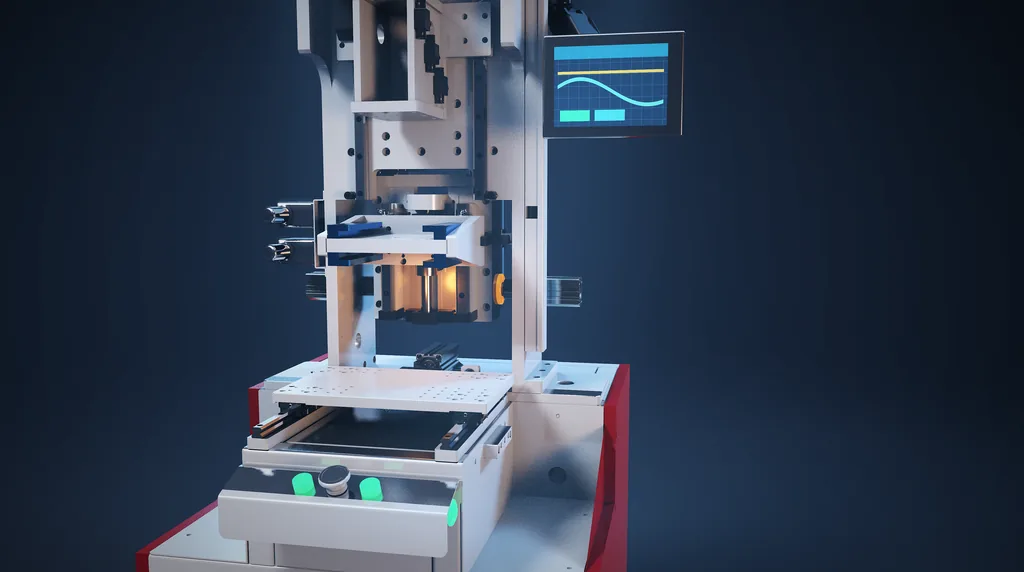
Inside every EV lithium-ion battery module and BESS pack, flame-retardant UL94 V-0 PC/ABS, PP-GF, PBT-GF, or PA66-GF high-voltage terminal covers, Cell Contacting System (CCS) busbar isolation frames, and flexible printed circuit (FPC) voltage/temperature sensor strips must be permanently locked directly atop live, laser-welded battery cells and copper/aluminum busbars. Using metallic screws introduces life-threatening conductive drop-short risks, while ultrasonic staking sends high-frequency vibration straight into delicate cell laser welds and NTC thermistors. Applying hot staking battery terminal covers—specifically multi-point hot-air cold staking—forms 10 to 80+ tight, rattle-free, zero-vibration plastic rivets simultaneously across the entire module top plate with strictly zero metal fasteners and zero conductive debris. SHNEHP engineers multi-zone hot staking welding machines built for EV battery and CCS gigafactories.
The part and its welding challenges
Securing insulating terminal covers, HV busbar shrouds, and CCS/FPC collector trays over live battery arrays creates five demanding battery-safety requirements:
- Strictly zero mechanical vibration near live cells and laser-welded busbars: Battery cell-to-busbar laser welds, aluminum wire-bonds, and surface-mount NTC temperature sensors sit millimeters from every staking boss; zero-vibration thermal or hot-air cold staking protects electrical joints completely.
- High-density simultaneous multi-point staking (12 to 80+ bosses per module): Modern prismatic and pouch EV modules carry dozens of insulating bosses locking copper/aluminum busbars, FPCs, and top dielectric covers together; individual sequential staking is too slow for gigafactory takt times, requiring synchronized parallel multi-nozzle arrays.
- Eliminating sticking and stringing on glass-filled PA66-GF / PBT-GF / PP-GF bosses: Contact-heated metal staking irons stick readily to high-temp semi-crystalline flame-retardant resins, pulling hazardous plastic strands across exposed busbar terminals; hot-air cold staking heats bosses with precision non-contact superheated air jets and forms them under an ambient cold metal punch, delivering zero sticking and zero stringing.
- Protecting heat-sensitive FPC polyimide films and copper busbars: Targeted laminar hot-air nozzles focus heat tightly on each Ø2.5–6.0 mm boss tip while localized cooling shields protect adjacent FPC traces and live cell tops from radiant overshoot.
- Insulated, ESD-safe & short-circuit-proof tooling: Any fixture or punch descending over an energized battery module requires non-conductive PEEK/ceramic guard bushings and strict grounding/ESD protection so an accidental live-busbar arc can never occur.
Why hot-air cold staking (vs. alternatives)
| Process | Fit for EV battery terminal covers & CCS busbar carriers | Live-cell safety & glass-filled cleanliness | Typical cycle time | Engineering boundary |
|---|---|---|---|---|
| Multi-point hot-air cold staking (SHNEHP) | Global gigafactory standard for locking CCS aluminum/copper busbars, FPC strips, and UL94 V-0 HV terminal covers directly onto battery modules | Zero vibration, zero sticking/stringing on PA66-GF/PBT-GF/PP-GF, tight zero-gap rivet preload, 12–80+ bosses staked simultaneously | ~10–18 s (entire module at once) | Requires molded plastic bosses protruding cleanly through busbar/FPC/cover mounting holes |
| Constant-heat / impulse contact staking | Smaller amorphous PC/ABS or ABS terminal shrouds with lower boss counts | Compact tooling, zero vibration | ~8–16 s | Contact tips prone to sticking/stringing on sticky semi-crystalline PA-GF/PP-GF bosses |
| Ultrasonic staking (20–35 kHz) | Empty unpopulated plastic carrier brackets before cell/busbar loading | Fast discrete cycle | ~0.3–1.0 s/point | Unacceptable vibration risk directly on populated cells, wire-bonds, or NTC solder joints |
| Metal screws / snap clips | Removable BDU service covers | Re-openable joint | ~20–60 s | Metal screws pose catastrophic HV drop/short risk; snap clips creep and rattle over 10-year EV vibration life |
Typical process window (industry ranges)
Multi-point hot-air cold staking decouples non-contact convective boss melting from instantaneous cold-punch forming, eliminating spring-back looseness on busbars and terminal covers. Exact nozzle temperatures and airflow rates are tuned during a SHNEHP trial.
| Parameter | Typical industry range (UL94 V-0 PC/ABS / PP-GF / PA66-GF / PBT-GF) | Engineering guidance |
|---|---|---|
| Boss geometry | Solid Ø2.5–5.0 mm or hollow Ø5.0–8.0 mm bosses (protrusion ~1.5–2.0× diameter) | Chamfered busbar/cover holes allow smooth molten-head seating with zero clearance rattle |
| Hot-air nozzle temperature | PC/ABS / PP-GF: 340–440 °C; PA66-GF / PBT-GF: 420–530 °C | Independent closed-loop PID heater + flow regulator per nozzle bank guarantees uniform melt across 12–80+ bosses |
| Heating duration | 3–8 s (all bosses heated in parallel) | Localized air shrouds shield nearby FPC traces and lithium cell vents from stray hot air |
| Cold-punch forming & hold | Room-temperature / water-cooled staking punches descend in 0.5 s; hold 2–5 s | Cold punch freezes the dome/rosette rivet immediately with zero stringing and tight zero-gap busbar clamping |
Recommended SHNEHP machine and fixture setup
SHNEHP engineers cleanroom-ready multi-zone hot staking welding machines specifically for EV battery and CCS module lines:
- Benchtop & medium HV terminal-cover stations: Compact servo/pneumatic hot-air cold staking presses handling 4 to 24 simultaneous bosses with individual PID channel monitoring and ESD-safe safety enclosures.
- Gigafactory wide-bed CCS & battery-module staking machines: Heavy four-post gantry hot-air cold staking systems driving 24 to 80+ synchronized nozzles and water-cooled cold punches across 600–1,400 mm EV module arrays in a single 12–18 second cycle, with automatic conveyor pallet indexing inside turnkey customized machines.
- HV-insulated & FOD-free tooling: Custom welding and testing fixtures integrate insulated PEEK/ceramic nozzle shields, poka-yoke busbar/FPC/cover presence sensors, and integrated top-mounted 2D vision verifying every finished rivet dome before module exit.
Quality and leak testing
EV terminal-cover and CCS staking stations enforce 100% electrical-safety and retention verification:
- 100% nozzle-temperature, airflow, stroke & vision inspection: Every hot-air channel logs real-time temperature and pressure while servo stroke sensors confirm exact cold-punch forming height; optional inline vision inspects every single staked dome for completeness and zero stray debris before releasing the module to MES.
- Retention pull-off & vibration endurance: Periodic batch pull tests and UN38.3 / GB 38031 random-vibration plus -40 °C to +85 °C thermal-shock audits confirm zero busbar loosening or cover creep.
FAQ
Why is hot-air cold staking the preferred method for EV battery CCS busbars and HV terminal covers? Hot-air cold staking applies strictly zero mechanical vibration (protecting live lithium cells, laser busbar welds, and wire-bonds), forms zero conductive debris, eliminates sticking/stringing on glass-filled UL94 V-0 PA66-GF/PBT-GF/PP-GF bosses, and stakes 12 to 80+ bosses simultaneously in one 12–18 second cycle.
Will superheated air nozzles damage adjacent FPC sensor strips or lithium-ion cell tops? No. Precision laminar-flow nozzles focus heated air directly onto the protruding millimeter-scale boss tips while water-cooled/PEEK local thermal shrouds shield surrounding FPC polyimide traces and cell surfaces cleanly.
How many battery terminal-cover bosses can one SHNEHP hot-air cold staking machine form per cycle? Depending on module length and boss spacing, SHNEHP machines routinely form 4 to 24 bosses on compact terminal covers/BDU shrouds and 24 to 80+ bosses simultaneously on full-length EV CCS battery module frames.
Can the staking machine verify automatically that every single boss formed properly? Yes. SHNEHP integrates per-channel temperature/airflow monitoring, closed-loop punch-stroke verification, and optional automated 2D vision inspection that checks every formed rivet dome and logs results directly to the battery module's MES serial number.
What CAD data is needed for a SHNEHP battery terminal cover or CCS hot-staking trial? Send 3D STEP/X_T models showing all boss diameters, protrusion heights, and busbar/FPC clearances, exact UL94 V-0 resin grade, live-cell insulation zones, and target cycle time.
Get a free weld trial
Share your EV battery terminal cover or CCS busbar carrier CAD models with SHNEHP engineering to optimize boss design, simulate multi-nozzle hot-air cold staking layout, and test retention strength on real moldings:
- 3D STEP / X_T / IGES models of terminal cover, CCS frame, busbars, and bosses
- UL94 V-0 polymer grade (PC/ABS, PP-GF, PA66-GF, PBT-GF) and boss count
- Target module cycle time (UPH) and vision / MES traceability requirements
Email yy@nbxiaoneng.com or connect through our contact page.
Request a Technical Consultation & Free Weld Trial
Send your 3D STEP/X_T drawing, resin grade, target cycle time, and leak-test specification. Our engineers will evaluate the joint and recommend a practical SHNEHP machine and fixture setup.