
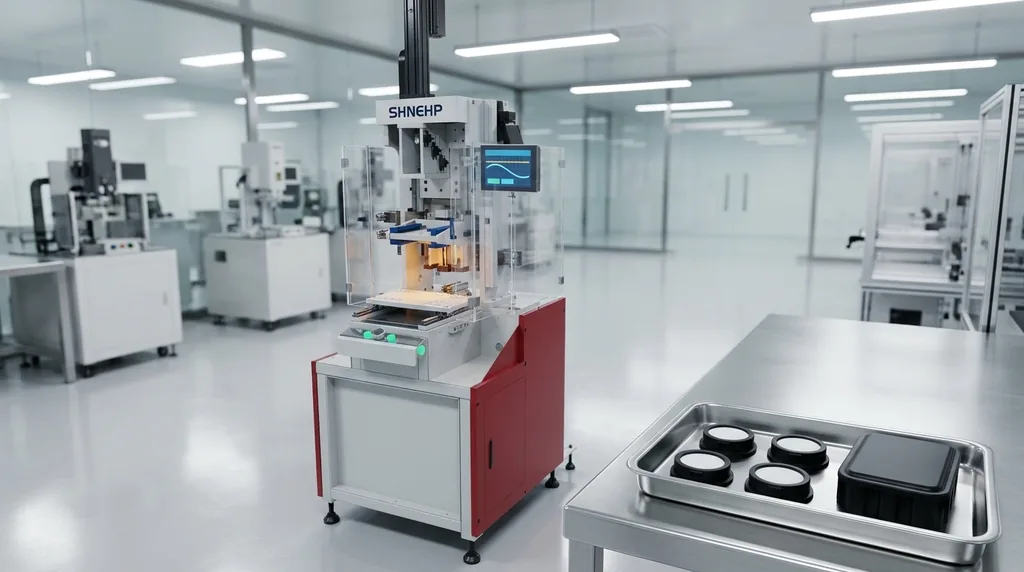
Battery safety depends on precision pressure-management valves: on EV lithium-ion battery packs, explosion-proof breathable pressure-relief vent caps equalize barometric pressure while bursting open cleanly during thermal runaway; on AGM / EFB lead-acid and stationary VRLA batteries, flame-arrestor labyrinth manifold vent caps condense sulfuric acid mist and block external sparks. Applying hot plate welding battery vent caps fuses multi-piece PP, flame-retardant PA66-GF, PBT-GF, or PPS vent housings cleanly around delicate internal ePTFE breathable membranes, silicone umbrella valves, and sintered flame-arrestor discs—delivering chemical-resistant IP67 / IP68 sealing with zero ultrasonic vibration shock to fragile membranes. SHNEHP engineers precision multi-cavity 3-axis servo hot plate welders (XNS2-B, XNS5-B, XNS6-B) built to DVS 2215 standards for EV and energy-storage battery component plants.
The part and its welding challenges
Battery vent caps and multi-cell manifold covers combine tight internal safety-valve calibration tolerances with harsh chemical and thermal environments, posing five manufacturing hurdles:
- Protecting delicate ePTFE breathable membranes and silicone burst diaphragms: EV pack breather valves contain ultra-thin hydrophobic ePTFE membranes and spring-loaded or scored burst discs calibrated to open at exact kPa thresholds (e.g., 15–50 kPa); excessive radiant heat, loose weld flash, or ultrasonic vibration tears or shifts membrane seating and invalidates burst-pressure calibration.
- Zero labyrinth clogging on multi-cell lead-acid acid-condensation caps: 6-cell automotive battery manifold vent caps rely on internal sloped condensation baffles and porous flame-arrestor frits; uncontrolled molten PP squeeze-out blocks gas relief pathways and causes hazardous internal cell pressurization.
- High-temperature flame-retardant EV resins (PA66-GF / PBT-GF / PPS): EV battery pack vent valves frequently use UL94 V-0 flame-retardant PA66-GF30 or PBT-GF30 requiring elevated melt temperatures above PTFE's ~270 °C durability limit—requiring non-contact infrared hot plate heating (300–500 °C) to avoid PTFE wear and stringing.
- High-cavitation multi-up consistency (4 to 16 cavities per cycle): Battery vent caps are high-volume Tier-1/Tier-2 parts requiring balanced multi-cavity platens and micron-accurate closed-loop servo meltdown stops so every cavity achieves identical internal valve pre-load.
- Strict IP67 / IP68 water-immersion & sulfuric-acid chemical resistance: Both EV underbody vent housings and lead-acid battery manifolds require void-free perimeter fusion free of moisture outgassing or cold-weld laminations.
Why hot plate welding (vs. alternatives)
| Process | Fit for EV vent valves & lead-acid manifold vent caps | Membrane safety & chemical resistance | Typical cycle time | Engineering boundary |
|---|---|---|---|---|
| Multi-cavity servo / non-contact IR hot plate welding (XNS2-B / XNS5-B / XNS6-B) | Top choice for multi-cell PP acid-condensation manifold caps and multi-cavity PA66-GF / PBT-GF EV vent housings | Zero vibration shock to ePTFE membranes/flame arrestors; handles complex internal labyrinth walls & non-circular manifolds; upgrade to IR above ~270 °C | ~16–28 s (4–16 cavities per tray) | Requires precision local thermal shields protecting internal silicone valves and ePTFE discs during soak |
| Ultrasonic welding (XNC-400 / XN-5) | Small circular rigid PC/ABS/PBT single-cell vent caps (when membrane sits well away from horn) | Ultra-fast 0.2–1.0 s cycle | ~0.2–1.0 s | Risk of tearing delicate ePTFE membranes via acoustic resonance and inconsistent acid-tightness on soft PP manifolds |
| Spin welding (XNX-100) | Purely cylindrical screw-in circular EV vent bodies without asymmetrical orientation | Fast 0.5–3 s circular seal | ~0.5–3 s | Cannot weld rectangular 6-cell battery manifold caps or multi-cavity trays simultaneously |
| Laser transmission welding | High-cosmetic single EV breather valves with laser-transparent/absorbent PBT pairs | Virtually zero flash near delicate membranes | ~3–8 s | Narrow flame-retardant pigment compatibility (many UL94 V-0 carbon/halogen packages block laser transmission) |
Typical process window (industry ranges)
Multi-cavity battery vent cap welding follows DVS 2215 precision displacement control, pairing shallow controlled meltdown with local thermal shields around internal valve elements. Baselines below are validated during a SHNEHP trial.
| Parameter | Typical industry range (PP / PA66-GF / PBT-GF) | Engineering guidance |
|---|---|---|
| Pre-weld resin drying | PA66-GF / PBT-GF: 80–120 °C; PP: clean & oil-free | Prevents moisture micro-voids in flame-retardant EV vent valves |
| Heating mode & temperature | PP manifolds contact: 215–245 °C; PA66-GF / PBT-GF (>270 °C or GF≥40%): non-contact IR 320–480 °C | Multi-zone PID uniformity across 4–16 cavity trays; non-contact IR prevents PTFE wear and resin strings on UL94 V-0 resins |
| Bead-up & thermal shielding | Shallow contact 0.3–0.5 mm; soak 5–12 s (or 1–2 mm IR gap) | Cooled tooling pockets shield internal silicone umbrella valves and ePTFE membranes from radiant heat |
| Servo changeover time | ≤1.3–1.8 s | Rapid 3-axis servo platen exit prevents thin-walled labyrinth ribs from skinning over |
| Joining & hold phase | 0.15–0.28 N/mm² to closed-loop servo hard stop (0.7–1.4 mm meltdown); hold 5–10 s | Closed-loop hard stop holds exact spring/valve compression height across every cavity |
Recommended SHNEHP machine and fixture setup
SHNEHP configures compact and mid-size 3-axis servo hot plate welding machines for battery vent-cap manufacturing (+60 mm platen margin rule):
- 4-to-8 cavity EV breather valves & pilot lines: XNS2-B and XNS5-B 3-axis full-servo hot plate welders deliver micron-level collapse repeatability, optional non-contact IR radiant modules for UL94 V-0 PA66-GF/PBT-GF resins, and compact automated-cell footprints.
- High-volume 8-to-16 cavity lead-acid manifold vent caps: XNS6-B servo platforms pair rigid parallel clamping with multi-zone PID platens and quick-change multi-cavity tray tooling.
- Membrane-safe fixtures & inline automation: Custom welding and testing fixtures integrate cooled membrane shields, optical valve-presence poka-yoke checks prior to closing, and direct transfer into automated leak/cracking-pressure stations via customized machines.
Quality and leak testing
Battery vent caps require dual verification—both housing hermeticity and exact safety-valve opening thresholds:
- 100% IP67/IP68 housing leak & airflow verification: Automated multi-channel fixtures block or isolate the breathable ePTFE window to verify housing weld-seam tightness at 10–30 kPa / 0.1–0.5 mL/min (1 Pa differential, 3–5 s stabilization), while simultaneously checking controlled airflow rate through the open breather membrane to confirm zero flash blockage.
- Burst / cracking-pressure & acid-mist audits: Batch sampling validates EV emergency thermal-runaway burst pressure (e.g., 15–50 kPa opening curve), IP68 submersion endurance, and flame-arrestor spark-resistance compliance.
FAQ
How do you prevent hot plate heat from damaging internal ePTFE membranes or silicone valves inside battery vent caps? Contoured platens (or targeted non-contact IR masks) heat only the outer perimeter weld wall while recessed, cooled metal shield cups inside the upper/lower fixtures completely block radiant heat from reaching the central ePTFE membrane or silicone diaphragm.
When should EV battery vent caps use non-contact IR instead of contact PTFE hot plates? Whenever EV breather valves are molded from flame-retardant PA66-GF30, PBT-GF30, or PPS requiring platen temperatures above PTFE's ~270 °C durability limit—or when zero stringing near microscopic breather pores is mandatory—non-contact IR (300–500 °C) is the cleaner, maintenance-free choice.
Can one SHNEHP hot plate welder seal multi-cell 6-port lead-acid battery manifold vent caps? Yes. XNS2-B, XNS5-B, and XNS6-B servo machines routinely weld 4 to 16 PP battery manifold caps per cycle, fusing both the outer perimeter and internal acid-condensation labyrinth baffles simultaneously with zero clogged vents.
How do you leak-test a welded EV battery vent cap that is intentionally designed to breathe air? Inline test fixtures use a soft temporary radial seal plug to isolate the central ePTFE membrane while pressure-testing the welded outer housing seam at 10–30 kPa, followed by an automated airflow/cracking-pressure check with the plug retracted.
What CAD data should we send for a battery vent cap weld trial? Share 3D STEP/X_T models showing internal membrane/labyrinth clearances, exact resin grade (PP, UL94 V-0 PA66-GF, PBT-GF, PPS), target cavities per cycle, and IP67/cracking-pressure criteria.
Get a free weld trial
Send your EV pack breather valve or lead-acid battery manifold vent cap CAD models to SHNEHP engineering to design membrane-shielded multi-cavity servo/IR tooling and validate zero-clog sealing on a physical trial:
- 3D STEP / X_T / IGES models of vent cap housing, cover, and internal valve/membrane
- Resin specification (PP, PA66-GF V0, PBT-GF V0, PPS)
- Target hourly output (UPH) and IP67/IP68 + cracking-pressure limits
Email yy@nbxiaoneng.com or connect through our contact page.
Request a Technical Consultation & Free Weld Trial
Send your 3D STEP/X_T drawing, resin grade, target cycle time, and leak-test specification. Our engineers will evaluate the joint and recommend a practical SHNEHP machine and fixture setup.