
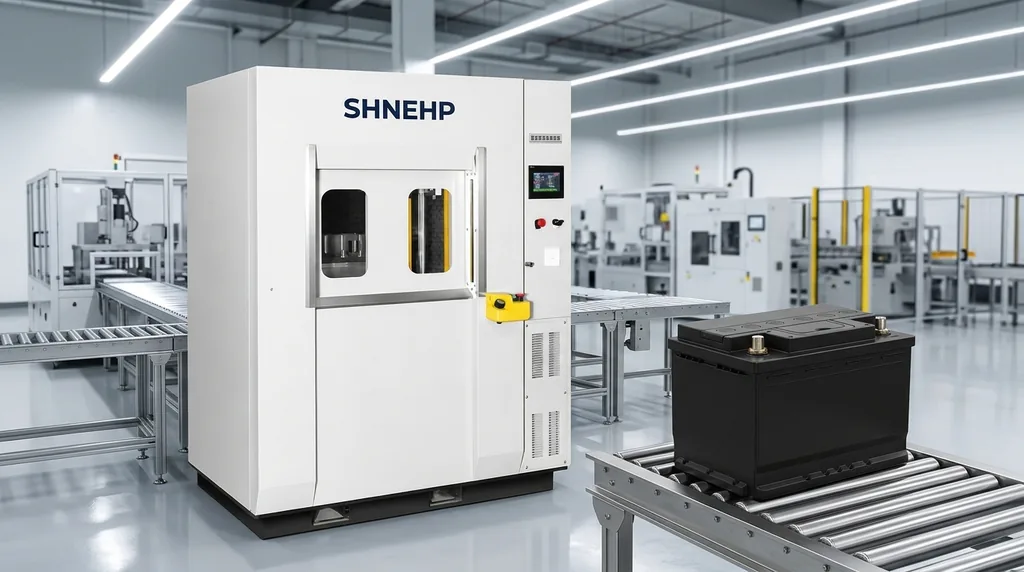
Automotive 12V SLI starter batteries, start-stop AGM batteries, golf-cart deep-cycle blocks, and stationary VRLA backup power batteries must seal corrosive sulfuric acid electrolyte and internal six-cell inter-cell partitions permanently against vibration, thermal cycling, and high-pressure vent surges. Applying vibration welding lead acid battery lids joins copolymer polypropylene covers, dual-layer labyrinth vent manifolds, and six-cell divider ribs cleanly in seconds without contact hot-plate sticking or lead-plate thermal soak. SHNEHP engineers high-frequency (210–270 Hz) linear vibration welders (XN-55, XN-70, XN-100) calibrated to DVS 2217 precision for battery-pack manufacturing plants.
The part and its welding challenges
Lead-acid battery cases and multi-chamber manifold lids are predominantly molded from acid-resistant, impact-modified copolymer polypropylene (PP) or flame-retardant ABS (common on telecom VRLA standby batteries). High-volume battery cover sealing presents five strict manufacturing hurdles:
- Simultaneous outer perimeter + 5 internal cell-partition sealing: A standard 12V lead-acid battery houses six isolated 2V cells; every internal partition rib must fuse hermetically alongside the outer rim so sulfuric acid never bridges between cells and causes internal self-discharge shorts.
- Zero thermal soak near pre-assembled lead plates & AGM separators: Unlike empty housings, battery lids are welded onto heavy lead-filled cases (12–40+ kg loaded weight); rapid 3–6 second frictional fusion avoids transferring excess heat into internal lead straps or fiberglass AGM mats.
- Labyrinth double-lid manifold sealing: Maintenance-free SMF and AGM batteries feature a secondary top labyrinth lid (acid-mist condenser and flame-arrestor channel) welded directly onto the main cover—requiring tight collapse stops so tiny acid-return holes stay completely unobstructed.
- Heavy loaded battery case clamping & datum stability: Loaded battery jars vary slightly in top-rim bow due to internal plate-pack compression; rigid lower pneumatic clamps must square the outer rim firmly before oscillation begins.
- High-volume automated line takt times: Automotive battery lines run continuously at 3–6 batteries per minute, requiring fast conveyor pass-through integration and quick-change tooling across DIN/JIS/BCI group sizes.
Why vibration friction welding (vs. alternatives)
| Process | Fit for lead-acid & VRLA battery lids | Speed & cell-partition sealing | Typical cycle time | Engineering boundary |
|---|---|---|---|---|
| Linear vibration friction (210–270 Hz: XN-55 / XN-70 / XN-100) | Strong choice for ABS telecom VRLA lids, SMF double-deck labyrinth manifolds, and planar PP starter battery covers | Rapid 5–12 s cycle with zero platen warm-up, minimal heat transfer into internal lead plates, and crisp labyrinth cleanliness | ~5–12 s total (1.5–5 s weld) | Requires ≥2.5–3.0 mm clearance around terminal bushings and rigid case-rim clamping; matched PP-to-PP or ABS-to-ABS only |
| Servo hot plate welding (XNS6-B / XNS8-B) | Traditional thick-walled PP starter battery case-to-lid welding with protruding terminal posts blocking linear motion | Handles protruding lead terminal bushings cleanly with zero horizontal oscillation | ~18–32 s total | Requires heated platen maintenance, PTFE cleaning, and slightly higher thermal radiation over open cells |
| Ultrasonic welding (XNC-400 / XN-5) | Small 6V/12V SLA motorcycle/UPS ABS lids and individual vent-valve caps | Sub-second local welds on rigid ABS | ~0.3–1.5 s | Struggles with large multi-cell automotive PP starter battery perimeters |
| Epoxy / bitumen potting | Legacy commercial industrial traction batteries | Fills large gaps | Slow curing & hazardous fumes | High adhesive BOM, messy rework, and long curing conveyors |
Typical process window (industry ranges)
The conservative DVS 2217 linear vibration baselines below cover copolymer PP and ABS lead-acid battery lids and secondary labyrinth manifolds. Exact settings are confirmed during a SHNEHP part-specific weld trial.
| Parameter | Typical industry range (Copolymer PP / ABS) | Engineering guidance |
|---|---|---|
| Operating frequency | 210–270 Hz (high-frequency electromagnetic drive) | Short amplitude (0.6–1.0 mm) minimizes terminal-post clearance demand and keeps labyrinth channels dust-free |
| Wall & partition rib thickness | Outer wall ≥2.5–4.0 mm; internal cell partitions ≥2.0–3.0 mm | Uniform height across outer rim and all five internal cell dividers guarantees zero inter-cell acid bypass |
| Weld pressure | 0.8–2.5 N/mm² (balanced across perimeter + internal partitions) | Levels bowed battery jar walls without deflecting internal plate-group straps |
| Weld time & meltdown | 1.5–5.0 s to closed-loop meltdown target 1.0–2.0 mm | Displacement-controlled stopping guarantees consistent finished battery height and terminal protrusion |
| Hold / cooling dwell | 1.5–4.0 s under clamping pressure | Locks hermetic six-cell isolation before conveyor index release |
Recommended SHNEHP machine and fixture setup
SHNEHP configures linear vibration friction welding machines engineered for heavy battery-plant duty cycles:
- Motorcycle, UPS & standard passenger-car lids (area ≤400 cm², upper tool ≤55 kg): XN-55 (18.5 kW, 2500 kgf clamp) high-frequency platform delivers rigid clamping and rapid pass-through cycling.
- Large truck/EFB/AGM lids & twin-cavity labyrinth manifolds (area ≤450–490 cm², upper tool ≤70–100 kg): XN-70 (30 kW) or XN-100 (65 kW) platforms handle wide multi-cell tooling cleanly.
- Quick-change battery-group fixtures & inline cells: Custom welding and testing fixtures integrate pass-through roller beds, automatic pneumatic case-squaring jaws, terminal-bushing relief cavities, and downstream 6-cell air-decay testing via customized machines.
Quality and leak testing
Every sealed lead-acid battery undergoes 100% multi-cell pneumatic screening prior to acid filling:
- 100% inline 6-cell differential leak testing: Six-channel pneumatic test heads pressurize alternate cells (e.g., cells 1-3-5 vs. 2-4-6) at 20–50 kPa across a 4-stage Fill / Stabilize (2–4 s) / Test / Exhaust cycle—verifying BOTH outer perimeter tightness AND zero inter-cell partition cross-leakage simultaneously.
- Destructive peel & acid-mist audits: Batch samples undergo weld-seam pull tests, cross-section inspection of all five cell dividers, and pressurized vent-valve proof checks.
FAQ
Can linear vibration welding seal all six internal cell partitions of a 12V lead-acid battery at once? Yes. Provided the outer case rim and all five internal cell dividers lie on a common weld plane with ≥2.5–3.0 mm clearance around terminal posts, high-frequency vibration fuses the entire outer perimeter and every internal partition simultaneously in 5–12 seconds.
When should a lead-acid battery line use hot plate welding instead of vibration welding? Choose linear vibration welding (XN-55 / XN-70 / XN-100) for ABS telecom VRLA batteries, double-lid labyrinth manifolds, and planar PP covers where rapid 5–12 s speed and zero platen sticking matter. Choose servo hot plate welding (XNS6-B / XNS8-B) when rigid cast lead terminal bushings prevent 2.5–3.0 mm of in-plane cover motion.
How do you test for leaks between adjacent cells inside a welded 12V battery? An automated 6-port pneumatic fixture pressurizes odd cells (1, 3, 5) while monitoring pressure rise in even cells (2, 4, 6)—catching both external rim pinholes and internal inter-cell partition leaks in one fast inline cycle before acid filling.
What SHNEHP machine size fits standard automotive SLI and AGM battery lids? Most passenger-car DIN/JIS/BCI battery covers run on XN-55 (≤400 cm² weld area, 2500 kgf clamp); heavy commercial truck batteries and twin-cavity labyrinth lid fixtures step up to XN-70 or XN-100.
What files does SHNEHP need for a battery lid weld trial? Share 3D STEP/X_T models of the battery jar, main lid, and top labyrinth cover (showing terminal-post clearances), exact PP or ABS resin grade, group sizes, and target hourly output (UPH).
Get a free weld trial
Send your battery jar and lid CAD files to SHNEHP engineering to evaluate XN-55 / XN-70 / XN-100 linear vibration welding versus servo hot plate welding and 6-cell inline leak testing:
- 3D STEP / X_T / IGES models of the case, main lid, and manifold cover
- Polymer grade (copolymer PP, flame-retardant ABS) and battery group sizes
- Target hourly output (UPH) and 6-cell pressure-test specification
Email yy@nbxiaoneng.com or connect through our contact page.
Request a Technical Consultation & Free Weld Trial
Send your 3D STEP/X_T drawing, resin grade, target cycle time, and leak-test specification. Our engineers will evaluate the joint and recommend a practical SHNEHP machine and fixture setup.