
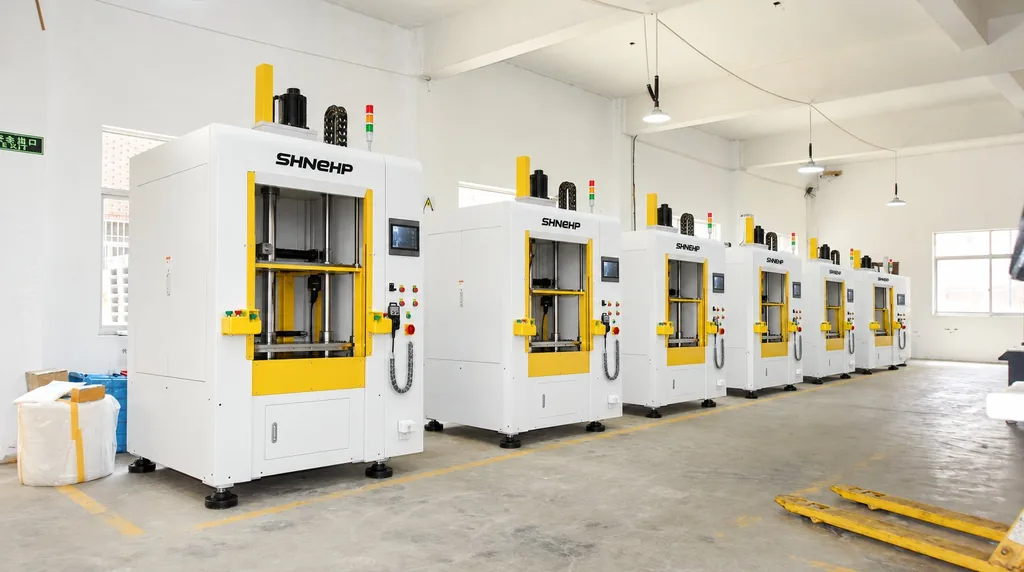
Engine air cleaner housings, sealed lifetime intake air-filter boxes, commercial-truck heavy-duty cyclonic air-filter bodies, and integrated MAF-sensor/resonator filter ducts must seal dirty ambient air 100% away from clean turbocharged engine air across -40 °C to +125 °C under-hood conditions. While flat-seam intake boxes run efficiently on linear vibration welders, modern space-constrained hybrid and ICE engine bays increasingly force air cleaner housings into deep 3D compound contours, multi-branch snorkel joints, and wide asymmetric shells molded from PP-T20/40, PP-GF20/30, or PA6-GF30 where lateral vibration clearance is impossible. Applying hot plate welding air filters fuses complex 3D perimeter flanges, dirty/clean divider walls, and integrated intake snorkels into one rigid, NVH-quiet, dust-proof assembly. SHNEHP engineers wide-bed 3-axis servo hot plate machines (XNS6-B, XNS8-B, XNS9-B) built to DVS 2215 standards.
The part and its welding challenges
Automotive engine air-cleaner housings and commercial heavy-duty air filters combine large molded spans with strict dirty-to-clean dust-bypass and NVH acoustic requirements, posing five production hurdles:
- Deep 3D compound curves and integrated intake snorkels: Engine-bay packaging wraps air filter housings tightly around shock towers and radiator shrouds, creating 40–150 mm Z-axis height drops that require 5-axis machined contoured hot plate tooling with multi-zone PID temperature balancing.
- Correcting molded warpage on wide PP-T20 / PP-GF shells: Large 350–700 mm air cleaner shells bow 2–5 mm out of the mold; sequential pneumatic clamping and vacuum nests straighten rims cleanly onto datum pins before bead-up begins.
- Zero unfiltered dust bypass and zero MAF-sensor fouling: Any tiny cold-weld gap downstream of the filter element lets abrasive road silica straight into turbocharger blades and pistons, while loose resin threads or carbonized flecks can foul hot-wire mass-airflow (MAF) sensors—making enclosed inner flash traps (and non-contact IR on >270 °C PA6-GF) essential.
- Simultaneous welding of outer walls and internal acoustic/cyclonic baffles: Multi-chamber air cleaner housings often integrate quarter-wave acoustic baffles or pre-cleaner vortex vanes that must fuse at the exact same servo collapse height as the outer shell.
- Heavy-duty vibration fatigue & hood-slam toughness: Air filter boxes bolt directly to engine blocks or fender aprons and endure continuous low-frequency engine shake without developing acoustic buzz or seam cracks.
Why hot plate welding (vs. alternatives)
| Process | Fit for 3D curved engine air filters & heavy-duty air cleaners | 3D geometry freedom & clean-side safety | Typical cycle time | Engineering boundary |
|---|---|---|---|---|
| Wide-bed 3-axis servo hot plate welding (XNS6-B / XNS8-B / XNS9-B) | Top choice for deeply 3D-contoured air filter boxes, multi-branch snorkel ducts, and sealed heavy-duty cyclonic air cleaners in PP-T20, PP-GF, and PA6-GF | Unlimited 3D contour reach, zero lateral clearance needed, zero friction dust near MAF sensors; upgrade to non-contact IR for high-temp PA6-GF | ~20–36 s | Slightly slower than vibration welding on purely flat boxes; requires multi-zone PID contoured tooling |
| Linear vibration friction welding (XN-55 / XN-70 / XN-100) | High-volume flat-plane air filter boxes and flat intake box sub-lids | Very fast 2–5 s weld cycle with low standby energy | ~10–18 s total | Strictly requires flat/gentle parting plane and ≥2.5–3.0 mm unilateral lateral clearance |
| Ultrasonic welding (XNC-400 / XN-5) | Compact secondary breather spigots, drain valves, or MAF sensor bosses only | Sub-second discrete auxiliary attachment | ~0.3–1.2 s | Cannot seal oversized 350–700 mm PP-T20/PP-GF air cleaner perimeters |
| Metal clips & EPDM perimeter gaskets | Serviceable filter-element access lids only | Re-openable for routine filter swaps | Fast clip latch | Used for the serviceable element lid, not permanent structural housing-to-snorkel/resonator seams |
Typical process window (industry ranges)
Air-filter housing thermal fusion follows DVS 2215 five-stage servo control, keeping contact PTFE temperatures safely below ~270 °C on polypropylene grades and switching to non-contact IR on high-temperature glass-filled nylon housings. Exact windows are proven during a SHNEHP trial.
| Parameter | Typical industry range (PP-T20 / PP-GF / PA6-GF) | Engineering guidance |
|---|---|---|
| Heating mode & temperature | PP-T20 / PP-GF contact: 225–255 °C; PA6-GF (>270 °C or GF≥40%): non-contact IR 320–460 °C | 8–16 independent PID zones balance thick snorkel bosses against thin box walls |
| Bead-up / warpage leveling (Stage 1) | 0.5–0.9 mm displacement at 0.15–0.25 N/mm² | Flattens large molded PP-T20 warpage cleanly across 3D heated faces |
| Melt / soak phase (Stage 2) | 8–18 s at low pressure (0.02–0.05 N/mm²) | Builds 1.0–1.5 mm ductile melt depth for strong engine-vibration fatigue life |
| Servo changeover time (Stage 3) | ≤1.5–2.2 s | Fast 3-axis servo platen exit prevents cold-skinning on thin acoustic baffles |
| Joining & hold phase (Stages 4–5) | 0.15–0.28 N/mm² to closed-loop servo hard stop (1.4–2.4 mm collapse); cool 8–15 s | Enclosed inner flash grooves keep clean-side airflow smooth and MAF-safe |
Recommended SHNEHP machine and fixture setup
SHNEHP manufactures rigid mid-to-large 3-axis servo hot plate welding machines tailored to automotive intake and filtration Tier-1 plants (+60 mm platen margin rule):
- Passenger-car air cleaner boxes & snorkel sub-assemblies: XNS6-B and XNS8-B 3-axis full-servo hot plate welders deliver wide parallel platen rigidity, closed-loop meltdown monitoring, and optional non-contact IR heating heads for PA6-GF turbo intake boxes.
- Commercial truck / off-highway heavy-duty air filters & dual-cavity boxes: XNS9-B wide-bed servo platforms support oversized multi-branch housings with rolling quick-change fixture carts for fast model changeovers.
- Anti-warp datum tooling: Custom welding and testing fixtures integrate sequential pneumatic anti-warp clamps, MAF-boss datum pins, and direct transfer into inline airflow/leak check stations via customized machines.
Quality and leak testing
Engine air-filter housings undergo 100% airtightness and dimensional checks before delivery to powertrain plants:
- 100% inline pressure-decay airtightness check: Automated fixtures plug the dirty inlet, clean outlet, and MAF port to verify zero dust-bypass leaks at 20–60 kPa (or OEM turbo-side specs up to 150 kPa) with quantitative mL/min pass/fail MES logging.
- Clean-side FOD, CMM & shaker-table audits: Batch inspections verify zero loose resin strings inside clean-side passages, BIW mounting-bracket CMM accuracy, and under-hood vibration endurance after -40 °C to +125 °C conditioning.
FAQ
When should an automotive air filter box use hot plate welding instead of linear vibration welding? Choose servo hot plate welding whenever the air cleaner housing has deep 3D stepped contours, integrated curved intake snorkels, or tight internal baffles lacking ≥2.5–3.0 mm lateral vibration clearance; choose linear vibration welding for flatter high-volume housings.
How do you prevent resin stringing inside clean-side air filter ducts near the MAF sensor? Keep contact PTFE platens strictly below ~270 °C on PP-T20/PP-GF with crisp servo break-away profiles, design enclosed inner flash traps, and upgrade to non-contact IR hot plate welding (300–500 °C) on high-temp PA6-GF housings.
Can SHNEHP hot plate welders seal both passenger-car and heavy-duty commercial truck air cleaners? Yes. SHNEHP XNS6-B, XNS8-B, and XNS9-B wide-bed servo machines scale cleanly from compact passenger-car air boxes up to large commercial-truck cyclonic air filter housings.
What test pressure is used to leak-test welded plastic engine air filter housings? Naturally aspirated engine air cleaner housings are typically dry-air leak-tested inline at 20–60 kPa (higher for pressurized turbocharger ducts) to guarantee zero unfiltered dust ingress and zero acoustic intake whistles.
What CAD data should we send for an air-filter hot plate weld trial? Provide 3D STEP/X_T models showing 3D flange contour drops, internal baffles, and MAF/mounting datums, exact resin grade (PP-T20, PP-GF, PA6-GF), and target hourly volume.
Get a free weld trial
Share your automotive or commercial air-filter housing CAD models with SHNEHP engineering to evaluate 3D contoured servo hot plate vs. linear vibration welding and validate dust-tight seams on real moldings:
- 3D STEP / X_T / IGES models of air cleaner housing, snorkel, and internal baffles
- Polymer grade (PP-T20, PP-T40, PP-GF20/30, PA6-GF30)
- Overall L×W×H envelope, target UPH, and leak-test criteria
Email yy@nbxiaoneng.com or connect through our contact page.
Request a Technical Consultation & Free Weld Trial
Send your 3D STEP/X_T drawing, resin grade, target cycle time, and leak-test specification. Our engineers will evaluate the joint and recommend a practical SHNEHP machine and fixture setup.