
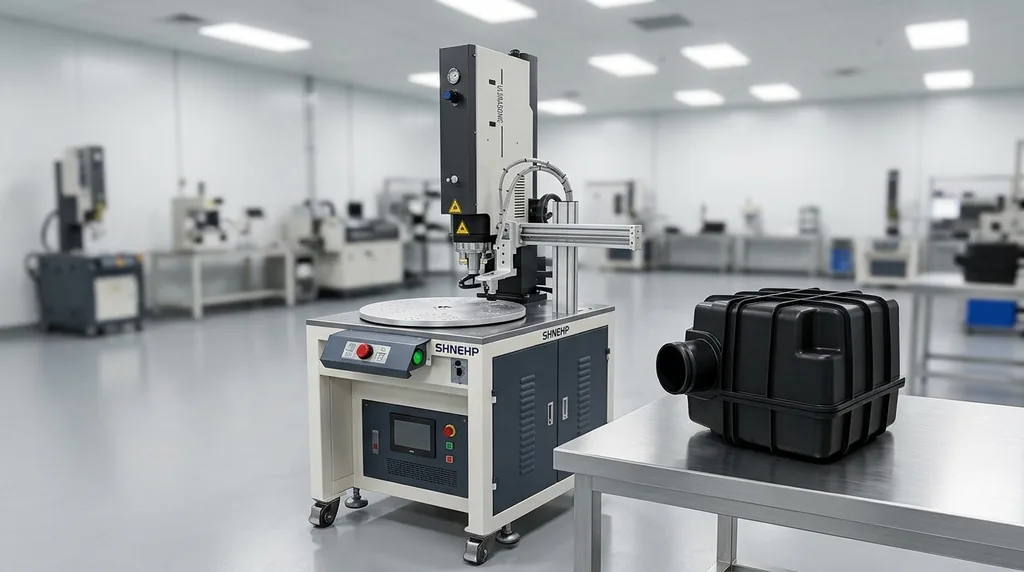
Engine intake Helmholtz resonators, turbocharger broad-band acoustic mufflers, and EV cabin HVAC noise-attenuation chambers cancel harsh induction drones and high-frequency whine across targeted RPM and airflow bands. Because resonator tuning relies on exact internal cavity volume and completely airtight acoustic walls, even a tiny perimeter leak ruins NVH damping and can trigger mass-airflow (MAF) engine fault codes. Applying ultrasonic welding automotive resonators seals compact, rigid PP-GF20/30, PP-T20, or PA6-GF30 acoustic chambers, side-branch quarter-wave tubes, and internal baffle inserts in 0.3–1.5 seconds with high throughput and low tooling investment. SHNEHP engineers high-rigidity 15 kHz and 20 kHz digital ultrasonic systems (XNC-400, XN-3, XN-5) tailored to automotive powertrain and NVH Tier-1 suppliers.
The part and its welding challenges
Automotive intake and HVAC resonators operate in high-vibration under-hood or dash zones with constant airflow pulsation. Sealing them ultrasonically requires careful acoustic and joint engineering around five challenges:
- Acoustic near-field boundary (≤6 mm) and part-size cutoff: Ultrasonic welding excels on compact Helmholtz side chambers, internal resonator baffles, and rigid resonator lids where the horn sits within ≤6 mm of the weld rib; oversized (>250–300 mm) or steeply curved multi-chamber resonators attenuate ultrasonic energy and should instead be welded via linear vibration or servo hot plate welding.
- Semi-crystalline glass-filled polypropylene and nylon (PP-GF / PA6-GF) weldability: Unlike amorphous ABS, semi-crystalline PP and PA6 require higher localized energy, rigid shear joints (rather than small triangular directors alone), and tight horn-to-part coupling to form pressure-tight NVH seams.
- Zero loose flash or glass-fiber debris inside clean-side intake paths: Any stray flash flake breaking loose downstream of the air filter can be ingested into the turbocharger compressor wheel or throttle body; internal flash traps must enclose the shear interface completely.
- Moisture sensitivity on PA6 / PA66 resonators: Un-dried glass-filled nylon absorbs ambient water that turns to steam during ultrasonic heating, causing spongy, porous welds that leak air and crack under under-hood vibration.
- Under-hood thermal cycling and engine-vibration fatigue: Intake resonators endure -40 °C to +125 °C temperature swings and continuous high-G engine vibration, demanding full-perimeter molecular fusion without stress-concentrating notches.
Why ultrasonic welding (vs. alternatives)
| Process | Fit for automotive intake & HVAC resonators | Cycle speed & capital cost | Typical cycle time | Engineering boundary |
|---|---|---|---|---|
| Precision ultrasonic welding (XNC-400 / XN-3 / XN-5, 15–20 kHz) | Fast, economical choice for compact Helmholtz side chambers, internal baffle plates, and rigid acoustic caps within ≤6 mm near-field | Sub-second cycle, compact footprint, quick horn/fixture changeover | ~0.3–1.5 s weld (~4–8 s total) | Limited to compact/medium rigid parts; oversized >300 mm or deeply curved PP/PA resonators require vibration or hot plate welding |
| Linear vibration friction welding (XN-35 / XN-55) | Large flat-plane intake resonators and heavy multi-chamber PA6-GF30 acoustic boxes | Very strong, fast 2–5 s hermetic joints across large areas | ~10–18 s total | Requires ≥2.5–3.0 mm clearance and flat/shallow parting plane |
| Servo hot plate welding (XNS5-B / XNS6-B) | Deep 3D curved air-duct resonators and complex multi-branch blow-molded/injection-molded chambers | Handles extreme 3D contours and soft un-filled PP/HDPE cleanly | ~22–38 s | Longer cycle time than ultrasonic for compact rigid caps |
| Spin welding (XNX-100) | Purely circular cylindrical turbo resonators or round Helmholtz cans | Ultra-fast 0.5–3 s circular hermetic seal | ~0.5–3 s | Restricted strictly to circular weld geometry |
Typical process window (industry ranges)
Ultrasonic resonator welding pairs high-amplitude 15 kHz (for larger PP-GF / PA6-GF chambers) or 20 kHz (for compact baffles and caps) stacks with precision shear-joint geometry and closed-loop collapse control. Baselines below are validated during a SHNEHP trial.
| Parameter | Typical industry range (PP-GF / PP-T20 / PA6-GF) | Engineering guidance |
|---|---|---|
| Pre-weld conditioning | PA6 / PA6-GF: weld dry-as-molded or condition dry; PP-GF / PP-T20: clean, oil-free | Prevents steam-void porosity on nylon intake resonators |
| Frequency & amplitude | 15 kHz (larger 120–240 mm chambers, PP/PA-GF) or 20 kHz (compact baffles/caps); high amplitude for semi-crystalline PP/PA | FEA-tuned slotted titanium/hardened steel horns prevent premature wear from abrasive glass fibers |
| Joint design | Shear joint (0.3–0.5 mm interference, 0.8–1.5 mm weld depth) with enclosed internal flash trap | Shear joints deliver far higher airtightness and vibration fatigue life on PP/PA than basic energy directors |
| Control mode & weld time | 0.3–1.5 s in closed-loop collapse distance mode with energy/power quality gates | Guarantees consistent internal chamber volume (critical for exact Helmholtz resonant frequency) |
| Hold time | 0.4–0.9 s under full clamp force | Allows semi-crystalline PP/PA melt to crystallize solidly without spring-back leaks |
Recommended SHNEHP machine and fixture setup
SHNEHP configures rigid 15 kHz and 20 kHz ultrasonic welding machines engineered to withstand abrasive glass-filled powertrain resins:
- Compact acoustic baffles & side-branch Helmholtz caps: XNC-400, XN-3, and XN-5 digital ultrasonic welders feature heavy cast/steel columns that prevent deflection under shear-joint clamp loads, automatic frequency tracking, and micron-scale collapse encoders.
- Wear-resistant tooling for glass-filled resins: Hardened tool-steel or titanium-carbide-coated FEA horns resist abrasive wear from 30% glass-fiber PA6/PP, paired with rigid cast-aluminum welding and testing fixtures that prevent outer-wall splaying during shear welding.
- Process boundary honesty: Whenever a resonator's footprint exceeds ultrasonic acoustic reach, SHNEHP seamlessly evaluates our XN-35 / XN-55 vibration friction or XNS5-B / XNS6-B hot plate platforms so your program launches with the right physics from day one.
Quality and leak testing
Intake resonators undergo 100% airtightness and structural checks before shipment to engine plants:
- Inline pressure-decay leak testing: Automated fixtures plug the intake branch port and test sealed resonator chambers at 20–100 kPa (or OEM turbo-boost specs up to 150–300 kPa on pressurized charge-air resonators) with quantitative mL/min reject gating.
- Cleanliness & burst/vibration audits: Periodic cut-sections verify zero loose flash particles inside clean-side airflow paths, while burst pressure and shaker-table endurance confirm long-term under-hood NVH durability.
FAQ
When should an automotive intake resonator use ultrasonic welding versus linear vibration or hot plate welding? Use ultrasonic welding for compact, rigid chambers and internal acoustic baffles where the horn sits within ≤6 mm of the weld seam (typically under ~220–250 mm). For larger flat-seam PP-GF/PA-GF resonators choose linear vibration welding, and for deeply contoured 3D duct resonators choose servo hot plate welding.
Why is a shear joint recommended over an energy director for PP-GF and PA6-GF automotive resonators? Semi-crystalline PP and PA6 drop sharply in viscosity once melted; a shear joint traps the molten resin under continuous telescoping wall pressure, eliminating air voids and producing far stronger, quieter airtight welds than a standard butt energy director.
How do you prevent abrasive glass fibers in PA6-GF30 from wearing out ultrasonic horns? SHNEHP machines horns from wear-resistant titanium or hardened tool steel (with optional surface hardening) and optimizes shear interference so welding completes rapidly in under 1.0–1.5 seconds.
Does ultrasonic welding preserve exact internal Helmholtz cavity volume? Yes. Terminating every weld on a closed-loop collapse-distance encoder holds finished chamber height within tight fractions of a millimeter so acoustic resonant frequency stays on target across every batch.
What engineering files do you need to evaluate our intake resonator for ultrasonic welding? Send 3D STEP/X_T models showing chamber dimensions, joint cross-section, and mounting bosses, plus exact PP-GF/PA-GF resin grade, pressure-test spec, and target hourly volume.
Get a free weld trial
Share your automotive intake or HVAC resonator CAD files with SHNEHP engineering to verify ultrasonic feasibility (or compare against vibration/hot plate welding), optimize shear-joint flash traps, and run physical test parts:
- 3D STEP / X_T / IGES models of resonator shells and internal baffles
- Resin specification (PP-GF, PP-T20, PA6-GF, PA66-GF)
- Leak-test pressure criteria and target hourly output (UPH)
Email yy@nbxiaoneng.com or connect through our contact page.
Request a Technical Consultation & Free Weld Trial
Send your 3D STEP/X_T drawing, resin grade, target cycle time, and leak-test specification. Our engineers will evaluate the joint and recommend a practical SHNEHP machine and fixture setup.