
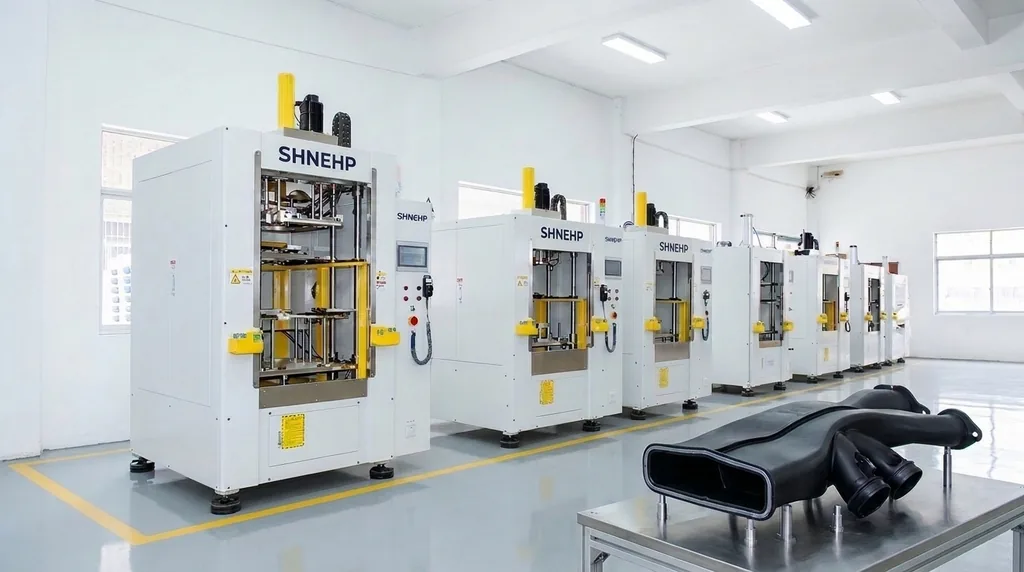
Automotive cabin HVAC defroster ducts, rear-seat footwell vents, battery-cooling air channels, and sculpted engine-bay intake snorkels snake tightly behind instrument panels and under floor carpets along sweeping 3D curves. Applying hot plate welding air ducts joins thin-walled clamshell duct halves cleanly across steep multi-plane bends with smooth internal airflow walls, zero air-whistle leaks, and exact mounting-clip spacing. SHNEHP engineers wide-platen 3-axis servo hot plate platforms (XNS6-B, XNS8-B, XNS9-B) built to DVS 2215 precision for automotive HVAC and interior Tier-1 suppliers.
The part and its welding challenges
Cabin HVAC and under-hood air ducts are commonly molded from PP, talc-filled PP (PP-TD10–20), HDPE, or ABS (replacing heavy blow-molded ducts wherever internal baffles, snap-on grille mounts, or multi-branch splits are needed). Welding long, winding thin-walled ducts brings five demanding production hurdles:
- Long 3D serpentine contours & branch splits: Windshield defroster ducts and floor manifolds often span 600–1200 mm with multiple curved outlets; flat welding platens cannot touch elevated bends without custom CNC-contoured heating shoes.
- Preventing airflow whistle & NVH noise: Rough protruding inner weld beads or small perimeter pinholes along high-velocity HVAC blower channels create audible cabin whistling at high fan speeds—making clean enclosed inner flash control vital.
- Thin hollow-wall collapse & molding bow: Injection-molded 1.5–2.2 mm clamshell duct halves twist and bow after demolding; full-length vacuum and mechanical perimeter clamping is mandatory to hold both halves straight through melting and cooling.
- Outlet-flange dimensional alignment: Duct outlets must mate cleanly into instrument-panel registers and HVAC blower housings without stressing foam gaskets; closed-loop servo meltdown stops lock exact overall duct height.
- High-volume multi-branch family changeovers: Each car platform carries 4–8 distinct HVAC ducts (driver, passenger, defroster, rear console), rewarding quick-change cassette tooling and saved HMI recipes.
Why hot plate welding (vs. alternatives)
| Process | Fit for curved automotive HVAC & intake air ducts | 3D curve reach & NVH silence | Typical cycle time | Engineering boundary |
|---|---|---|---|---|
| Servo hot plate welding (XNS6-B / XNS8-B / XNS9-B) | Primary choice for 3D-curved clamshell PP, PP-TD, HDPE, and ABS HVAC defroster ducts, rear floor channels, and multi-branch manifolds | CNC-contoured platens follow steep 3D curves evenly with zero vibration dust and smooth whistle-free inner walls | ~22–40 s (twin-cavity LH+RH runs double output) | Keep wall ≥1.5–2.0 mm, apply +60 mm fixture margin rule, and hold changeover ≤2.5 s for PP/HDPE |
| Linear vibration friction (XN-55 / XN-70 / XN-100) | Flat, rigid, planar under-hood air-cleaner ducts or straight acoustic resonators | Fast 6–15 s high-strength weld | ~6–15 s total | Linear oscillation struggles on sweeping 3D bends and thin hollow walls that flex and absorb energy |
| Ultrasonic welding (XNC-400) | Small outlet vent clips, flapper hinges, or localized short tack welds | Sub-second local welds | ~0.2–1.5 s | Unsuitable for sealing continuous 600–1000 mm serpentine semi-crystalline PP HVAC ducts |
| Blow molding (single-piece) | Simple smooth single-branch ducts without internal directional vanes | No seam | Blow-molding cycle | Cannot mold crisp internal splitter vanes, precision clip bosses, or tight variable wall thickness like injection-molded welded ducts |
Typical process window (industry ranges)
The conservative DVS 2215 five-stage baselines below cover PP, PP-TD, HDPE, and ABS automotive HVAC ducts. Exact zone temperatures and collapse stops are confirmed during a SHNEHP part-specific weld trial.
| Parameter | Typical industry range (PP / PP-TD / HDPE / ABS) | Engineering guidance |
|---|---|---|
| Platen face temperature | HDPE: 225–255 °C; ABS: 235–265 °C; PP / PP-TD: 245–275 °C | Independent multi-zone PID heaters balance narrow branch tips against wide main plenums |
| Bead-up / leveling (Stage 1) | 0.4–0.8 mm displacement | Straightens longitudinal twist and bow across 600–850+ mm clamshell halves |
| Melt / soak phase (Stage 2) | 6–15 s at 0.05–0.09 N/mm² | Shallow, uniform viscous melt prevents sagging on thin 1.5–2.2 mm duct walls |
| Changeover time (Stage 3) | ≤1.8–2.5 s | Rapid 3-axis servo withdrawal avoids cooling skin along exposed narrow branches |
| Joining & collapse (Stage 4) | 0.14–0.25 N/mm² to closed-loop servo hard stop (1.0–1.8 mm) | Hard servo stop protects outlet-flange alignment and minimizes inner bead height |
| Cooling / hold (Stage 5) | 6–14 s under clamping load | Locks 3D serpentine geometry cleanly so ducts snap right into cockpit carriers |
Recommended SHNEHP machine and fixture setup
Applying our +60 mm clearance rule (platen footprint ≥ duct L×W + 60 mm for clamps, dowel pins, and vacuum cups), SHNEHP matches wide-format hot plate welding machines to HVAC duct spans:
- Medium floor & console ducts (up to ~600 mm): XNS6-B 3-axis full-servo hot plate welder delivers balanced parallel motion and multi-zone PID thermal accuracy.
- Full-width defroster & twin LH+RH ducts (up to ~850×800 mm): XNS8-B and XNS9-B heavy-duty wide-platen servo platforms handle broad serpentine fixtures (and custom extended-width platens up to 1200+ mm on customized machines).
- Anti-bow vacuum tooling & quick-change cassettes: Custom welding and testing fixtures integrate contoured vacuum cradles along thin walls, spring-loaded branch alignment locators, and rapid cassette swaps between vehicle duct variants.
Quality and leak testing
HVAC air ducts verify dimensional clip-fit accuracy and low-pressure airflow tightness:
- Inline low-pressure air-leak & flow checking: Ducts are capped with soft silicone outlet pads and tested at low pressure (5–25 kPa, 3–5 s stabilization) to confirm zero whistle-inducing perimeter leaks and unobstructed internal airflow.
- 3D checking-fixture & rattle audits: Go/no-go checking fixtures confirm all dashboard mounting clips, foam-seal faces, and outlet angles sit within OEM geometric tolerances.
FAQ
Why is hot plate welding preferred over vibration welding for curved automotive HVAC air ducts? Sweeping 3D dashboard defroster ducts and multi-branch floor vents curve across multiple planes where linear vibration cannot oscillate without wall interference or flexing. CNC-contoured servo hot plate platens heat the entire 3D perimeter uniformly with smooth, whistle-free internal seams.
How do you prevent thin-walled 1.5–2.0 mm PP air ducts from warping or collapsing during hot plate welding? Support the full serpentine contour with vacuum-assisted aluminum cradles, apply gentle DVS 2215 Stage 1 bead-up leveling, limit melt pressure to 0.05–0.09 N/mm², and stop closing on a closed-loop 3-axis servo hard stop.
Can one SHNEHP machine weld multiple different HVAC duct models for the same vehicle platform? Yes. XNS6-B / XNS8-B / XNS9-B platforms support quick-change fixture and heating-platen cartridges plus stored HMI recipes, letting Tier-1 plants switch between defroster, console, and footwell ducts in minutes.
How wide of an automotive defroster duct can SHNEHP servo hot plate machines handle? Standard XNS8-B and XNS9-B platforms cover duct footprints up to ~850×800 mm (following our +60 mm fixture margin rule), while full-width 1000–1400 mm cross-car defroster ducts run on custom wide-platen servo frames.
What files should we send for an automotive air duct weld trial? Share frozen 3D STEP/X_T models of both duct clamshells, exact PP/PP-TD/HDPE/ABS resin grade, wall thickness, LH+RH cavity plan, and target hourly output (UPH).
Get a free weld trial
Send your HVAC or intake air-duct CAD files to SHNEHP engineering to evaluate wide-platen servo hot plate sizing (XNS6-B / XNS8-B / XNS9-B) and quick-change 3D tooling:
- Frozen 3D STEP / X_T / IGES models of the duct clamshells and mounting brackets
- Polymer grade & wall thickness (PP, PP-TD10–20, HDPE, ABS)
- Target hourly output (UPH) and duct family changeover lineup
Email yy@nbxiaoneng.com or connect through our contact page.
Request a Technical Consultation & Free Weld Trial
Send your 3D STEP/X_T drawing, resin grade, target cycle time, and leak-test specification. Our engineers will evaluate the joint and recommend a practical SHNEHP machine and fixture setup.