
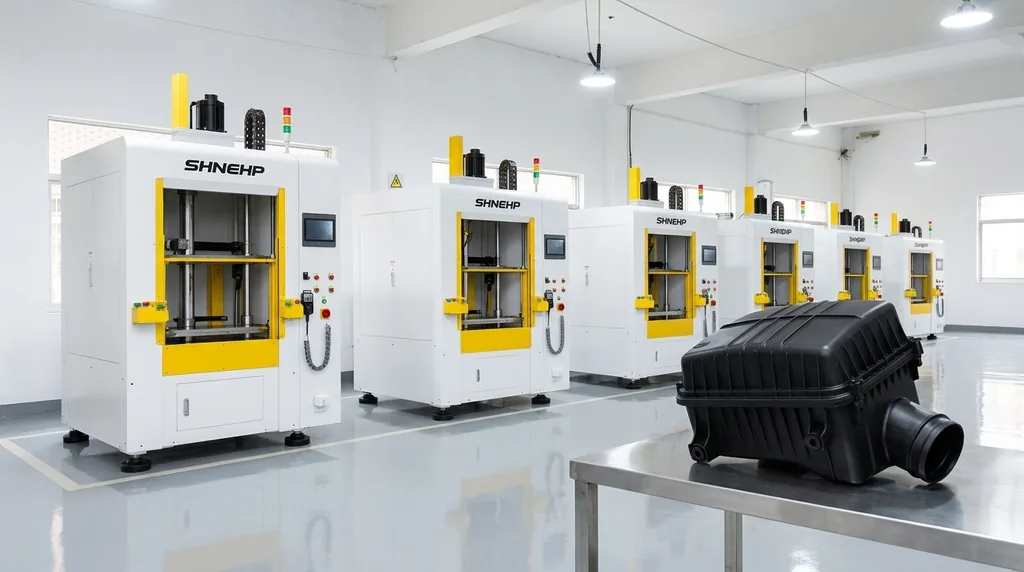
Automotive engine air-cleaner boxes, integrated acoustic Helmholtz resonators, MAF-sensor ducts, and heavy-duty commercial truck air-filter canisters are large, hollow thermoplastic assemblies that must stay airtight under engine intake vacuum and under-hood thermal cycling without resonating or rattling. Applying vibration welding air filters joins large upper/lower shells, attached snow-valves, and integrated acoustic chambers in a single 5–15 second stroke with high structural stiffness. SHNEHP engineers high-frequency (210–270 Hz) linear vibration welders (XN-40, XN-55, XN-70, XN-100) tailored to large under-hood air-induction modules.
The part and its welding challenges
Automotive and commercial-vehicle air filter boxes are typically molded from talc-filled polypropylene (PP-TD20 / PP-TD30), glass-filled polypropylene (PP-GF20 / PP-GF30), or PA6-GF30 for high-temperature turbocharger zones. Welding broad, hollow thin-wall air boxes creates five practical manufacturing hurdles:
- Acoustic & dust-ingress sealing on clean-air side: Even a minor pinhole downstream of the paper filter element admits unfiltered road grit directly into engine cylinders and skews mass airflow (MAF) sensor readings, triggering check-engine faults.
- Hollow box wall flexing under vibration: Large air-cleaner boxes feature broad, unsupported thin sidewalls (2.0–3.0 mm) that absorb oscillation energy like a drum if the lower nest lacks perimeter stiffening supports directly beneath the weld flange.
- Large part warpage across 400–700 mm spans: Broad PP-TD and PP-GF air boxes cool unevenly out of the injection mold; upper and lower tooling must apply uniform leveling clamp force across the full perimeter before vibration begins.
- Attached ducts, resonators & mounting grommets: Air boxes frequently integrate protruding intake snorkels, resonator chambers, and mounting bosses that require custom fixture clearances and balanced upper-tool mass.
- Cosmetic & NVH rib stiffness: Exposed under-hood seams must look uniform and flash-trapped while withstanding continuous engine vibration without cracking at flange corners.
Why vibration friction welding (vs. alternatives)
| Process | Fit for automotive air filter boxes & resonators | Cycle speed & structural stiffness | Typical cycle time | Engineering boundary |
|---|---|---|---|---|
| Linear vibration friction (210–270 Hz: XN-40 / XN-55 / XN-70) | Primary choice for large planar or gently contoured PP-TD, PP-GF, and PA6-GF air cleaner boxes and attached acoustic resonators | Rapid 5–15 s cycles with strong, vibration-resistant under-hood joints and multi-chamber sealing | ~5–15 s total (1–6 s weld) | Requires ≥2.5–3.0 mm in-plane clearance and rigid sidewall nest backing; incompatible polymer pairs cannot fuse |
| Servo hot plate welding (XNS6-B / XNS8-B / XNS9-B) | Deep 3D-curved air-intake snorkels, curved resonator bends, or blow-molded ducts where linear motion is blocked | Follows steep 3D multi-plane seams cleanly with zero vibration dust | ~25–45 s total | Longer cycle time than vibration; better when geometry prevents 2.5–3.0 mm planar oscillation |
| Ultrasonic welding (XNC-400 / XN-5) | Small attached MAF sensor bosses, drain valves, or compact auxiliary resonator caps | Sub-second local welds on small rigid attachments | ~0.2–1.5 s | Unsuitable for large 400–700 mm air-filter box perimeters |
| Metal spring clips + foam/rubber gaskets | Serviceable upper filter-access lid (needs periodic filter replacement) | Field-openable access cover | Manual clip assembly | Used ONLY for the replaceable service lid—permanent air-box shells, snorkels, and resonators are welded to cut BOM cost and leak paths |
Typical process window (industry ranges)
The conservative DVS 2217 linear vibration baselines below cover PP-TD20/30, PP-GF20/30, and PA6-GF30 automotive air-cleaner boxes. Part-specific parameters are established during a SHNEHP weld trial.
| Parameter | Typical industry range (PP-TD / PP-GF / PA6-GF) | Engineering guidance |
|---|---|---|
| Operating frequency | 210–270 Hz (high-frequency drive; XN-200 70–120 Hz for oversized >1.5 m commercial truck boxes) | Keeps amplitude compact (0.6–1.0 mm) to fit tight under-hood packaging clearances |
| Flange & rib geometry | Wall ≥2.0–3.0 mm; flange width ≥3.0–4.0 mm with outer/inner flash-trap ribs | Add stiffening gussets parallel to the vibration axis on tall sidewalls to stop flexing |
| Weld pressure | PP-TD / PP-GF: 0.8–2.5 N/mm²; PA6-GF: 1.5–3.5 N/mm² | Balanced pressure levels molded box warpage without crushing thin hollow walls |
| Weld time & meltdown | 1.5–5.0 s to closed-loop meltdown target 1.0–2.0 mm | Meltdown-distance control absorbs part-to-part molding shrink variation cleanly |
| Hold / cooling dwell | 1.5–4.0 s under clamping pressure | Prevents spring-back along broad curved air-box flanges while resin solidifies |
| Total machine cycle | ~6–15 s | Easily meets high-volume automotive Tier-1 line takt times |
Recommended SHNEHP machine and fixture setup
SHNEHP matches linear vibration friction welding machines to your air-box footprint, weld-seam area, and upper-tool weight:
- Medium passenger-car air boxes & resonators (area ≤300–400 cm², upper tool ≤40–55 kg): XN-40 or XN-55 (18.5 kW, 2500 kgf clamp) high-frequency platforms with full sound enclosures.
- Large SUV / twin-cavity air boxes (area ≤450–490 cm², upper tool ≤70–100 kg): XN-70 (30 kW) or XN-100 (65 kW) platforms handle wide multi-chamber tooling cleanly.
- Oversized commercial-truck air cleaners (>1.5 m, area ≤650 cm², upper tool ≤200 kg): XN-200 low-frequency (70–120 Hz) heavy-duty platform.
- Sidewall-braced tooling & auxiliary stations: Custom welding and testing fixtures integrate full-perimeter lower backing cradles directly under the weld flange, balanced upper-tool plates verified via empty-run frequency checks, and optional downstream leak/flow testing via customized machines.
Quality and leak testing
Air-cleaner housings operate under low intake vacuum rather than high hydraulic pressure, requiring sensitive low-pressure leak verification:
- 100% inline low-pressure air-decay testing: Clean-air outlets and resonators are typically screened at 10–50 kPa (positive or negative pressure) with 3–5 s stabilization to absorb thin-wall flexing, catching pinholes that could bypass unfiltered air past the MAF sensor.
- Acoustic & dimensional gauge checks: Automated go/no-go fixtures verify mounting-grommet pitch, filter-element tray flatness, and clean exterior flash-trap appearance.
- Destructive pull & thermal-shock audits: Periodic lot audits test weld-seam pull strength and cross-section continuity before and after under-hood thermal aging (-40 °C to +110 °C).
FAQ
How do you keep hollow thin-walled PP-TD air filter boxes from flexing during vibration welding? Support the lower shell with rigid CNC-machined backing walls directly beneath and alongside the weld flange, orient the vibration axis along the stiffer box dimension, and include molded stiffening ribs parallel to the motion axis.
When should an automotive air box or intake duct use hot plate welding instead of vibration welding? Use vibration friction welding (XN-40 / XN-55 / XN-70) for planar or gently contoured air-cleaner shells and resonators where fast 5–15 second cycles matter. Switch to servo hot plate welding (XNS6-B / XNS8-B) when curved 3D snorkels or blow-molded ducts lack 2.5–3.0 mm of unobstructed planar clearance.
Can you weld a PP-TD20 air filter body to a PA6-GF30 intake resonator? No. Linear vibration welding requires chemically compatible polymers (e.g., PP-TD to PP-GF, or PA6-GF to PA6-GF). Incompatible families such as PP and PA66 cannot form a structural molecular weld.
What SHNEHP vibration welder size fits standard passenger-car air filter housings? Most passenger-car air boxes and resonators fit XN-40 (≤300 cm² weld area) or XN-55 (≤400 cm², 2500 kgf clamp); twin-cavity fixtures and large SUV/commercial truck housings step up to XN-70, XN-100, or XN-200.
What files does SHNEHP need for an air filter box weld trial? Share frozen 3D STEP/X_T models of both mating halves, exact resin and talc/glass-fiber percentage, target hourly output (UPH), and low-pressure leak-test criteria.
Get a free weld trial
Send your air-cleaner box or resonator CAD files to SHNEHP engineering to evaluate weld-area sizing (XN-40 / XN-55 / XN-70), sidewall-support tooling, and inline leak testing:
- Frozen 3D STEP / X_T / IGES models of the air box, snorkel, and resonator chambers
- Resin & filler specification (PP-TD20/30, PP-GF20/30, PA6-GF30)
- Target hourly output (UPH) and clean-air leak threshold
Email yy@nbxiaoneng.com or connect with our engineers on our contact page.
Request a Technical Consultation & Free Weld Trial
Send your 3D STEP/X_T drawing, resin grade, target cycle time, and leak-test specification. Our engineers will evaluate the joint and recommend a practical SHNEHP machine and fixture setup.