
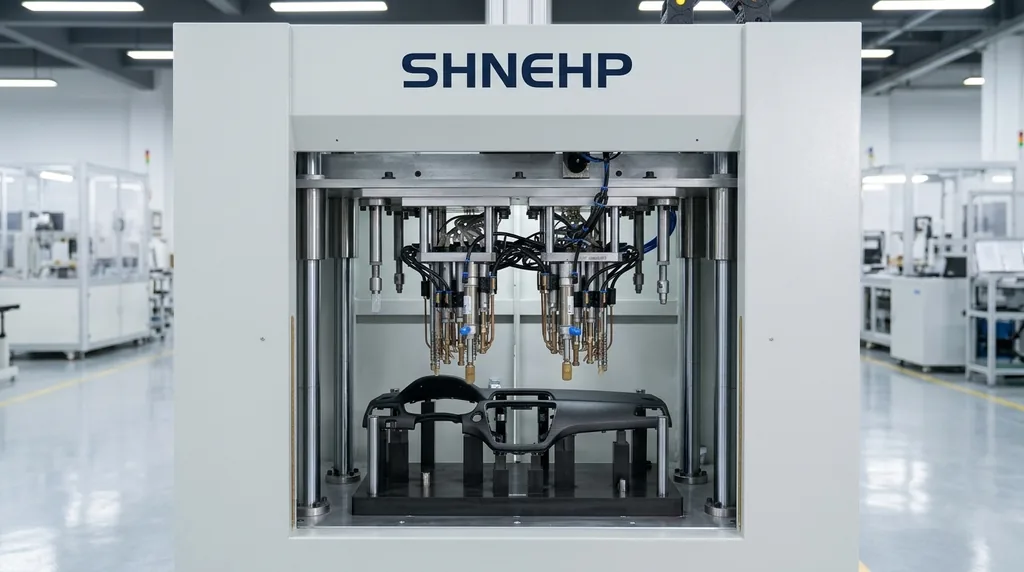
An automotive cockpit instrument panel (IP) brings together dozens of aesthetic and functional sub-assemblies—HVAC air-register vents, decorative chrome/piano-black bezels, infotainment display brackets, ambient light-guide diffusers, glovebox strikers, and airbag-chute retainers—onto a broad, contoured structural carrier. Selecting hot staking instrument panel assembly replaces dozens of self-tapping screws and snap clips with quiet, zero-gap thermoplastic rivets formed simultaneously in a single multi-point press stroke. SHNEHP engineers multi-zone thermal staking (XNR-100) and hot-air cold staking (XNRZ-100) systems built for zero-witness-mark Class-A cockpit trim.
The part and its staking challenges
Instrument panel carriers and decorative trim inserts span PP-TD20 / PP-TD30, PC/ABS, ABS, ASA, PMMA (light guides), SMA, and high-temperature PA6T / PPA / LCP structural mounts near defroster ducts and sun-load zones. Multi-point dashboard staking presents five critical Tier-1 manufacturing hurdles:
- Zero Class-A read-through on soft-touch & high-gloss surfaces: Piano-black bezels, TPO slush skins, and leather-wrapped IP toppers reveal even microscopic sink depressions, gloss spots, or stress whitening if heat conducts too deeply through the boss base.
- High-temperature sun-load & defroster durability: Top-of-dash components endure extreme cabin solar heating (+90 °C to +110 °C); high-heat PA6T, PPA, and PC/ABS bosses string heavily on conventional contact tips unless hot-air cold staking is used.
- Zero-play NVH / BSR elimination: Any loose clearance between staked display brackets, HVAC registers, or speaker bezels produces audible dashboard squeaks and rattles over rough roads.
- Compound 3D dashboard curvature (20–60+ stake points): Instrument panels span 1.2–1.6 meters wide with deep sweeps across driver gauges, center stacks, and passenger panels—requiring synchronized multi-angle pneumatic/servo slides.
- Protecting integrated electronics & light guides: Infotainment bezels and ambient lighting modules contain fragile LEDs, optical acrylic pipes, and wiring harnesses that cannot tolerate ultrasonic acoustic shock.
Why hot staking and hot-air cold staking (vs. alternatives)
| Process | Fit for instrument panel & cockpit trim assembly | Class-A cosmetics & BSR control | Typical cycle time | Engineering boundary |
|---|---|---|---|---|
| Hot-air cold staking (XNRZ-100) | Primary choice for high-gloss/soft-touch cockpit trim, PA6T/PPA/LCP bosses, and strict zero-stringing, zero-whitening Class-A dashboards | Superheated air softens only the boss crown; chilled punch forms a crisp, tightly clamped dome with zero stringing or stress whitening | ~12–28 s (entire IP simultaneously) | Requires tuned multi-zone air nozzles and indexed cold-punch shuttle actuation |
| Direct contact thermal staking (XNR-100) | Non-cosmetic PP-TD structural carriers, HVAC ducts, and standard ABS/PC-ABS trim brackets | Quiet, vibration-free multi-point fastening with individual PID tip heaters | ~10–24 s (entire IP simultaneously) | Risk of stringing on glass-filled or high-temp PPA/PA6T unless tips cool before lift |
| Ultrasonic staking (XNC-400) | Small standalone sub-bezels without embedded LEDs or Class-A show skins | Fast single-point local stakes | ~1–3 s per point | High-frequency energy risks cracking nearby acrylic light guides, damaging cockpit electronics, or marking soft-touch surfaces |
| Self-tapping screws / spring clips | Heavy structural cross-car beam interfaces requiring service removal | Serviceable | Slow multi-spindle driving | Adds fastener BOM weight, strip-out risk, and potential thermal-cycle loosening (BSR) |
Typical process window (industry ranges)
Consistent dashboard retention relies on balanced boss sizing paired with localized thermal softening and continuous cooling hold. The conservative industry ranges below are finalized during a SHNEHP part-specific weld trial.
| Parameter | Typical industry range | Engineering guidance |
|---|---|---|
| Boss geometry & wall rule | Protruding height H = 1.5–2.0 × D; switch solid bosses to hollow bosses once D ≥ 4 mm |
Hollow bosses heat twice as fast and prevent heat-sink dimples on the Class-A show side |
| Formed stake head | Finished head diameter D_head ≈ 1.9 × D (domed, flanged, or rosette) |
Delivers wide bearing overlap over HVAC bezel tabs and metal display brackets |
| Direct thermal tip temp | PP-TD: 220–260 °C; PC/ABS / ABS: 235–275 °C; PA6/66: 265–310 °C | Independent PID zones keep tall and short bosses at matching melt viscosity |
| Hot-air cold staking temp | Superheated air 280–450 °C (material-dependent); chilled punch ≤40 °C | Mandatory for PA6T / PPA / LCP and strict zero-stringing / zero-whitening Class-A bezels |
| Softening dwell | 4–12 s | Localizes melt strictly above the mating bracket face |
| Cold forming & hold dwell | 3–8 s under controlled force | Eliminates post-stake elastic spring-back so trims stay rattle-free under cabin thermal shock |
| Full-IP multi-point cycle | ~12–28 s (all 20–60+ bosses staked in one synchronized cell cycle) | Twin shuttle nests allow operator load/unload during machine cycle |
Recommended SHNEHP machine and fixture setup
SHNEHP engineers multi-point hot staking welding machines and large-format dashboard assembly cells:
- XNR-100 multi-point thermal staking systems: Modular vertical and compound-angle heated staking columns with individual thermocouple monitoring and HMI zone diagnostics for PP-TD and PC/ABS IP sub-assemblies.
- XNRZ-100 hot-air cold staking systems: Precision superheated-air manifold nozzles paired with actively cooled forming punches on rigid shuttle frames—delivering zero-stringing, zero-whitening Class-A retention across premium cockpit trim and PA6T/PPA mounts.
- Class-A protective nests & poka-yoke sensors: Custom welding and testing fixtures use molded polyurethane soft cradles that protect grained TPO/leather skins, plus inductive/optical sensors confirming every bezel, vent, and clip is seated before staking initiates.
- Turnkey cockpit cells: Full-width dashboard lines built via customized machines combine dual-operator light-curtain bays, multi-angle staking, vision boss-head verification, and barcode MES traceability.
Quality inspection and process control
Instrument panel staking quality combines 100% automated sensor poka-yoke with rigorous mechanical and cosmetic auditing:
- 100% per-zone PLC monitoring: Every heating zone logs live temperature, air flow/pressure (on XNRZ-100), stroke-depth encoder position, and dwell time; any thermocouple drift or short stroke locks out part release.
- Pull-out, shear & BSR rattle audits: Periodic destructive pull tests verify retention force before and after cabin thermal cycling (-40 °C to +95 °C), confirming zero buzz, squeak, or rattle across bezel joints.
- Grazing-light Class-A cosmetic check: Show-surface inspection opposite every staked boss confirms zero sink marks, zero gloss rings, and zero stress whitening on piano-black or grained skins.
FAQ
Why is hot-air cold staking preferred for high-gloss and soft-touch automotive instrument panels? Hot-air cold staking (XNRZ-100) softens only the boss tip with targeted hot air and immediately forms and chills the rivet head with a cold punch—eliminating melt stringing, scorching, and witness marks on Class-A dashboard surfaces while clamping brackets tightly against BSR rattle.
What boss diameter requires switching from solid to hollow staking bosses on dashboards?
Once boss outer diameter reaches 4 mm or larger, switch to a hollow tubular boss (maintaining protruding height H = 1.5–2.0 × D and formed head D_head ≈ 1.9 × D) to shorten heating time and prevent cosmetic sink read-through on the front trim face.
Can one SHNEHP staking machine handle 40+ compound-angle bosses across a full-width dashboard? Yes. Multi-point XNR-100 and XNRZ-100 cells mount independent vertical and angled staking modules with individual PID zones, completing an entire cockpit panel in one synchronized cycle.
Is hot staking safe near dashboard infotainment displays and ambient LED light guides? Yes. Unlike ultrasonic staking, thermal and hot-air cold staking transmit zero high-frequency acoustic vibration into adjacent LED boards, displays, or fragile acrylic light guides.
What engineering data does SHNEHP need for an instrument panel hot staking trial? Provide 3D STEP/X_T assemblies showing all boss coordinates and entry angles, exact substrate and bezel resin grades, A-surface cosmetic zones, target UPH, and OEM pull-force requirements.
Get a free weld trial
Share your instrument panel or cockpit trim CAD assembly with SHNEHP engineering to evaluate XNR-100 thermal staking versus XNRZ-100 hot-air cold staking before finalizing mold boss geometry:
- 3D STEP / X_T / IGES models of the IP carrier, vents, bezels, and brackets
- Substrate resin grades & filler specs (PP-TD20/30, PC/ABS, ABS, PA6T/PPA)
- Total boss count, compound-angle envelope, target UPH, and pull-out specs
Email yy@nbxiaoneng.com or reach our engineers on our contact page.
Request a Technical Consultation & Free Weld Trial
Send your 3D STEP/X_T drawing, resin grade, target cycle time, and leak-test specification. Our engineers will evaluate the joint and recommend a practical SHNEHP machine and fixture setup.