
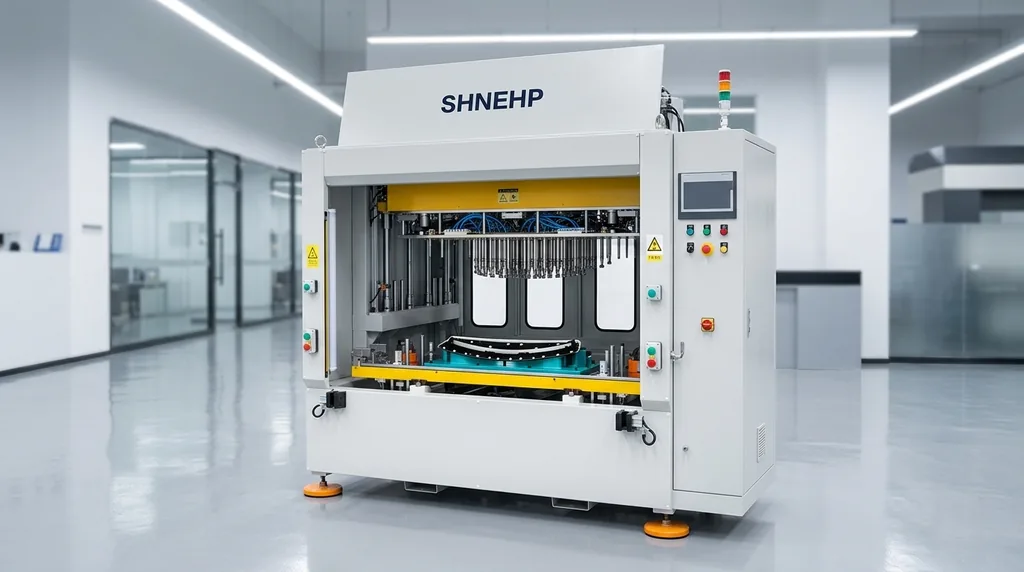
Modern automotive door trim carriers integrate dozens of dissimilar attachments—steel hinge reinforcement brackets, armrest retainers, speaker grilles, wiring harness clips, map-pocket inserts, and acoustic felt pads—onto injection-molded polymer substrates. Selecting a hot staking machine automotive door panel hinges line lets Tier-1 interior suppliers reform thermoplastic bosses into permanent, rattle-free rivets in a single multi-point stroke without screws, adhesives, or acoustic vibration marks. SHNEHP engineers multi-zone thermal staking (XNR-100) and hot-air cold staking (XNRZ-100) platforms tailored to Class-A door trim aesthetics.
The part and its staking challenges
Automotive door panels are typically molded from talc-filled polypropylene (PP-TD20 / PP-TD30), ABS, PC/ABS, PA6/PA66, or high-temperature engineering grades (PA6T / PPA / LCP) for heavy-load hinge mounts and switch bezels. Fastening hinges and clips onto thin, textured door panels presents five core production challenges:
- Class-A cosmetic sink and witness marks: Over-heating thick solid bosses or driving excessive staking force telegraphs gloss spots, dimples, or stress whitening directly through thin grained skins or leather-wrapped surfaces.
- Polymer stringing and glass-fiber pull-out: Contact heated tips can pull molten strings when retracting from PA-GF, PP-TD, or high-temperature PPA/PA6T bosses, leaving debris on decorative trim and weakening stake head geometry.
- High boss count on contoured 3D panels: A single front door panel frequently carries 15 to 40+ staking bosses positioned at compound angles across armrests, pull cups, and hinge brackets; sequential single-point joining cannot meet OEM line takt times.
- Dissimilar material retention: Plastic bosses must lock metal hinge plates, stamped steel spring clips, and foam-backed fabrics tightly without loosening under cabin thermal cycling (-40 °C to +85 °C) or door-slam shock loads (buzz, squeak, and rattle / BSR prevention).
- Tight boss-to-hole fitment: Excessive radial clearance between the boss OD and the hinge bracket slot lets molten resin ooze laterally rather than forming a concentric, high-pull-out rivet head.
Why hot staking and hot-air cold staking (vs. alternatives)
| Process | Fit for door panel hinges & clips | Cosmetic & BSR performance | Typical cycle time | Engineering boundary |
|---|---|---|---|---|
| Hot-air cold staking (XNRZ-100) | Primary choice for Class-A door panels, PA6T/PPA/LCP, and zero-stringing cosmetic bosses | Non-contact hot-air softening followed by a chilled forming punch eliminates stringing, stress whitening, and tip sticking | ~10–25 s (multi-point simultaneous) | Requires engineered hot-air nozzles and calibrated air flow/temperature per boss zone |
| Direct contact thermal staking (XNR-100) | High-volume PP-TD, ABS, and PC/ABS interior clips, brackets, and non-cosmetic bosses | Clean, quiet, repeatable domed or rosette heads with independent PID heaters | ~8–20 s (multi-point simultaneous) | Tip-retraction stringing risk on high-temp PA6T/PPA or high-GF resins unless cooled before lift |
| Ultrasonic staking | Small localized clips on rigid amorphous ABS/PC brackets | Fast local cycling, low energy | ~1–3 s per point | High-frequency vibration can mar soft-touch foils, transmit marks to Class-A surfaces, or crack brittle metal-insert joints |
| Self-tapping screws / fasteners | Heavy structural latch mounts requiring field serviceability | Removable, high shear strength | Slow multi-spindle feeding | Adds fastener BOM cost, weight, cross-threading risk, and potential BSR loosening over vehicle life |
Typical process window (industry ranges)
Reliable hinge and clip retention starts with disciplined boss design paired with repeatable thermal and forming control. The baseline engineering ranges below are verified during a part-specific SHNEHP weld trial.
| Parameter | Typical industry range | Engineering guidance |
|---|---|---|
| Boss geometry ratio | Protruding height H = 1.5–2.0 × D (boss diameter) |
Switch from solid bosses to hollow tubular bosses once D ≥ 4 mm to cut heating time and prevent A-surface sink marks |
| Formed head diameter | D_head ≈ 1.9 × D (domed, knurled, or rosette profile) |
Provides sufficient bearing area over steel hinge brackets and slotted clip holes |
| Direct thermal tip temperature | PP-TD: 220–260 °C; ABS / PC-ABS: 230–275 °C; PA6/66: 260–310 °C | Independent PID cartridge zones keep uneven boss heights at uniform melt viscosity |
| Hot-air cold staking temperature | Superheated air stream 280–450 °C (resin-dependent); cold punch ≤40 °C | Mandatory for PA6T / PPA / LCP or strict zero-stringing / zero-whitening cosmetic trim |
| Heating / softening dwell | 3–12 s (boss wall and resin dependent) | Softens only the protruding boss crown without transferring soak heat to the A-side substrate |
| Cold forming & hold dwell | 2–8 s under controlled pneumatic or servo force | Solidifies the head tightly against the bracket while eliminating spring-back and BSR clearance |
| Multi-point cycle time | ~10–25 s for an entire door panel (all bosses simultaneously) | Scales easily to left/right-hand twin nests or rotary-table cells |
Recommended SHNEHP machine and fixture setup
SHNEHP builds single-station and multi-point hot staking welding machines engineered around Class-A automotive interior production:
- XNR-100 multi-point thermal staking platform: Modular multi-zone PID temperature controllers, precision linear guides, and servo or pneumatic pressing heads for high-volume PP-TD, ABS, and PC/ABS door-panel clips, armrest carriers, and trim retainers.
- XNRZ-100 hot-air cold staking platform: Combines targeted superheated-air manifolds with dedicated water- or air-cooled forming punches on indexed shuttle frames, eliminating polymer stringing, scorching, and witness marks on premium door panels and high-temperature PA6T/PPA brackets.
- Multi-angle actuation & quick-change tooling: Custom welding and testing fixtures integrate compound-angle pneumatic slides for side-wall bosses, polyurethane Class-A contour nests that protect grained vinyl/leather skins, and poke-yoke optical or inductive sensors confirming every metal hinge bracket and clip is seated before staking starts.
- Turnkey interior cells: For high-volume OEM lines, customized machines combine dual-stage shuttle tables, ultrasonic auxiliary heads, automatic part-presence vision checks, and barcode-linked cycle traceability.
Quality inspection and process control
Because door panel hinges and clips are structural safety and NVH (noise, vibration, harshness) interfaces rather than sealed fluid vessels, quality assurance centers on mechanical pull-out strength and 100% poka-yoke verification:
- Destructive pull-out & shear testing: Periodic lot audits measure axial pull-off force and shear retention across hinge brackets and retainer clips before and after cabin thermal-shock conditioning.
- Formed head geometry verification: Visual or camera inspection confirms symmetrical 360° head formation (
D_head ≈ 1.9 × D), zero radial cracking, zero stringing, and tight zero-gap seating against the bracket face. - A-surface cosmetic audit: Grazing-light inspection checks the show surface directly opposite every staked boss for gloss variation, sink depressions, or stress whitening.
- Closed-loop PLC monitoring: Per-zone thermocouple fault alarms, air-pressure/flow interlocks (for hot-air cold staking), stroke-depth encoders, and automated part-marking prevent under-heated or missed stakes from reaching final vehicle assembly.
FAQ
When should automotive door panel staking use hot-air cold staking instead of direct heated tips? Choose hot-air cold staking (XNRZ-100) whenever you stake high-temperature resins (PA6T, PPA, LCP), glass-filled bosses prone to stringing, or thin Class-A grained/wrapped door panels where zero witness marks and zero stress whitening are required.
What boss dimensions work best for hot staking metal hinge brackets onto plastic door panels?
A proven baseline is protruding boss height H = 1.5–2.0 × D, forming a finished head diameter around 1.9 × D. Once boss diameter reaches 4 mm or larger, use a hollow boss design to shorten melt time and prevent cosmetic sink on the opposite show surface.
Can one SHNEHP staking machine join 20 or 30 bosses on a door panel at once? Yes. Multi-point XNR-100 and XNRZ-100 fixtures mount independent vertical and angled staking modules with separate PID temperature zones, finishing an entire left- or right-hand door panel in one synchronized cycle.
How do you prevent rattling (BSR) on metal clips staked onto plastic door trim? Maintain tight boss-to-bracket hole concentricity, apply continuous hold pressure while the staked head cools below its softening temperature (cold-punch dwell on XNRZ-100), and verify clip presence via inductive sensors before the stroke triggers.
What information is needed to start a door-panel hot staking trial? Send 3D STEP/X_T assemblies showing all boss locations and bracket clearances, exact substrate resin and filler percentage, cosmetic A-surface constraints, and target hourly output (UPH).
Get a free weld trial
Share your door-panel CAD assembly with SHNEHP engineering to evaluate direct thermal staking (XNR-100) versus hot-air cold staking (XNRZ-100) and confirm boss geometry before steel tooling cut:
- 3D STEP / X_T / IGES models of the door carrier, hinge brackets, and clips
- Substrate resin and filler spec (e.g., PP-TD20, ABS, PC/ABS, PA6-GF, PPA)
- Boss count, angle envelope, target UPH, and OEM pull-out force requirement
Email yy@nbxiaoneng.com or reach our team via the contact page.
Request a Technical Consultation & Free Weld Trial
Send your 3D STEP/X_T drawing, resin grade, target cycle time, and leak-test specification. Our engineers will evaluate the joint and recommend a practical SHNEHP machine and fixture setup.