
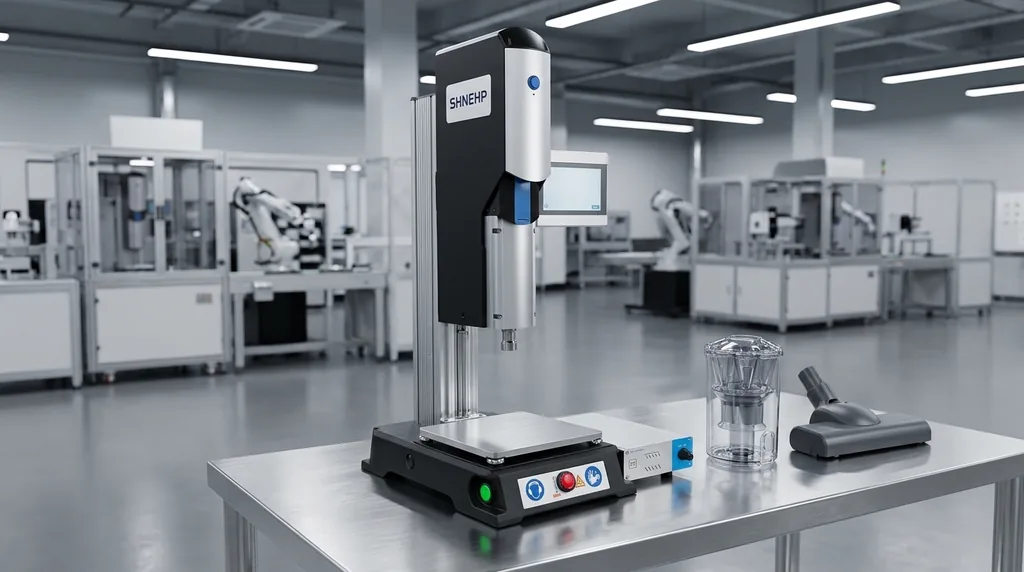
Cordless stick vacuums, robotic floor cleaners, and canister vacuum systems integrate high-speed cyclonic air separators, transparent polycarbonate dust bins, ergonomic handle halves, motorized brush-bar housings, and HEPA filter frames that must stay airtight under high suction while meeting consumer Class-A cosmetic expectations. Deploying ultrasonic welding vacuum cleaner parts fuses rigid amorphous and semi-crystalline appliance components in 0.1–1.5 seconds with clean flash-free exterior seams and zero adhesive fumes. SHNEHP engineers digital ultrasonic welding platforms (XNC-400, XN-3, XN-5) built for high-volume home-appliance assembly lines.
The part and its welding challenges
Vacuum cleaner assemblies span transparent polycarbonate (PC) or SAN dust cups, glossy ABS and PC/ABS motor housings and handles, POM brush-head gears, and PP cyclone cones or HEPA filter cages. High-volume consumer vacuum manufacturing faces five distinct ultrasonic challenges:
- Class-A glossy & metallic-painted surface protection: Modern cordless vacuums feature high-gloss painted ABS shells and clear PC dust canisters; ultrasonic horns can leave scuff rings, burn marks, or micro-crazing if horn contact faces lack proper contouring or protective film/amplitude control.
- Maintaining airtight cyclone suction paths: Any air bypass along cyclone cone dividers or HEPA filter frames cuts suction wattage immediately and leaks fine dust back into motor bearings.
- Near-field vs. far-field geometry limits: Ultrasonic welding performs cleanly within ≤6 mm near-field coupling from horn face to weld seam; tall, narrow vacuum nozzles or deeply recessed ducts lose acoustic energy and require careful horn stepping or switching to hot plate/vibration welding.
- Internal wire harnesses & motor switches: Ergonomic vacuum handles contain trigger switches, LED battery indicators, and motor power wires that must stay clear of ultrasonic energy directors and acoustic nodal zones.
- High-speed multi-SKU consumer output: Appliance OEMs produce millions of units per year across multiple accessory nozzles, demanding fast-changeover titanium/aluminum horns and sub-2-second cycle times.
Why ultrasonic welding (vs. alternatives)
| Process | Fit for vacuum cleaner components | Speed & cosmetic finish | Typical cycle time | Engineering boundary |
|---|---|---|---|---|
| Digital ultrasonic welding (15–20 kHz: XNC-400 / XN-3 / XN-5) | Primary choice for ABS, PC, PC/ABS, and SAN vacuum handles, floor-nozzle shells, HEPA filter frames, battery packs, and compact cyclone cones | Sub-second clean welds with crisp molded energy directors and zero consumable BOM | ~0.1–1.5 s weld + hold | Best for near-field joints (≤6 mm) on rigid amorphous resins; large >250 mm PP ducts or curved water-mop tanks need hot plate/vibration |
| Hot staking (XNR-100 / XNRZ-100) | Locking metal brush bearings, PCB trigger modules, or acoustic foam retainers inside vacuum bodies | Zero acoustic vibration near sensitive battery BMS/PCBs | ~6–18 s (multi-point) | Fastening mechanical bosses rather than continuous airtight cyclone suction seams |
| Servo hot plate welding (XNS5-B / XNS6-B) | Wet-dry vacuum clean/dirty water tanks and large curved PP floor ducts | Hermetic waterproof seals on semi-crystalline PP/HDPE tanks | ~20–35 s total | Slower than ultrasonic; reserved for large waterproof wet-dry vacuum reservoirs |
| Self-tapping screws + foam gaskets | Serviceable motor-cover housings | Field-openable | High screw BOM & multi-spindle labor | Visible screw bosses spoil sleek cordless vacuum aesthetics and add weight |
Typical process window (industry ranges)
The conservative ultrasonic engineering baselines below guide ABS, PC, PC/ABS, and PP vacuum cleaner sub-assemblies. Exact frequency, booster gain, and collapse depth are established during a SHNEHP part-specific weld trial.
| Parameter | Typical industry range (15 kHz / 20 kHz) | Engineering guidance |
|---|---|---|
| Ultrasonic frequency | 15 kHz for larger floor nozzles, wide cyclone assemblies, and semi-crystalline PP parts; 20 kHz for handles, HEPA frames, and compact ABS/PC parts | Lower 15 kHz delivers higher amplitude and reaches slightly deeper joints; 20 kHz runs quieter and gentler on clear PC dust cups |
| Joint geometry | 60°–90° triangular energy director (0.4–0.8 mm height) on amorphous ABS/PC; stepped shear joint on PP HEPA frames | Add a recessed step lip to hide exterior flash on glossy consumer handles |
| Horn-to-joint coupling | ≤6 mm (near-field) preferred | Contoured CNC-machined titanium or 7075-aluminum horns match curved vacuum shells without scuffing |
| Weld control mode | Weld-by-energy or Weld-by-collapse distance (preferred over pure time mode) | Eliminates cosmetic over-welding and detects missed HEPA gaskets or pinched internal wires automatically |
| Weld / Hold duration | 0.2–1.0 s weld / 0.4–1.2 s hold | Hold pressure locks rigid ABS/PC seams flat with zero cosmetic step |
Recommended SHNEHP machine and fixture setup
SHNEHP builds precision ultrasonic welding machines engineered for consumer-appliance visual standards and multi-shift durability:
- 20 kHz handles, HEPA filters & accessories: XNC-400 and XN-3 digital ultrasonic welders offer automatic frequency tracking, stable amplitude regulation, and multi-parameter alarm windows (energy, peak power, collapse distance).
- 15 kHz large floor nozzles & wider cyclone bodies: XN-5 high-power ultrasonic platform delivers deep-weld acoustic power for larger PP and wide ABS vacuum sub-assemblies.
- Cosmetic-safe contoured fixtures & rotary cells: Custom welding and testing fixtures pair polyurethane-lined anti-scuff lower cradles with FEA-tuned contoured horns, scalable into dual-station shuttle or rotary cells via customized machines.
Quality and leak testing
Vacuum cleaner parts combine 100% real-time ultrasonic envelope verification with suction-integrity and drop audits:
- 100% per-shot ultrasonic telemetry: Every weld verifies energy, collapse depth, peak power, and weld time automatically—catching missing filter screens, warped shells, or misaligned tabs instantly.
- Suction & low-pressure air-flow checks: Cyclone bins and HEPA filter frames undergo rapid inline low-pressure air-decay or vacuum-suction checks (5–25 kPa) to confirm zero bypass leaks.
- Drop-impact & cosmetic inspection: Batch audits verify Class-A seam aesthetics under grazing light plus 1-meter consumer drop toughness.
FAQ
When should vacuum cleaner parts use 15 kHz versus 20 kHz ultrasonic welding? Use 20 kHz (XNC-400 / XN-3) for compact ABS/PC handles, clear dust-bin sub-parts, and HEPA frames requiring gentle cosmetic control. Step to 15 kHz (XN-5) for wider floor nozzles, thicker shells, or semi-crystalline PP components needing higher acoustic energy.
How do you prevent ultrasonic horns from leaving shiny burn marks or scratches on glossy ABS vacuum shells? Contour the horn face to match the exact 3D shell curvature, keep horn-to-joint distance near-field (≤6 mm), use moderate amplitude with weld-by-collapse control, and apply thin non-marring protective film (or reverse-weld from the non-cosmetic side) when needed.
What welding process is better for wet-dry cordless vacuum water tanks? While dry vacuum handles and HEPA frames use fast ultrasonic welding, sealed clean-water and dirty-water tanks molded in PP/HDPE/PCTA are best joined via servo hot plate welding (XNS2-B / XNS5-B) for reliable waterproof hermetic seams.
Can ultrasonic welding secure a HEPA filter pleat pack directly into a plastic frame? Yes. Using a dedicated stepped energy director or shear-lip perimeter, 15–20 kHz ultrasonic welding seals the outer filter frame around the pleat edge cleanly without hot-melt glue guns.
What files does SHNEHP need for a vacuum cleaner part ultrasonic weld trial? Share 3D STEP/X_T models showing cosmetic Class-A faces and joint geometry, exact ABS/PC/PP resin grade, internal component clearances, and target hourly output (UPH).
Get a free weld trial
Send your vacuum cleaner component CAD files to SHNEHP engineering to optimize frequency (15 vs. 20 kHz), energy-director geometry, and scratch-free contoured horn design on a free weld trial:
- 3D STEP / X_T / IGES models of the nozzle, handle, cyclone cone, or HEPA frame
- Polymer grade & cosmetic surface spec (glossy ABS, PC, PC/ABS, PP)
- Target hourly output (UPH) and suction/drop acceptance criteria
Email yy@nbxiaoneng.com or reach our team on our contact page.
Request a Technical Consultation & Free Weld Trial
Send your 3D STEP/X_T drawing, resin grade, target cycle time, and leak-test specification. Our engineers will evaluate the joint and recommend a practical SHNEHP machine and fixture setup.