
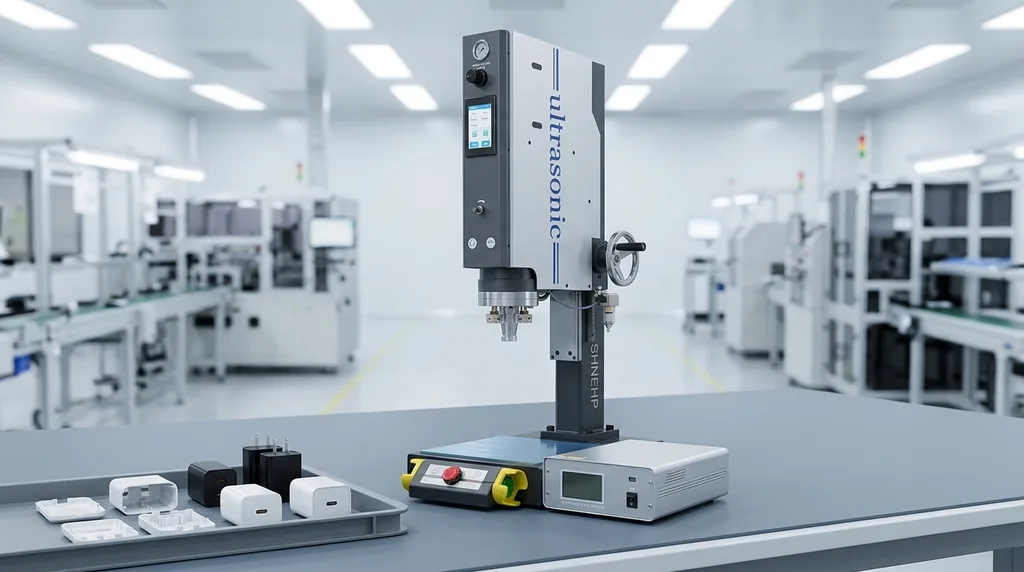
Compact GaN USB-C fast chargers, laptop power bricks, smart-home wall plugs, and travel power adapters must pass tough UL/IEC safety drop tests and electrical-insulation creepage standards while presenting a seamless, zero-flash consumer finish. Applying ultrasonic welding usb chargers fuses flame-retardant polycarbonate housing halves permanently in 0.2–0.8 seconds with zero screws, zero curing adhesives, and high-volume automated throughput. SHNEHP engineers digital ultrasonic welding platforms (XNC-400, XN-3, XN-5) with tight energy/collapse control tailored to consumer power-adapter lines.
The part and its welding challenges
Modern USB-C and GaN power-adapter enclosures are almost universally molded from UL94 V-0 flame-retardant polycarbonate (PC-FR) or PC/ABS-FR in high-gloss white, matte black, or soft-textured finishes. Sealing tightly packed high-density power electronics introduces five exacting consumer-electronics challenges:
- Passing strict UL 62368-1 / IEC drop & impact tests: Power bricks must survive repeated 1-meter hard-floor corner drops without splitting open and exposing live mains circuitry—demanding uniform 360° step-joint fusion around all four corners.
- Protecting dense GaN PCBs & transformers inside: Tightly packed SMD inductors, ceramic capacitors, and potted transformers sit millimeters behind the plastic wall; excessive low-frequency amplitude or long weld times can crack solder joints or loosen transformer cores.
- Cosmetic zero-flash, zero-scuff exterior seam: Consumers hold glossy white/matte-black chargers directly in hand; any visible flash bead, shiny horn burn ring, or stepped lid mismatch causes instant visual line rejection.
- Electrical creepage & flame-retardant PC-FR weld window: UL94 V-0 additives slightly reduce polycarbonate melt ductility, making clean stepped energy-director design and tight collapse-distance termination essential.
- Pre-drying hygroscopic PC-FR housings: Moisture-laden PC-FR shells foam along the seam and exhibit brittle drop failures unless molded fresh or dried cleanly before assembly.
Why ultrasonic welding (vs. alternatives)
| Process | Fit for USB-C chargers, GaN bricks & wall adapters | Speed, drop safety & cosmetics | Typical cycle time | Engineering boundary |
|---|---|---|---|---|
| Digital ultrasonic welding (20–35 kHz: XNC-400 / XN-3 / XN-5) | Global industry standard for UL94 V-0 PC and PC/ABS wall plugs, GaN USB-C chargers, and laptop power bricks | Sub-second permanent tamper-proof closure, UL drop toughness, crisp invisible step-joint cosmetic seam | ~0.2–0.9 s weld + hold | Keep horn-to-joint near-field (≤6 mm), use stepped tongue-and-groove joints, and tune amplitude gently to protect internal SMD components |
| Servo hot plate welding (XNS2-B) | Larger outdoor IP67/IP68 waterproof LED drivers and heavy sealed power supplies containing delicate sensors | Zero acoustic vibration, waterproof hermetic perimeter | ~18–35 s total | Too slow for high-volume consumer USB charger takt times |
| Snap-fits + adhesive / screws | Low-volume prototypes or serviceable industrial bench supplies | Re-openable | Slow labor / glue cure | Fails UL permanent-enclosure anti-tamper rules (without security screws) and adds adhesive VOC/curing cost |
Typical process window (industry ranges)
Achieving drop-proof UL safety seams without scuffing glossy PC-FR shells or shocking GaN PCBs relies on crisp stepped-joint geometry and weld-by-collapse-distance control. Exact parameters are validated during a SHNEHP weld trial.
| Parameter | Typical industry range (20 kHz / 35 kHz on UL94 V-0 PC / PC-ABS) | Engineering guidance |
|---|---|---|
| Ultrasonic frequency | 20 kHz for standard laptop bricks & multi-port GaN chargers; 30–35 kHz for ultra-compact mini USB-C plugs with tight PCB clearance | Higher frequency lowers mechanical amplitude, minimizing acoustic stress on nearby SMD ceramic capacitors |
| Joint geometry | Stepped joint (tongue-and-groove) with 0.3–0.5 mm recessed triangular energy director | Stepped joint locks both halves laterally for drop toughness and conceals weld flash completely inside the wall |
| Horn & anvil finish | Precision-contoured titanium/steel horn + polyurethane/hard-anodized non-marring anvil with AC-prong relief pockets | Keeps glossy white/black shells completely free of scuff marks and protects AC plug pins |
| Control mode | Weld-by-collapse distance + Energy/Peak Power guardrails | Guarantees flush exterior step alignment and detects pinched internal wires or shifted PCBs automatically |
| Weld / Hold duration | 0.20–0.65 s weld / 0.35–0.80 s hold | Short pulse minimizes heat transfer and acoustic exposure to internal power electronics |
Recommended SHNEHP machine and fixture setup
SHNEHP supplies precision ultrasonic welding machines engineered for consumer power-electronics assembly factories:
- High-speed benchtop & inline units: XNC-400, XN-3, and XN-5 digital ultrasonic welders feature automatic frequency tracking, amplitude stepping (high start to initiate melt, gentle finish to protect PCBs), and closed-loop collapse-distance monitoring.
- Anti-scuff AC-prong fixtures & multi-cavity automation: Custom welding and testing fixtures integrate precision AC-pin relief cavities (US, EU, UK, CN plug variants) and quick-change nest inserts—scalable into automated ultrasonic + Hi-Pot electrical test + laser-marking cells via customized machines.
Quality inspection and process control
Power-adapter lines pair 100% real-time ultrasonic telemetry with mandatory electrical safety and mechanical drop qualification:
- 100% per-shot weld monitoring: Every adapter logs collapse depth, energy (J), peak power (W), and weld time (ms); any out-of-window unit drops into a locked NG bin prior to Hi-Pot testing.
- UL/IEC drop & functional electrical checks: Inline automated testing performs 100% Hi-Pot dielectric withstand and functional load testing post-weld (confirming zero ultrasonic PCB damage), backed by periodic 1-meter hard-surface corner drop tests and seam cross-sections.
FAQ
How do you ultrasonically weld GaN USB-C chargers without damaging internal SMD components or transformers? Keep the joint strictly near-field (≤6 mm from the horn), use a crisp stepped energy director so weld time stays very short (0.2–0.5 s), apply amplitude stepping or 30–35 kHz frequency on ultra-compact chargers, and verify post-weld functional/Hi-Pot yields during a weld trial.
What joint design passes UL drop testing best for PC-FR power adapters? A stepped (tongue-and-groove) joint with an internal triangular energy director provides both strong lateral mechanical interlocking against corner-drop shear and complete visual concealment of exterior flash.
How do you prevent shiny burn rings on glossy white polycarbonate USB chargers? Use precision-contoured horns matched to the lid surface, clean non-marring protective films where required, tight parallelism shimming, and closed-loop collapse-distance stopping so energy cuts off the instant the step seats flush.
Can one SHNEHP ultrasonic welder handle US, EU, and UK plug versions of the same charger? Yes. Modular quick-change lower anvils swap prong-relief inserts in minutes while retaining the same digital ultrasonic press and saved HMI weld recipes.
What files does SHNEHP need for a USB charger ultrasonic weld trial? Send 3D STEP/X_T models showing the stepped joint and internal PCB/transformer clearances, exact UL94 V-0 PC or PC/ABS resin grade, plug variant(s), and target hourly output (UPH).
Get a free weld trial
Share your USB charger or power-adapter CAD files with SHNEHP engineering to verify cosmetic finish, stepped-joint drop toughness, and PCB-safe ultrasonic parameters on a free weld trial:
- 3D STEP / X_T / IGES models of the charger shell, lid, and internal PCB clearance
- UL94 V-0 resin grade (PC-FR, PC/ABS-FR) and surface finish (glossy/matte)
- Target hourly output (UPH) and UL/IEC drop-test requirements
Email yy@nbxiaoneng.com or connect through our contact page.
Request a Technical Consultation & Free Weld Trial
Send your 3D STEP/X_T drawing, resin grade, target cycle time, and leak-test specification. Our engineers will evaluate the joint and recommend a practical SHNEHP machine and fixture setup.