
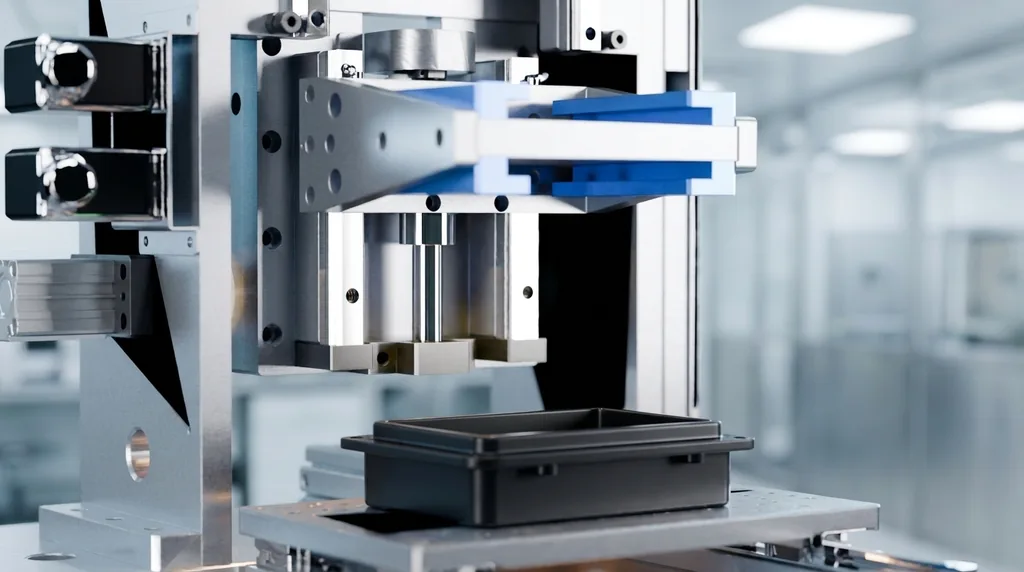
Outdoor industrial IoT gateways, 5G telecom junction boxes, EV/automotive control modules, marine instrumentation cases, and agricultural telemetry enclosures must block dust and temporary water immersion (IP67/IP68) without exposing delicate internal circuit boards to mechanical shock or adhesive fumes. Implementing hot plate welding ip67 electronics enclosures fuses perimeter flanges into a continuous, gasket-free waterproof barrier with zero high-frequency vibration near sensitive PCBs. SHNEHP builds 3-axis servo contact (XNS2-B, XNS5-B, XNS6-B) and non-contact infrared (IR) hot plate welders engineered around DVS 2215 thermal and displacement control.
The part and its welding challenges
Waterproof electronics cases are predominantly molded from polycarbonate (PC), PC/ABS, flame-retardant ABS (ABS-FR / UL94 V-0), PBT, or glass-filled nylon (PA6/PA66-GF). Sealing an enclosure that already contains populated electronics creates five distinct manufacturing constraints:
- Protecting populated PCBs from vibration & shock: Unlike ultrasonic or linear vibration welding, which can fracture ceramic SMD capacitors, crack solder joints, or delaminate wire-bonded MEMS sensors and quartz oscillators, hot plate welding applies pure thermal fusion with gentle linear closing force.
- Particulate & melt-stringing contamination: Even a single loose conductive-filler flake or charred polymer string falling onto an exposed circuit board during platen retraction can create shorts or fail cleanliness audits.
- Moisture sensitivity in hygroscopic resins: PC, PC/ABS, PBT, and PA absorb ambient humidity rapidly. Welding un-dried housings flashes trapped water into steam bubbles inside the weld line, creating microscopic leak paths that fail IP67 immersion or air-decay screening.
- Thermal clearance near electronic components: Internal heat-sensitive batteries, relays, OLED displays, and potting compounds sit millimeters from the perimeter flange; radiant heat shielding and tight melt-zone localization are essential.
- Perimeter flatness on rectangular boxes: Injection-molded rectangular covers bow inward along long straight edges; without controlled DVS 2215 bead-up leveling and vacuum-assisted support fixtures, corner joints over-compress while mid-span walls stay under-fused.
Why hot plate welding (vs. alternatives)
| Process | Fit for IP67 electronics enclosures | PCB safety & cleanliness | Typical cycle time | Engineering boundary |
|---|---|---|---|---|
| Servo hot plate — contact & non-contact IR (XNS2-B / XNS5-B / XNS6-B) | Primary choice for medium-to-large IP67/IP68 boxes, UL94 V-0 enclosures, and sensor/controller housings containing delicate PCBs | Zero mechanical vibration; non-contact IR eliminates platen contact, PTFE wear, and stringing over exposed electronics | ~20–40 s total | Pre-dry PC/PC-ABS (100–120 °C) and PA (80–90 °C); switch to non-contact IR above ~270–300 °C or GF≥40% |
| Ultrasonic welding (XNC-400) | Small, compact chargers, key fobs, and simple rigid ABS cases without fragile MEMS/crystals | Fast local cycle with minimal radiant heat | ~0.1–1.5 s | High-frequency mechanical energy risks damaging sensitive PCBs, solder joints, and wire bonds; limited to small footprints |
| Linear vibration friction (XN-15 / XN-35) | Empty sub-housings or rugged potted automotive modules with thick ribs | High mechanical weld strength | ~5–15 s total | Linear acceleration and fine particulate flash are hazardous to un-potted electronics and tight optical/sensor cavities |
| Rubber gaskets + screws / epoxy potting | Serviceable outdoor junction boxes needing field opening | Removable (gasketed) | Slow manual assembly / long cure | Gaskets compress-set over thermal cycles and add fastener BOM/labor; adhesives require curing racks and VOC handling |
Typical process window (industry ranges)
The DVS 2215 baseline below covers the core engineering plastics used in IP67 waterproof boxes. Exact soak times, IR gaps, and collapse stops are established during a SHNEHP part-specific weld trial.
| Parameter | Typical industry range (PC / PC-ABS / ABS / PBT) | Engineering guidance |
|---|---|---|
| Pre-drying before welding | PC & PC/ABS: 100–120 °C; PBT: 100–120 °C; PA-GF: 80–90 °C | Mandatory to prevent steam micro-porosity along the IP67 perimeter seam |
| Heating mode & temperature | Contact platen: ABS 235–265 °C, PC/ABS 265–295 °C, PC/PBT 275–310 °C; Non-contact IR: 300–500 °C | Switch to non-contact IR above ~270 °C PTFE ceiling, for PBT/PA-GF40+, or for strict particle-free PCB interiors |
| Bead-up / leveling (Stage 1) | 0.4–0.8 mm (contact mode) | Flattens bowed rectangular box walls prior to soak; non-contact IR uses controlled 1–2 mm emitter standoff |
| Melt / soak phase (Stage 2) | 5–18 s at 0.05–0.10 N/mm² (contact) or timed IR radiation | Localizes melt to the flange lip while shielding internal electronics |
| Changeover time (Stage 3) | ≤1.5–1.8 s (especially critical on fast-freezing PC and PBT) | High-speed 3-axis servo retraction avoids cold skin formation at box corners |
| Joining & meltdown (Stage 4) | 0.15–0.25 N/mm² to servo hard stop (1.0–2.0 mm collapse) | Enclosed double flash traps hide exterior beads and shield internal PCB clearance |
| Cooling / hold (Stage 5) | 5–14 s | Locks box flatness and prevents corner spring-back while amorphous/semi-crystalline resin solidifies |
Recommended SHNEHP machine and fixture setup
Applying our +60 mm clearance rule (platen footprint ≥ maximum housing L×W + 60 mm for clamps, ESD locators, and vacuum cups), SHNEHP matches the hot plate welding machine platform to your box dimensions and PCB sensitivity:
- Compact sensors, IoT nodes & control boxes (50–300 mm): XNS2-B or XNS5-B 3-axis servo hot plate welders offer micron-class closed-loop collapse control, multi-zone PID heaters, and compact clean-bench footprints.
- Large telecom junction boxes, smart meters & EV power modules (up to ~850×800 mm): XNS6-B, XNS8-B, or XNS9-B servo platforms weld broad rectangular flanges and internal partitioning ribs uniformly in one cycle.
- Non-contact infrared (IR) heating upgrade: Ideal for PC, PBT, UL94 V-0 flame-retardant grades, and exposed PCB assemblies—eliminating physical platen contact, PTFE coating degradation, and resin stringing.
- ESD-safe fixtures & integrated IP67 test cells: Custom welding and testing fixtures use anti-static (ESD-dissipative) nest inserts, thermal-shield baffles over sensitive components, and seamless transfer into downstream 10–30 kPa leak stations via customized machines.
Quality and leak testing
Every IP67/IP68 electronics enclosure line pairs closed-loop weld telemetry with 100% dry-air tightness verification:
- 100% inline IP67 leak verification: Welded thin-walled electronics enclosures are typically screened at 10–30 kPa (positive pressure or vacuum) against strict acceptance limits of 0.1–0.5 mL/min, using 1 Pa-resolution differential pressure testers and a 3–5 s stabilization stage to absorb thin-wall elastic creep.
- Breathable vent & sealed-box testing: Enclosures are pressurized through an open cable-gland port or ePTFE membrane port prior to final vent welding, or tested inside a close-fitting sealed test chamber when completely enclosed.
- Optical & dimensional checks: Post-weld inspection verifies flush outer flash-trap closure, zero cosmetic heat distortion on exterior labels/windows, and consistent overall housing thickness for downstream snap-in mounting brackets.
- Full MES traceability: Per-cycle logging of platen zone temperatures, changeover duration, servo meltdown depth, and differential leak-test result binds directly to the enclosure barcode.
FAQ
Why is hot plate welding safer than ultrasonic welding for electronics enclosures containing PCBs? Hot plate welding melts only the mating flange thermally and closes with controlled low-speed servo force—introducing zero high-frequency acoustic vibration that could crack ceramic capacitors, fatigue solder joints, or damage MEMS sensors and crystal oscillators.
When should IP67 electronics boxes use non-contact infrared (IR) hot plate welding? Select non-contact IR heating when welding polycarbonate (PC), PBT, PA-GF40+, or flame-retardant UL94 V-0 grades above the ~270 °C PTFE contact ceiling, or whenever exposed electronics demand strictly zero-contact, zero-stringing cleanliness.
Do PC and PC/ABS electronics enclosures need drying before hot plate welding? Yes. Polycarbonate and PC/ABS are hygroscopic; drying parts or molded lots properly (typically 100–120 °C per resin supplier guidance) prevents trapped moisture from forming steam bubbles inside the weld line that cause IP67 micro-leaks.
What air leak-test pressure validates IP67 waterproof plastic enclosures? Industry baselines use 10–30 kPa (positive or negative pressure) with 0.1–0.5 mL/min leak thresholds on a 1 Pa-resolution differential pressure tester, including a 3–5 s stabilization period so thin enclosure walls finish flexing before measurement.
What files should we send for a SHNEHP IP67 enclosure weld trial? Share frozen 3D STEP/X_T housing and cover models, resin and UL94 flame-retardant grade, clearance distance to internal PCB components, target hourly output (UPH), and IP67/IP68 leak-test specification.
Get a free weld trial
Send your enclosure CAD files to SHNEHP engineering to evaluate contact versus non-contact IR hot plate welding, flash-trap geometry, and downstream IP67 leak testing:
- Frozen 3D STEP / X_T / IGES models of the housing, cover, and PCB keep-out zones
- Resin & flame-retardant grade (PC, PC/ABS, ABS-FR, PBT, PA-GF)
- Target hourly output (UPH) and IP67/IP68 leak threshold
Email yy@nbxiaoneng.com or reach our engineers on our contact page.
Request a Technical Consultation & Free Weld Trial
Send your 3D STEP/X_T drawing, resin grade, target cycle time, and leak-test specification. Our engineers will evaluate the joint and recommend a practical SHNEHP machine and fixture setup.