
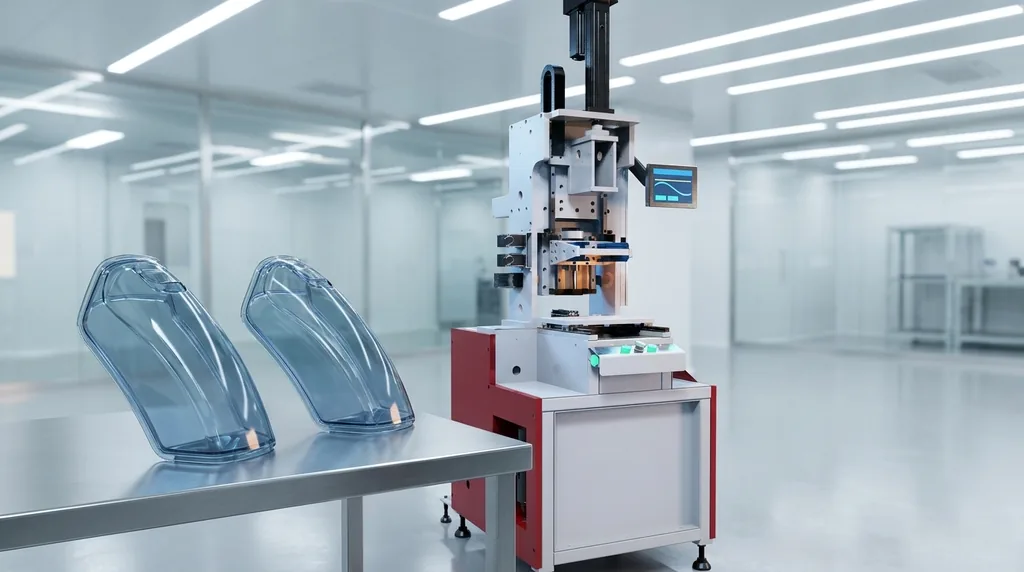
Handheld steam irons and pressurized garment-steamer base stations rely on curved, translucent thermoplastic water tanks perched directly above heated soleplates and steam boilers. Applying hot plate welding steam iron reservoirs creates a leak-proof, consumer-cosmetic perimeter seam along sculpted ergonomic contours without rubber gaskets that harden under thermal cycling or adhesives that turn cloudy in hot water. SHNEHP engineers 3-axis servo hot plate platforms (XNS2-B, XNS5-B, XNS6-B) built to DVS 2215 precision for high-volume small-appliance OEMs.
The part and its welding challenges
Steam iron and garment-steamer water reservoirs are commonly molded from transparent or tinted polypropylene (clarified PP), SAN / AS, polycarbonate (PC), ABS, or heat-resistant PA / PBT near boiler interfaces. Welding thin-walled, curved consumer-facing water tanks brings five distinct production challenges:
- Class-A translucent cosmetic visibility: Consumers inspect water levels directly through clear or smoky-tinted iron shells; any uneven melt bead, yellowing, water-vapor micro-bubbles, or visible stringing inside the tank triggers immediate cosmetic rejection.
- Complex 3D ergonomic body contours: Steam iron handles and pointed nose sections sweep along compound 3D curves; flat welding plates cannot heat the nose and heel simultaneously without CNC-contoured heating shoes.
- Thermal-shock & steam-pressure endurance: Repeated heating near the hot soleplate (60–110 °C ambient tank zone) plus pressurized steam-generator surge in base-station irons exposes any weak cold-weld spot to weeping or stress cracking.
- Thin curved walls & clamping marks: Thin 1.5–2.2 mm clear ABS/SAN/PC shells easily show gloss scuffs or micro-crazing if clamping nests lack smooth, non-marring contoured support.
- High daily appliance output: Consumer iron assembly lines demand stable 2-cavity or 4-cavity tooling with crisp repeatability and fast changeover between SKU colors.
Why hot plate welding (vs. alternatives)
| Process | Fit for steam iron & garment-steamer water tanks | 3D aesthetics & thermal sealing | Typical cycle time | Engineering boundary |
|---|---|---|---|---|
| Servo hot plate welding (XNS2-B / XNS5-B / XNS6-B) | Primary choice for 3D-curved PP, SAN/AS, PC, and ABS steam iron water reservoirs and pressurized steamer base tanks | CNC-contoured heating shoes match pointed nose/handle curves seamlessly; hidden flash traps preserve clear consumer aesthetics | ~18–35 s (2-cavity or 4-cavity tooling raises UPH) | Pre-dry PC/SAN/ABS; switch to non-contact IR if PC/PA temperature exceeds ~270 °C PTFE ceiling |
| Ultrasonic welding (XNC-400 / XN-5) | Small flat filler-cap covers, spray-nozzle inserts, or compact flat rigid SAN/ABS sub-tanks | Rapid 0.2–1.5 s local welds | ~0.2–1.5 s | Struggles with steep 3D pointed iron contours, clarified PP hermetic seams, and risks stress-crazing clear shells |
| Linear vibration friction (XN-35) | Large flat opaque base-station steamer boilers | Strong structural weld on planar PP/PA tanks | ~5–15 s total | Linear motion cannot follow pointed 3D iron-nose profiles and creates visible dust inside clear water tanks |
| Silicone gaskets + screws | Removable detachable water tanks (for external filling) | Detachable assembly | Manual screw/seal labor | Only suited to removable tank lids; permanent sealed iron bodies rely on hot plate welding to eliminate weeping and screw BOM |
Typical process window (industry ranges)
The DVS 2215 five-stage baselines below guide clarified PP, SAN/AS, ABS, and PC steam iron water reservoirs. Final parameters are confirmed during a SHNEHP part-specific weld trial.
| Parameter | Typical industry range (PP / SAN-AS / ABS / PC) | Engineering guidance |
|---|---|---|
| Pre-drying before welding | PC: 100–120 °C; SAN / ABS: 80–90 °C | Essential on clear housings to stop steam micro-bubbles clouding the weld seam |
| Heating mode & temperature | Contact platen: PP 245–275 °C, SAN/ABS 230–265 °C, PC 270–295 °C; Non-contact IR: 300–450 °C | Keep contact PTFE ≤270 °C for clean zero-yellowing surfaces; use non-contact IR for optical PC or PA grades |
| Bead-up / leveling (Stage 1) | 0.4–0.8 mm displacement | Levels molded curvature variation along pointed iron noses and curved handles |
| Melt / soak phase (Stage 2) | 5–14 s at 0.05–0.09 N/mm² | Balanced PID thermal zones prevent overheating thin pointed tips while fully melting wider heel sections |
| Changeover time (Stage 3) | ≤1.5–2.2 s (≤1.5 s for PC/SAN, ≤2.2 s for PP) | Rapid 3-axis servo retraction stops cold-weld lines in sharp nose corners |
| Joining & collapse (Stage 4) | 0.14–0.25 N/mm² to closed-loop servo hard stop (1.0–1.8 mm) | Closed-loop servo stop guarantees clean step-free mating with outer decorative iron trim |
| Cooling / hold (Stage 5) | 5–12 s | Lets clear amorphous shells solidify stress-free before gentle fixture release |
Recommended SHNEHP machine and fixture setup
SHNEHP configures compact and mid-size 3-axis servo hot plate welding machines tailored to small-appliance assembly lines:
- Single & twin-cavity handheld iron tanks: XNS2-B and XNS5-B 3-axis full-servo hot plate welders offer crisp displacement repeatability, fast servo changeover, and compact assembly-line footprints.
- 4-cavity high-volume or steamer base-station tanks: XNS6-B servo platform (sized using our +60 mm fixture clearance rule) runs multi-cavity contoured nests to keep pace with high-volume consumer appliance lines.
- Scratch-free cosmetic tooling: Custom welding and testing fixtures feature smooth polyurethane/acetal contour cradles that protect glossy tinted shells, precision 3D CNC-machined PTFE heating blocks, and quick-change nest plates.
- Integrated inline testing cells: Pair hot plate welding with twin-nest pneumatic leak testers on customized machines for 100% leak-free shipping.
Quality and leak testing
Steam iron reservoirs undergo 100% dry-air inline leak verification plus periodic thermal-shock endurance checks:
- 100% inline pneumatic pressure-decay testing: Handheld steam iron tanks are commonly screened at 20–60 kPa (and pressurized garment-steamer base tanks at 100–300 kPa) across a 4-stage Fill → Stabilize (2–5 s) → Test → Exhaust cycle—with a short cooling buffer after welding so residual heat does not trigger false rejects.
- Cosmetic & optical seam inspection: Grazing-light visual checks verify clean, uniform flash-trap closure, zero yellowing or bubbles inside transparent walls, and crisp step-free fit with external housing trim.
- Hot-water thermal-shock & drop testing: Batch audits perform boiling-water fill cycles, pressurized burst sampling, and consumer drop tests to confirm long-term weld toughness.
FAQ
How do you weld transparent SAN or PC steam iron water tanks without yellowing or internal bubbles? Pre-dry transparent SAN/ABS (80–90 °C) and PC (100–120 °C) thoroughly, maintain clean PTFE contact temperatures below ~270 °C (or switch to non-contact IR for PC), keep servo changeover ≤1.5 s, and enclose the weld bead inside a stepped flash trap.
Can servo hot plate welding handle the sharp 3D pointed nose of a steam iron reservoir? Yes. CNC-machined 3D contoured heating platens follow the pointed nose and handle sweeps accurately, while independent PID heating zones keep the narrow tip from overheating relative to the broader heel.
Why use hot plate welding instead of ultrasonic welding for clarified PP steam iron tanks? Semi-crystalline clarified polypropylene absorbs ultrasonic vibrations over steep 3D curves, making consistent hermetic seams difficult. Servo hot plate welding fuses the full 3D perimeter evenly with strong thermal-shock resistance.
What leak-test pressure is typical for steam iron water tanks? Gravity-fed handheld steam iron reservoirs are commonly air-tested at 20–60 kPa with 2–5 s stabilization, while pressurized steam-generator base reservoirs test at 100–300 kPa (1–3 bar) using locking pneumatic fixtures.
What files does SHNEHP need for a steam iron reservoir weld trial? Send 3D STEP/X_T models of both tank shells, exact resin grade (clarified PP, SAN/AS, PC, ABS, PA), cosmetic transparent zones, target hourly output (UPH), and leak-test pressure criteria.
Get a free weld trial
Send your steam iron or garment-steamer tank CAD models to SHNEHP engineering to evaluate 3D-contoured multi-cavity tooling, cosmetic flash-trap geometry, and inline leak testing:
- 3D STEP / X_T / IGES models of the reservoir halves and fill/steam ports
- Polymer grade & clarity spec (clarified PP, SAN/AS, PC, ABS, PA)
- Target hourly output (UPH) and inline leak-test pressure
Email yy@nbxiaoneng.com or reach our team on our contact page.
Request a Technical Consultation & Free Weld Trial
Send your 3D STEP/X_T drawing, resin grade, target cycle time, and leak-test specification. Our engineers will evaluate the joint and recommend a practical SHNEHP machine and fixture setup.