
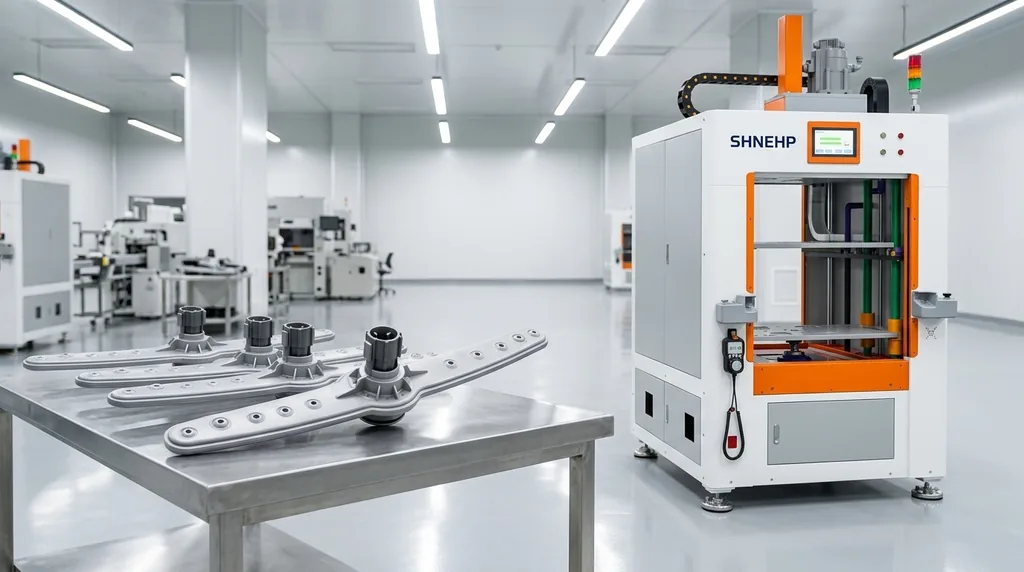
Dishwasher upper, middle, and lower rotary spray arms distribute pressurized 70–85 °C alkaline detergent jets across racks over thousands of daily wash cycles. Choosing hot plate welding dishwasher spray arms joins long, slender, S-curved or multi-blade upper and lower polypropylene arm halves along their entire 350–550 mm perimeter while keeping directional spray nozzles completely free of molten flash. SHNEHP engineers 3-axis servo hot plate platforms (XNS5-B, XNS6-B, XNS8-B) with multi-cavity tooling engineered to DVS 2215 displacement control for high-volume home-appliance OEMs.
The part and its welding challenges
Dishwasher spray arms are typically molded from heat- and detergent-stabilized talc-filled polypropylene (PP-TD20 / PP-TD30), glass-filled PP (PP-GF20), or homopolymer PP to resist boiling-water creep and chemical stress cracking. Welding long, hollow thin-walled appliance spray arms presents five stubborn production hurdles:
- Long slender molding warpage & bow: 400–550 mm hollow spray-arm halves bow along their length after injection molding; without full-length vacuum/mechanical clamping and controlled DVS 2215 bead-up leveling, arm tips under-melt while the center hub over-compresses.
- Zero flash clogging angled spray nozzles: Internal flash squeezed into narrow water channels breaks off during household wash cycles and plugs directional spray jets—or slows hydraulic jet rotation speed.
- Uniform outer cosmetic seam: Consumers directly touch and remove dishwasher spray arms for routine cleaning; sharp exterior flash burrs or mismatched step alignment fail appliance OEM tactile and visual audits.
- Center bearing-hub concentricity: The central rotational bearing socket must stay strictly perpendicular and free of weld flash so the spray arm spins freely at low pump pressure without binding.
- High-volume multi-cavity takt time: Appliance factories produce hundreds of thousands of spray arms per model year, requiring 2-cavity to 4-cavity tooling nests with rapid changeover and ergonomic dual-hand or robotic loading.
Why hot plate welding (vs. alternatives)
| Process | Fit for dishwasher spray arms | Seam geometry & hydraulic cleanliness | Typical cycle time | Engineering boundary |
|---|---|---|---|---|
| Servo hot plate welding (XNS5-B / XNS6-B / XNS8-B) | Industry standard for long curved PP, PP-TD, and PP-GF dishwasher spray arms and multi-arm appliance families | Follows straight, S-curved, or 3D-contoured blades uniformly; enclosed double flash traps protect inner water jets and outer hand-feel | ~22–38 s (2-cavity or 4-cavity fixtures multiply UPH) | Keep wall ≥1.5–2.0 mm and fast servo changeover ≤2.5 s for PP |
| Linear vibration friction (XN-55 / XN-70) | Strictly flat planar spray arms with heavy sidewalls | Fast 5–15 s cycle on flat profiles | ~5–15 s total | Linear motion struggles on narrow curved blades without sidewall flexing and risks loose vibration fuzz clogging tiny spray nozzles |
| Ultrasonic welding (XNC-400) | Small center hub snap caps or tiny auxiliary rinse nozzles | Rapid local welds | ~0.2–1.5 s | Cannot weld 400–550 mm semi-crystalline PP hydraulic arms hermetically in one shot |
| Snap-fit mechanical clips | Low-cost budget spray arms | No welding equipment | Fast snap assembly | Leaks hydraulic pressure along the seam, lowers jet spray force, and splits open under hot-water thermal creep |
Typical process window (industry ranges)
The conservative DVS 2215 five-stage baselines below cover PP, PP-TD20/30, and PP-GF20 dishwasher spray arms. Final heating profiles and collapse stops are confirmed during a SHNEHP part-specific weld trial.
| Parameter | Typical industry range (PP / PP-TD / PP-GF) | Engineering guidance |
|---|---|---|
| Platen face temperature | 245–280 °C (PTFE-coated contact heating blocks) | Multi-zone PID heating balances narrow outer nozzle tips against the thicker center bearing hub |
| Bead-up / leveling (Stage 1) | 0.5–0.9 mm displacement | Straightens longitudinal molding bow across the full 400–550 mm arm span |
| Melt / soak phase (Stage 2) | 6–15 s at 0.05–0.10 N/mm² | Uniform viscous melt ensures full-perimeter fusion without thinning delicate nozzle walls |
| Changeover time (Stage 3) | ≤1.8–2.5 s | Fast 3-axis servo retraction prevents tip cooling on slender outer blades |
| Joining & meltdown (Stage 4) | 0.15–0.28 N/mm² to closed-loop servo hard stop (1.2–2.2 mm) | Hard servo stop protects overall arm height and keeps molten bead inside enclosed flash traps |
| Cooling / hold (Stage 5) | 6–14 s under clamping load | Locks arm straightness and eliminates post-weld bow after demolding |
| Multi-cavity cycle time | ~22–38 s for 2–4 spray arms per cycle | Delivers high appliance-line UPH with minimal operator labor |
Recommended SHNEHP machine and fixture setup
Applying our +60 mm clearance rule (effective platen length ≥ longest spray arm + 60 mm for end locators and vacuum clamps), SHNEHP sizes hot plate welding machines specifically for white-goods appliance lines:
- 2-cavity standard spray arms (up to ~600 mm length): XNS6-B 3-axis full-servo hot plate welder delivers balanced twin-leadscrew parallelism, multi-zone PID control, and micron-class collapse stops across slender arms.
- 4-cavity high-volume or long commercial arms (up to ~840 mm length): XNS8-B servo platform runs four spray arms simultaneously (or twin upper + lower arm sets together) in one stroke.
- Anti-bow vacuum/mechanical tooling: Custom welding and testing fixtures integrate full-length contoured aluminum cradles, center-hub concentricity mandrels, and quick-change fixture cartridges so appliance lines switch dishwasher models in minutes.
- Automated appliance cells: Pair servo hot plate welding with robotic unloading, inline nozzle-flow/leak checking, and automatic sorting via customized machines.
Quality and leak testing
Because spray arms deliberately feature open jet nozzles, inline testing combines seam leak verification (with nozzles plugged) and nozzle flow/occlusion verification:
- 100% inline pressure-decay seam check: Silicone pads seal the spray jets temporarily while the center hub is pressurized at 30–100 kPa across a 4-stage Fill / Stabilize (2–4 s) / Test / Exhaust cycle to confirm zero perimeter seam leakage.
- Nozzle flow & back-pressure check: Unplugged air-flow testing immediately verifies that no internal weld flash obstructed any spray jet or narrowed the hub passage.
- Hot-water burst & detergent-soak audits: Periodic lot audits subject welded arms to 85 °C pressurized hot-water endurance cycles, drop-impact testing, and cross-section bead inspection.
FAQ
How do you weld 450–550 mm long dishwasher spray arms without warping or weak tips? Use full-length contoured holding fixtures with vacuum or perimeter clamping to straighten molded bow before melting, divide the heating platen into independent PID zones (center hub vs. narrow tips), and run fast 3-axis servo changeover (≤2.5 s).
How do you prevent plastic weld flash from blocking dishwasher spray arm nozzles? Mold a recessed inner flash trap along the blade perimeter, keep nozzle openings set back slightly from the weld rib, and use closed-loop servo meltdown stops so excess bead volume stays strictly predictable.
Can one SHNEHP hot plate welder run both upper and lower dishwasher spray arms in the same cycle? Yes. On XNS6-B or XNS8-B platforms, multi-cavity fixtures can run either 2–4 identical arms or a matched set (upper + lower spray arm) simultaneously with independent thermal zones.
How do you leak-test a dishwasher spray arm that has open water-jet holes? Inline testing fixtures clamp soft silicone sealing pads over the jet holes to verify perimeter weld airtightness via air decay, then release the pads for an instant air-flow back-pressure check confirming every jet is 100% unobstructed.
What files should we send for a SHNEHP dishwasher spray arm weld trial? Share 3D STEP/X_T models of both arm halves, exact PP/PP-TD/PP-GF resin grade, overall arm length, desired cavity count or target hourly output (UPH), and seam-leak/flow specs.
Get a free weld trial
Send your dishwasher spray arm CAD files to SHNEHP engineering to design multi-cavity anti-bow tooling, optimize flash-trap geometry, and validate cycle time on a physical weld trial:
- 3D STEP / X_T / IGES models of upper and lower spray arm shells
- Polymer grade & filler (PP, PP-TD20/30, PP-GF20)
- Target hourly output (UPH) and multi-cavity family lineup
Email yy@nbxiaoneng.com or connect via our contact page.
Request a Technical Consultation & Free Weld Trial
Send your 3D STEP/X_T drawing, resin grade, target cycle time, and leak-test specification. Our engineers will evaluate the joint and recommend a practical SHNEHP machine and fixture setup.