
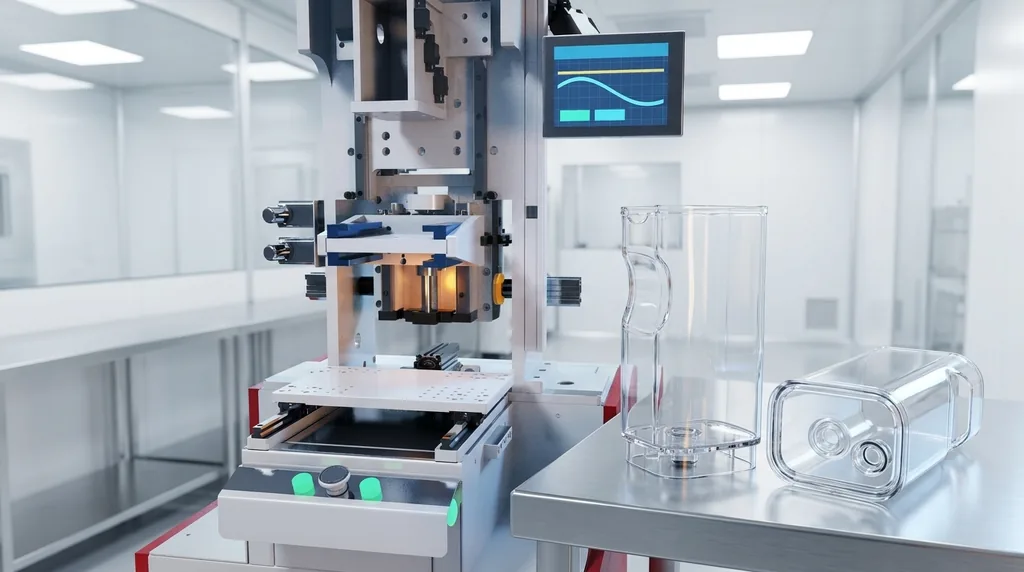
Countertop espresso machines, single-serve capsule brewers, and commercial bean-to-cup coffee stations use crystal-clear removable water reservoirs, internal pre-heating chambers, and integrated float-valve manifolds that sit directly in consumer kitchens. Selecting hot plate welding coffee machine tanks joins food-contact thermoplastic halves into a smooth, odor-free, watertight vessel with zero solvent adhesives, zero bacterial-trap crevices, and crisp consumer aesthetics. SHNEHP engineers 3-axis servo hot plate platforms (XNS2-B, XNS5-B, XNS6-B) built to DVS 2215 precision for kitchen-appliance OEMs.
The part and its welding challenges
Coffee-maker water tanks and internal brew chambers are typically molded from BPA-free food-contact polymers including SAN / AS, copolyester (PCTG / Tritan), food-grade PP, ABS, or PSU/PES for high-temperature internal brew blocks. Joining kitchen-grade transparent water tanks brings five key manufacturing challenges:
- Food-contact hygiene & crevice-free interiors: Uncontrolled inner flash creates rough overhangs where limescale, biofilm, and coffee-water mineral deposits accumulate; enclosed stepped flash traps keep wetted surfaces smooth and easy to rinse.
- Crystal clarity without stress crazing: Transparent SAN and PCTG reservoirs reveal yellowing, haze, or hairline stress cracks immediately under countertop lighting if heating overshoots or clamping loads pinch curved walls.
- Internal float-magnet cages & filter docks: Many coffee tanks incorporate internal water-level reed-switch float guides, anti-scale filter cartridges, and spring-loaded bottom outlet valves that must align cleanly without thermal distortion.
- Dishwasher & descaling chemical durability: Removable tanks endure warm soapy washing and acidic citric/lactic descaling solutions; weak cold-weld seams craze or leak rapidly under chemical + thermal stress.
- Consistent exterior dimensional fit: Removable tanks slide directly into tight-tolerance slots on the espresso machine chassis; closed-loop servo weld collapse must hold exact overall tank width and height so the bottom check-valve engages without dripping.
Why hot plate welding (vs. alternatives)
| Process | Fit for coffee machine water tanks & brew chambers | Hygiene & clear-part cosmetics | Typical cycle time | Engineering boundary |
|---|---|---|---|---|
| Servo hot plate welding (XNS2-B / XNS5-B / XNS6-B) | Primary choice for contoured SAN, PCTG, PP, and ABS coffee water reservoirs, curved wrap-around tanks, and internal valve manifolds | Adhesive-free food-contact fusion; closed-loop servo stops hold tight chassis slide-in dimensions; clean flash-trap concealment | ~18–35 s (2-cavity nests multiply output) | Pre-dry PCTG/SAN/ABS cleanly; keep PTFE contact ≤270 °C (switch to non-contact IR for high-temp PSU/PES brew blocks) |
| Linear vibration friction (XN-35 / XN-55) | Thick opaque internal PP/PA coffee brew manifolds or large commercial machine reservoirs | Fast 5–15 s high-strength structural seam | ~5–15 s total | Linear motion creates fine particulate fuzz inside transparent potable water tanks and cannot follow deep 3D curved profiles |
| Ultrasonic welding (XNC-400 / XN-5) | Small spring-valve seats, float-cage caps, and compact rigid ABS/SAN sub-parts | Sub-second local welds | ~0.2–1.5 s | Struggles with large 200–350 mm curved tanks and risks crazing clear SAN/PCTG walls under acoustic stress |
| Silicone seals + screws | Heavy commercial stainless-steel boilers | Serviceable | Manual assembly labor | Adds gasket aging, taste/odor transfer risks, and crevice cleaning issues in consumer countertop reservoirs |
Typical process window (industry ranges)
The conservative DVS 2215 five-stage baselines below cover SAN/AS, PCTG (Tritan), food-grade PP, and ABS coffee-machine reservoirs. Exact heating profiles and collapse stops are confirmed during a SHNEHP part-specific weld trial.
| Parameter | Typical industry range (SAN / PCTG / PP / ABS) | Engineering guidance |
|---|---|---|
| Pre-drying before welding | PCTG (Tritan): 70–85 °C; SAN / ABS: 80–90 °C | Eliminates moisture bubbles and haze along transparent tank walls |
| Heating mode & temperature | Contact platen: SAN/PCTG 230–265 °C, ABS 235–265 °C, PP 245–275 °C; Non-contact IR: 300–450 °C (for PSU/PES) | Controlled low-char thermal profiles preserve crystal clarity and food-contact purity |
| Bead-up / leveling (Stage 1) | 0.4–0.8 mm displacement | Compensates for molded rim warp on tall, deep-drawn clear tanks |
| Melt / soak phase (Stage 2) | 5–14 s at 0.05–0.09 N/mm² | Uniform melt film seals curved walls and internal valve bosses simultaneously |
| Changeover time (Stage 3) | ≤1.5–2.2 s (≤1.6 s for SAN/PCTG, ≤2.2 s for PP) | Rapid 3-axis servo retraction stops surface skinning and maintains transparent joint clarity |
| Joining & collapse (Stage 4) | 0.14–0.24 N/mm² to closed-loop servo hard stop (1.0–1.8 mm) | Exact final height ensures leak-free seating onto the espresso machine base valve |
| Cooling / hold (Stage 5) | 5–12 s | Relieves clamping stress before demolding to prevent chemical stress crazing |
Recommended SHNEHP machine and fixture setup
SHNEHP applies our +60 mm clearance rule across our servo hot plate welding machine platforms for kitchen-appliance production:
- Compact single-serve brewer tanks: XNS2-B and XNS5-B 3-axis full-servo hot plate welders offer smooth servo deceleration, multi-zone PID stability, and spotless low-footprint operation.
- Large wrap-around espresso tanks & twin-cavity lines: XNS6-B servo platform supports 2-cavity tooling or tall deep-drawn water reservoirs with generous vertical daylight stroke.
- Optical-safe scratch-free tooling: Custom welding and testing fixtures use non-marring polyurethane/acetal contour cradles, vacuum holding nests that never scuff clear PCTG/SAN surfaces, and precision valve-port locating pins.
- Inline weld & leak-test automation: Combine hot plate welding with automated dry-air leak testing and bottom-valve seating checks via customized machines.
Quality and leak testing
Coffee-machine water reservoirs combine 100% dry-air inline airtightness testing with consumer durability validation:
- 100% inline dry-air pressure-decay testing: Atmospheric countertop water tanks are commonly tested at 15–50 kPa (and pressurized internal brew chambers at 100–300 kPa) across a 4-stage Fill → Stabilize (3–5 s) → Test → Exhaust sequence using soft silicone sealing pads over the fill lid and outlet valve, paired with a post-weld cooling buffer to prevent thermal false rejects.
- Visual clarity & crevice audit: Backlit inspection confirms transparent seams are bubble-free, non-yellowed, and completely enclosed within inner/outer flash traps.
- Descaler chemical & thermal-shock testing: Lot samples undergo warm citric-acid descaler immersion, hot/cold thermal cycling, and drop testing to verify zero environmental stress cracking.
FAQ
Can BPA-free copolyester (PCTG / Tritan) and SAN coffee tanks be hot plate welded clearly without hazing? Yes. Pre-dry parts per resin supplier guidance (70–90 °C), hold clean PTFE platen temperatures in a disciplined 230–265 °C window, minimize servo changeover time (≤1.6 s), and cradle clear walls in non-marring polyurethane fixtures.
How do you keep coffee machine tank interiors smooth so limescale and biofilm do not collect on the weld seam? Design a stepped inner flash trap (tongue-and-groove lip) so displaced molten resin flows into a sealed hidden pocket rather than protruding into the wetted water chamber, controlled precisely by a 3-axis servo collapse stop.
When should a coffee maker tank use hot plate welding versus vibration welding? Choose servo hot plate welding (XNS2-B / XNS5-B / XNS6-B) for transparent SAN/PCTG/PP removable tanks and curved housings where particulate-free cleanliness and aesthetics are essential. Use linear vibration welding (XN-35 / XN-55) only for thick opaque internal structural brew blocks or commercial reservoirs.
What leak-test pressure is recommended for removable coffee-maker water tanks? Unpressurized removable water tanks are typically screened with dry air at 15–50 kPa (3–5 s stabilization to absorb thin-wall flex), while pressurized internal espresso pre-heating chambers test at 100–300 kPa using locking fixtures.
What files does SHNEHP need for a coffee machine tank weld trial? Share 3D STEP/X_T models of both reservoir halves, exact food-contact resin grade (SAN, PCTG/Tritan, PP, ABS, PSU), optical cosmetic zones, target UPH, and leak-test specification.
Get a free weld trial
Share your coffee-maker reservoir CAD files with SHNEHP engineering to verify crystal-clear joint cosmetics, hidden flash-trap geometry, and inline dry-air leak testing:
- 3D STEP / X_T / IGES models of the tank halves, float guides, and valve ports
- Food-contact resin grade (SAN/AS, PCTG/Tritan, PP, ABS, PSU)
- Target hourly output (UPH) and leak-test criteria
Email yy@nbxiaoneng.com or connect through our contact page.
Request a Technical Consultation & Free Weld Trial
Send your 3D STEP/X_T drawing, resin grade, target cycle time, and leak-test specification. Our engineers will evaluate the joint and recommend a practical SHNEHP machine and fixture setup.