
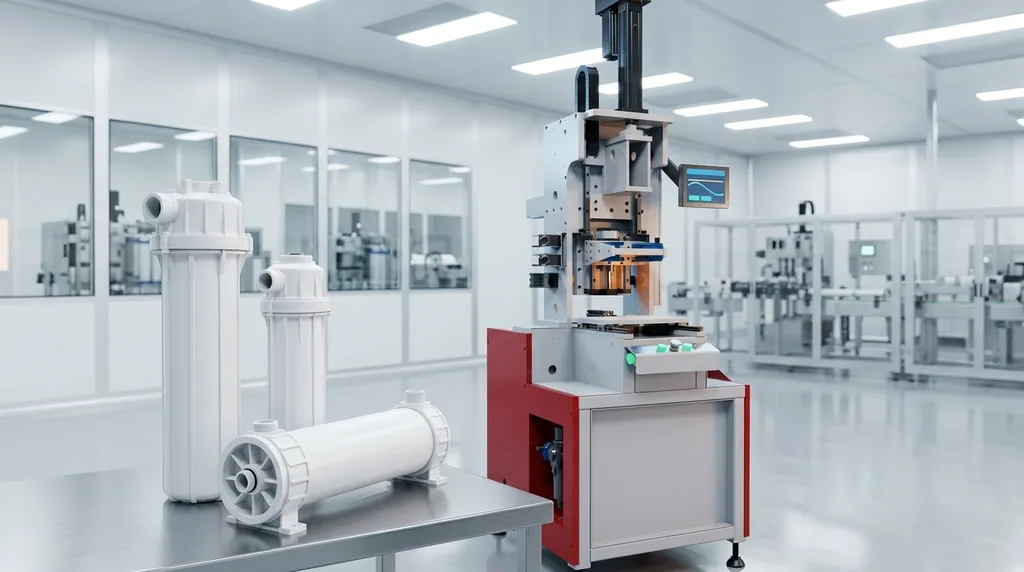
Under-sink potable filtration cartridges, refrigerator inline canisters, whole-house sediment bowls, and commercial manifold heads operate continuously under municipal line pressure and hydraulic water-hammer spikes. Choosing hot plate welding water filter housings gives filtration OEMs a hermetic, adhesive-free polymer seam that resists cyclic pressure fatigue while sealing asymmetrical ports, mounting brackets, and internal flow dividers in one controlled operation. SHNEHP builds 3-axis servo hot plate platforms (XNS2-B, XNS5-B, XNS6-B) engineered to DVS 2215 precision for high-volume water-treatment production.
The part and its welding challenges
Residential and commercial water filter canisters are commonly molded from food-contact polypropylene (PP homopolymer or copolymer), glass-reinforced PP (PP-GF20/30), transparent SAN / AS (styrene-acrylonitrile) bowls, or ABS. Welding pressurized potable-water components introduces five strict engineering demands:
- Municipal pressure & water-hammer endurance: Household and commercial supply lines subject filter seams to constant static load plus thousands of hydraulic shock pulses; any cold-weld pocket or air entrapment along the joint initiates premature stress cracking.
- Potable-water cleanliness & zero loose flash: Excess molten bead squeezed into the wetted interior can detach into drinking-water streams or obstruct filter media seats, so enclosed inner flash traps are mandatory.
- Asymmetrical ports and internal baffles: Inline filter heads and dual-stage manifolds combine offset inlet/outlet quick-connect ports, bypass valves, and internal partition walls that cannot be rotated relative to each other.
- Transparent SAN / AS clarity and stress control: Clear filter sumps reveal cosmetic yellowing, bubbles, or internal weld-zone crazing immediately if heating temperatures overshoot or clamping loads distort the thin bowl wall.
- Wall thickness & mold-parting ovality: Deep-drawn cylindrical filter sumps frequently cool slightly out-of-round after injection molding; tooling must center and round the rim accurately before melting starts.
Why hot plate welding (vs. alternatives)
| Process | Fit for water filter housings | Geometry & hygiene control | Typical cycle time | Engineering boundary |
|---|---|---|---|---|
| Servo hot plate welding (XNS2-B / XNS5-B / XNS6-B) | Primary choice for non-round housings, oriented inlet/outlet ports, internal baffle manifolds, and multi-cavity high-burst PP/SAN sumps | Seals outer shell and internal divider walls simultaneously; enclosed flash traps keep potable water paths clean | ~25–45 s (multi-cavity nests multiply output) | Requires uniform wall thickness ≥1.5–2.0 mm and fast servo changeover ≤2.5 s |
| Spin welding (XNX-100 / XNX-200) | Fastest option for purely circular symmetrical filter canisters without angular orientation | Extremely strong circular hermetic seam at 3–15 m/s surface speed (Dukane standard 9–15 m/s) | ~0.5–3 s weld | Strictly limited to rotationally symmetrical circular joints; cannot weld offset ports unless servo-angular-indexed |
| Linear vibration friction (XN-35 / XN-55) | Thick-walled industrial manifold blocks and PA-GF/PP-GF commercial filter heads | High burst strength on rigid rectangular or large housings | ~5–15 s total | Linear oscillation can generate fine particulate fuzz inside potable channels; requires ≥2.5–3.0 mm clearance |
| Ultrasonic welding (XNC-400) | Small refrigerator cartridges, end-cap screens, and thin-wall disposable filters | Rapid, clean local welds on amorphous ABS/SAN | ~0.1–1.5 s | Struggles with thick semi-crystalline PP pressure vessels requiring high cyclic burst safety factors |
Typical process window (industry ranges)
The DVS 2215 five-stage ranges below provide a disciplined starting baseline for PP, SAN/AS, and ABS filter housings. Exact parameters are validated during a SHNEHP part-specific weld trial.
| Parameter | Typical industry range (PP / SAN / ABS) | Engineering guidance |
|---|---|---|
| Platen face temperature | PP / PP-GF: 245–280 °C; SAN / AS: 230–265 °C; ABS: 235–270 °C | Stay below ~270 °C for PTFE anti-stick longevity; switch to non-contact IR if high-temp/high-GF grades exceed PTFE limits |
| Bead-up / leveling (Stage 1) | 0.5–1.0 mm displacement | Removes rim ovality and warpage across deep-drawn filter sumps |
| Melt / soak phase (Stage 2) | 6–18 s at 0.05–0.10 N/mm² | Establishes uniform melt depth around both perimeter wall and internal flow ribs |
| Changeover time (Stage 3) | ≤1.5–2.5 s (≤1.8 s for SAN/ABS, ≤2.5 s for PP) | Rapid 3-axis servo platen retraction prevents surface skinning before fusion |
| Joining & meltdown (Stage 4) | 0.15–0.30 N/mm² to hard servo displacement stop (1.5–2.5 mm) | Closed-loop servo stop guarantees repeatable finished canister height for snap-in brackets |
| Cooling / hold (Stage 5) | 6–15 s | Locks molecular entanglement before fixture release to prevent micro-cracking under clamp recoil |
| Total cycle time | ~25–45 s per cycle (2-cavity or 4-cavity tooling raises UPH) | Paired with multi-cavity fixtures for high-volume cartridge production |
Recommended SHNEHP machine and fixture setup
SHNEHP sizes every hot plate welding machine using our +60 mm fixture margin rule (effective platen dimensions ≥ total part/multi-cavity nest footprint + 60 mm for centering rings, clamps, and guides):
- Single-cavity inline canisters & small cartridges: XNS2-B or XNS5-B compact 3-axis servo hot plate welders deliver tight displacement repeatability and multi-zone PID stability for thin-wall SAN, ABS, and PP bowls.
- Multi-cavity residential filters & commercial manifold housings: XNS6-B or XNS8-B servo platforms accommodate 2-cavity to 4-cavity tooling nests in one stroke, balancing hot-plate cycle time against high daily output targets.
- Circular canister alternative: When a cartridge body and end-cap are strictly axisymmetric without offset manifolds, compare against SHNEHP XNX-100 / XNX-200 spin welding machines (Ø12–450 mm) for sub-3-second fusion speed.
- Custom rounding fixtures & inline leak stations: Purpose-built welding and testing fixtures feature self-centering collets to correct molded bowl ovality, quick-change PTFE heating shoes, and integrated downstream pneumatic leak stations on customized machines.
Quality and leak testing
Potable water filter manufacturers combine 100% inline airtightness screening with periodic hydraulic destruction audits:
- 100% inline pressure-decay testing: Water filter and valve housings are typically tested at 100–300 kPa (1.0–3.0 bar) with pass/fail leak limits around 1–5 mL/min, running a four-stage Fill → Stabilize (2–5 s) → Test → Exhaust sequence.
- High-pressure fixture clamping: Because 1.0–3.0 bar internal air pressure generates significant axial blow-off force across wide canister cross-sections, test fixtures incorporate heavy pneumatic locking cylinders and soft polyurethane port plugs to prevent seal slip.
- Thermal stabilization discipline: Testing hot welded canisters immediately out of the hot plate introduces air-temperature drift; adding a short cooling conveyor buffer or verifying repeatability on a golden non-porous master eliminates false rejects.
- Lot hydrostatic burst & cyclic fatigue audits: Sampled housings undergo pressurized water burst testing and multi-thousand-cycle water-hammer endurance tests (aligned with NSF/ANSI 42/53 structural test protocols) plus weld-seam microtome cross-sections.
FAQ
Should water filter housings be hot plate welded or spin welded? Use hot plate welding (XNS2-B / XNS5-B / XNS6-B) whenever the housing has non-circular geometry, internal divider baffles, mounting brackets, or angularly oriented inlet/outlet ports. Choose spin welding (XNX-100 / XNX-200) when both mating parts are purely circular and rotational speed (0.5–3 s weld) is the top priority.
How do you stop plastic weld flash from entering the clean water side of a filter housing? Design an enclosed inner flash trap (recessed step or tongue-and-groove lip) into the injection mold so displaced melt flows into a sealed pocket, and hold exact meltdown depth via closed-loop servo displacement stops.
Can transparent SAN / AS water filter bowls be hot plate welded without yellowing or crazing? Yes. Keep platen temperatures in a controlled 230–265 °C window with clean PTFE-coated heating shoes, minimize changeover time (≤1.8 s), and use soft, even-pressure radial clamping nests so residual clamping stress does not craze the clear bowl.
What leak-test pressure is standard for plastic water filter housings? Inline dry-air decay fixtures typically test water filter housings at 100–300 kPa (1.0–3.0 bar) with rejection limits of 1–5 mL/min, backed by periodic wet hydrostatic burst and cyclic water-hammer tests.
What files should we prepare for a SHNEHP water filter weld trial? Share 3D STEP/X_T models of the bowl and head, exact resin grade (e.g., food-grade PP, PP-GF20, SAN, ABS), cavity count or target hourly output (UPH), and required burst and inline leak-test pressures.
Get a free weld trial
Send your filter housing drawings to SHNEHP engineering to compare multi-cavity servo hot plate welding versus spin welding and review joint flash-trap design before tooling:
- 3D STEP / X_T / IGES models of the sump, cap, and internal flow paths
- Polymer grade & food-contact spec (PP, PP-GF, SAN/AS, ABS)
- Target hourly output (UPH), inline leak-test pressure (100–300 kPa), and burst target
Email yy@nbxiaoneng.com or connect through our contact page.
Request a Technical Consultation & Free Weld Trial
Send your 3D STEP/X_T drawing, resin grade, target cycle time, and leak-test specification. Our engineers will evaluate the joint and recommend a practical SHNEHP machine and fixture setup.