
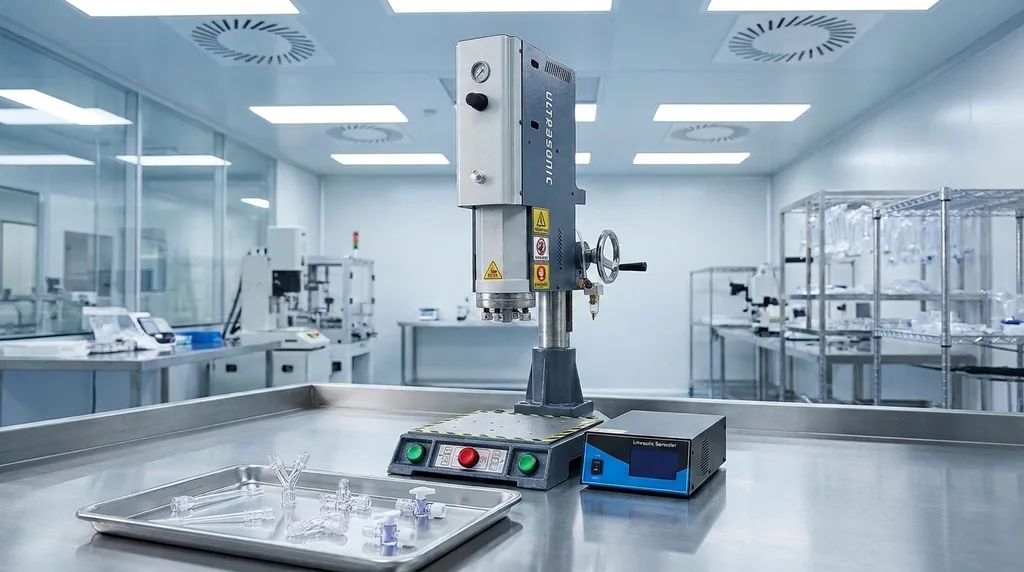
Medical Luer-lock hubs, needle-free injection valves, catheter Y-connectors, stopcock manifolds, and micro-bore check valves are produced in tens of millions of single-use units per year where every miniature joint must hold sterile fluid pressure without solvents, adhesive curing ovens, or lumen occlusion. Applying ultrasonic welding medical catheters luer parts delivers clean, localized molecular fusion in 0.1–1.0 seconds with micron-scale collapse repeatability. SHNEHP engineers precision ultrasonic welding platforms (XNC-400, XN-3, XN-5) with digital amplitude control, servo/precision collapse modes, and tuned titanium horns built for miniature medical connectors.
The part and its welding challenges
Rigid medical catheter hubs, Luer fittings, and stopcock bodies are typically molded from amorphous polycarbonate (PC), ABS / MABS, acrylic (PMMA), polysulfone (PSU), or rigid PP / HDPE (note: flexible PVC/PU/silicone catheter tubing itself is bonded/tipped via RF, thermal tipping, or adhesive—ultrasonic welding joins the rigid thermoplastic hub halves, valve housings, caps, and check-valve retainers). Miniature medical connectors pose five demanding technical challenges:
- Protecting the 6% Luer taper (ISO 80369-7 geometry): Excessive horn clamping force or high-amplitude low-frequency energy can ovalize or scar precision male/female Luer tapers, causing downstream hospital syringe leaks.
- Zero flash inside micro-bore fluid lumens: Catheter hubs and Y-connectors contain 1–3 mm internal channels; an oversized energy director or uncontrolled collapse squeezes molten bead straight into the fluid bore, restricting flow or shedding emboli.
- Near-field acoustic coupling discipline: Ultrasonic welding relies on crisp acoustic transmission—keeping horn-to-joint distance ≤6 mm (near-field) is critical so energy concentrates purely at the triangular energy director or shear joint without vibrating adjacent thin wings or delicate valve leaflets.
- Stress cracking in clear polycarbonate hubs: Clear PC Luer housings are prone to micro-crazing if amplitude is set too high, horn alignment is slightly tilted, or parts retain molding stress without proper fixture support.
- High-speed automation repeatability: Medical connector lines often cycle at 20–60+ parts per minute on rotary indexing tables, requiring closed-loop weld-by-energy or weld-by-collapse-distance monitoring on every shot.
Why ultrasonic welding (vs. alternatives)
| Process | Fit for rigid Luer locks, catheter hubs & valves | Speed & lumen cleanliness | Typical cycle time | Engineering boundary |
|---|---|---|---|---|
| Precision ultrasonic welding (20–40 kHz: XNC-400 / XN-3 / XN-5) | Primary choice for rigid PC, MABS, ABS, PMMA, and compact PP Luer connectors, stopcocks, and check-valve hubs | Localized fusion purely at molded energy director or shear joint; zero solvents or cure ovens | ~0.1–1.2 s weld + hold | Requires near-field horn access (≤6 mm), rigid matched polymers, and proper energy-director / shear-joint mold design |
| Hot staking / thermal swaging (XNR-100 / XNRZ-100) | Securing internal metal springs, filter discs, or dissimilar retention rings inside catheter manifolds | Zero acoustic stress on sensitive internal valves | ~3–8 s | Slower than ultrasonic; suited for mechanical retention rather than high-pressure circular fluid seams |
| Spin welding (XNX-100) | Larger purely circular screw-on medical canisters or thick semi-crystalline PP check-valve bodies | Very high circular hoop strength | ~0.5–3 s | Cannot weld winged Luer hubs, Y-connectors, or multi-port stopcock geometries |
| Solvent / UV adhesive bonding | Joining soft flexible PVC/PU catheter tubing into rigid polycarbonate hubs | Handles flexible-to-rigid tubing transitions | Curing dwell | Solvent extractables, dispensing variation, and UV shadowing on opaque hubs |
Typical process window (industry ranges)
Selecting the right ultrasonic frequency (higher frequency = lower amplitude, gentler force, cleaner micro-seams) and closed-loop trigger/collapse control makes or breaks miniature medical Luer welding. Exact settings are verified during a SHNEHP weld trial.
| Parameter | Typical industry range (20 / 30 / 35 / 40 kHz) | Engineering guidance |
|---|---|---|
| Ultrasonic frequency | 35–40 kHz for miniature Luer hubs, valves & thin PC parts; 20 kHz for larger/multi-cavity manifolds | Higher frequency (35–40 kHz) cuts amplitude to 10–25 µm, preventing cracking and taper distortion on tiny medical hubs |
| Joint design | Triangular energy director (0.2–0.5 mm height) or stepped shear joint (for hermetic semi-crystalline PP/HDPE) | Mold an enclosed flash pocket adjacent to the fluid bore to guarantee zero internal lumen flash |
| Horn-to-joint distance | ≤6 mm (near-field) | Keeps acoustic attenuation minimal and prevents marking thin finger wings |
| Weld mode | Weld-by-collapse distance or Weld-by-energy (preferred over pure time mode) | Compensates automatically for minor injection-molding flash or cavity-to-cavity height variance |
| Trigger & weld force | Low precision force (50–300 N at 35–40 kHz; higher on multi-cavity 20 kHz) | Gentle trigger avoids crushing the molded energy director before ultrasonic power starts |
| Weld time / Hold time | 0.1–0.6 s weld / 0.3–1.0 s hold | Hold dwell locks the hermetic seal under pressure while the micro-seam solidifies |
Recommended SHNEHP machine and fixture setup
SHNEHP configures precision ultrasonic welding machines engineered for medical connector cleanliness and repeatability:
- Miniature Luer hubs & precision valves: XNC-400, XN-3, and XN-5 ultrasonic welding platforms offer digital automatic frequency tracking, closed-loop energy/collapse-distance control, and tight alarm windows (time, peak power, energy, collapse depth) to catch defective shots automatically.
- Tuned titanium horns & rigid carbide/hard-anodized anvils: Titanium sonotrodes deliver long fatigue life and cleanroom durability, paired with precision-ground lower nesting anvils that support the exact hub shoulder without loading the delicate 6% Luer taper.
- Rotary-index automation cells: For high-volume catheter hub and check-valve assembly, customized machines combine vibratory bowl feeding, ultrasonic welding, 100% inline pressure-decay/flow testing, and vision inspection inside compact cleanroom enclosures.
Quality and leak testing
Single-use Luer fittings and catheter manifolds combine 100% real-time ultrasonic telemetry with automated pneumatic and functional screening:
- 100% per-shot ultrasonic envelope monitoring: Every cycle verifies weld energy (J), peak power (W), weld time (ms), and final collapse distance (mm) against tight suspect/reject limits; out-of-window parts drop directly into locked NG chutes.
- 100% inline air-decay & occlusion check: Automated test nests run a fast Fill → Stabilize → Test → Exhaust pressure-decay check (and simultaneous flow/occlusion check) verifying both hermetic external sealing and an unobstructed internal fluid lumen.
- Luer-taper & tensile pull qualification: Batch audits test ISO 80369-7 taper gauging, axial pull-off strength, hydrostatic pressure hold, and post-sterilization (EtO/gamma) dye-penetration integrity.
FAQ
Why is 35 kHz or 40 kHz ultrasonic welding often preferred over 20 kHz for miniature Luer parts? Higher frequencies (35–40 kHz) operate at smaller mechanical amplitudes and gentler clamping forces, concentrating melt strictly at miniature energy directors without cracking clear polycarbonate walls or distorting precision 6% Luer tapers.
Can ultrasonic welding join flexible silicone or PVC catheter tubing to a rigid hub? No. Soft elastomers like silicone and flexible PVC absorb ultrasonic vibration instead of transmitting it. Ultrasonic welding excels at joining rigid thermoplastic hub halves, check-valve bodies, caps, and manifolds; flexible tubing is attached via RF welding, thermal tipping, or adhesive bonding.
How do you stop weld flash from blocking the small fluid channel inside a catheter Y-connector? Use a properly sized energy director or stepped shear joint paired with a molded flash-catch groove away from the lumen, and run the welder in weld-by-collapse-distance mode so melt displacement stops at an exact repeatable depth.
What joint design works best for hermetic PP versus PC medical connectors? Amorphous polycarbonate (PC) and MABS weld hermetically with precision triangular energy directors plus an enclosed flash trap; semi-crystalline polypropylene (PP) achieves stronger leak-tight seals using a stepped shear joint.
What files does SHNEHP need for a medical Luer or catheter hub weld trial? Provide 3D STEP/X_T models showing internal lumen diameters and joint geometry, exact medical resin grade, target hourly output (UPH), and pressure-decay/tensile acceptance criteria.
Get a free weld trial
Send your Luer connector or catheter hub CAD files to SHNEHP engineering to optimize frequency selection (20–40 kHz), joint geometry, titanium horn design, and inline occlusion/leak testing:
- 3D STEP / X_T / IGES models of the rigid hub halves and valve seats
- Medical resin grade (PC, MABS, ABS, PMMA, PSU, PP) and wall thickness
- Target cycle rate (UPH) and leak/pull-test specification
Email yy@nbxiaoneng.com or connect with our team via the contact page.
Request a Technical Consultation & Free Weld Trial
Send your 3D STEP/X_T drawing, resin grade, target cycle time, and leak-test specification. Our engineers will evaluate the joint and recommend a practical SHNEHP machine and fixture setup.