
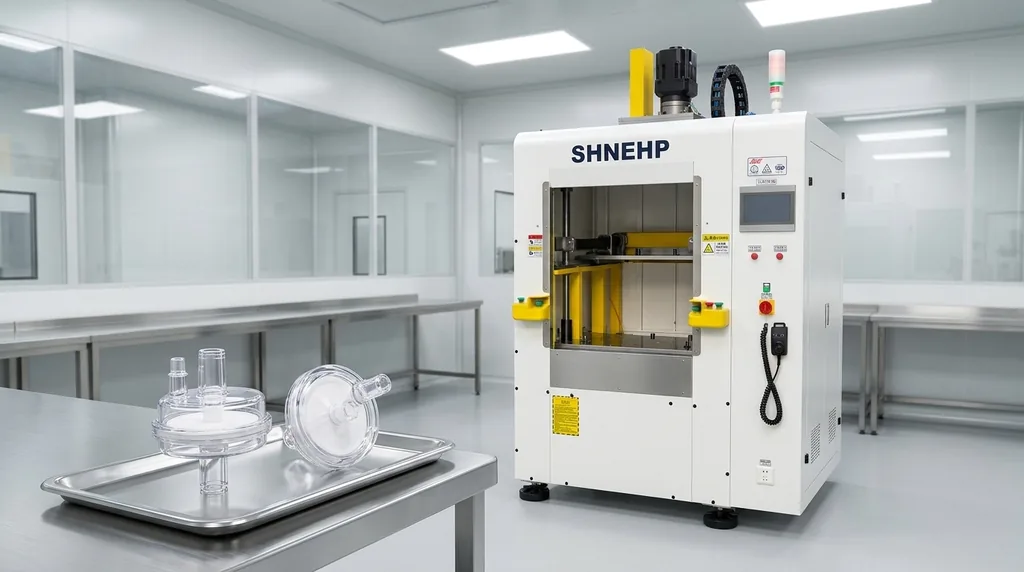
Intravenous (IV) infusion filters, air-eliminating inline filters, and sterile drug-delivery chambers protect patients from air embolisms, particulate contamination, and microbial ingress during hospital therapy. Applying hot plate welding medical iv filters fuses medical-grade thermoplastic upper and lower filter shells around hydrophobic/hydrophilic filter membranes without solvent adhesives or extractables. SHNEHP builds compact 3-axis servo hot plate platforms (XNS2-B, XNS5-B) with optional non-contact infrared (IR) heating and enclosed displacement telemetry designed to support medical-device IQ/OQ/PQ validation workflows.
The part and its welding challenges
Single-use IV infusion filter housings are typically molded from medical-grade acrylic (PMMA / MABS), polycarbonate (PC), ABS, PP, PETG, or PSU/PES where optical clarity allows nurses to visually inspect fluid flow and air bubbles. Joining miniature sterile fluid chambers imposes five critical engineering requirements:
- Zero solvent extractables & biocompatible seams: Liquid solvent bonding introduces leachables and curing volatility risks; thermal fusion produces a pure parent-resin hermetic barrier suitable for gamma, E-beam, or EtO sterilization compatibility testing.
- Protecting delicate internal filter membranes: Hydrophobic PTFE/PES membranes sit millimeters from the perimeter weld bead; radiant heat spillover or uncontrolled melt squeeze-out can scorch, wrinkle, or bypass the membrane edge.
- Zero particulate shedding inside the fluid path: Loose polymer strings, PTFE coating flakes, or vibration fuzz inside an IV chamber are immediate patient-safety hazards, making enclosed flash traps and non-contact IR heating vital for strict cleanliness specs.
- Optical clarity without stress crazing: Transparent PC, MABS, and PMMA housings easily craze or cloud under uneven clamping pressure, moisture foaming, or post-weld thermal shock.
- High-cavitation consistency & traceability: High-volume medical consumables run multi-cavity nests (4-cavity to 12-cavity) where every individual filter must log verified weld depth, zone temperature, and inline pressure-decay pass status.
Why hot plate welding (vs. alternatives)
| Process | Fit for medical IV filter housings | Cleanliness & membrane safety | Typical cycle time | Engineering boundary |
|---|---|---|---|---|
| Servo hot plate — contact & non-contact IR (XNS2-B / XNS5-B) | Strong choice for contoured oval/rectangular IV chambers, thicker PP/PETG shells, and multi-cavity hermetic runs | Gentle zero-vibration closure protects fragile membranes; non-contact IR eliminates PTFE wear and stringing | ~15–30 s per multi-cavity stroke | Pre-dry PC/MABS/PMMA before welding; enclosed flash traps required around fluid channels |
| Ultrasonic welding (XNC-400 / XN-3 / XN-5) | Very small rigid amorphous ABS/PC/MABS round or compact filter bodies with molded energy directors | Ultra-fast localized energy with minimal bulk heat | ~0.1–1.2 s | High-frequency energy can vibrate or tear delicate membranes or create fine particulate dust on semi-crystalline PP |
| Laser transmission welding | Premium low-flash medical filters where a laser-transparent upper shell meets an IR-absorbing lower shell | Near-zero visible flash and particulate-free seam | ~2–8 s | Requires specialized laser-absorbing pigment/additive approval and tight optical clamping flatness |
| Solvent / UV adhesive bonding | Low-volume legacy assemblies | No molten flash | Curing / ventilation time | Extractables, biocompatible validation burden, bond-line voids, and VOC management |
Typical process window (industry ranges)
The DVS 2215 five-stage control baselines below support clean, repeatable sealing across common medical housing resins. Exact temperatures, IR standoffs, and collapse stops are confirmed during a SHNEHP part-specific weld trial.
| Parameter | Typical industry range (PC / MABS / PMMA / PP) | Engineering guidance |
|---|---|---|
| Pre-drying discipline | PC: 100–120 °C; PMMA / MABS: 75–85 °C | Eliminates steam micro-bubbles that compromise visual clarity and sterile barrier integrity |
| Heating mode & temperature | Contact tooling: PP 240–270 °C, MABS/PMMA 230–265 °C, PC 270–295 °C; Non-contact IR: 300–450 °C | Use non-contact IR above ~270 °C or whenever zero-contact particulate prevention is mandated |
| Bead-up / leveling (Stage 1) | 0.2–0.5 mm (contact mode) | Gently levels miniature rim flatness across multi-cavity medical nests |
| Melt / soak phase (Stage 2) | 3–10 s at 0.04–0.08 N/mm² | Shallow, uniform melt keeps heat strictly away from internal filter membranes |
| Changeover time (Stage 3) | ≤1.2–1.6 s | Fast 3-axis servo retraction avoids surface skinning on fast-freezing PC and PMMA |
| Joining & collapse (Stage 4) | 0.12–0.22 N/mm² to closed-loop servo hard stop (0.5–1.2 mm) | Hard servo stop protects membrane compression height and prevents fluid-port occlusion |
| Cooling / hold (Stage 5) | 3–8 s | Stabilizes clear housings before smooth pneumatic ejection without stress whitening |
Recommended SHNEHP machine and fixture setup
SHNEHP configures cleanroom-friendly hot plate welding machines tailored to medical consumable manufacturing:
- Compact multi-cavity platforms: XNS2-B (small footprint, 3-axis full-servo displacement control) and XNS5-B deliver micron-grade repeatability and independent multi-zone PID thermal uniformity across 4-cavity to 8-cavity IV filter tooling.
- Cleanroom hardware finishes: Stainless-steel/hard-anodized tooling nests, enclosed low-particle servo actuators, oil-free pneumatic filtration, and smooth wipe-down enclosures support cleanroom production environments.
- Non-contact infrared heating head: Eliminates direct platen contact on high-temperature PC or particulate-critical fluid pathways, preventing PTFE degradation and melt stringing.
- Integrated leak-test & traceability fixtures: Custom welding and testing fixtures pair vacuum-assisted membrane-safe nests with multi-channel inline leak stations and PLC audit trails (supporting IQ/OQ/PQ data capture) inside customized machines.
Quality and leak testing
Every sterile IV filter assembly requires 100% non-destructive integrity verification plus batch destructive qualification:
- 100% inline pneumatic pressure-decay testing: IV filter housings are typically screened via dry filtered air across a four-stage Fill → Stabilize (2–4 s) → Test → Exhaust cycle at OEM-specified test pressures (commonly 50–150 kPa for infusion-pump ratings) using high-resolution 1 Pa differential pressure transducers to catch micro-pinholes before packaging.
- Membrane bypass & bubble-point audit: Offline lot audits verify that molten flash has not bridged or damaged the internal hydrophilic/hydrophobic filter membrane and that bubble-point integrity meets device specs.
- Visual clarity & sterilization validation: Sampled housings undergo optical microscopy for micro-crazing and post-sterilization (EtO / gamma) burst and dye-penetration testing.
- Batch recipe lockout & audit logs: Password-protected PLC parameter windows, per-cycle meltdown/temperature recording, and automated NG reject chutes prevent out-of-tolerance units from entering sterile packaging.
FAQ
Can hot plate welding seal medical IV filter housings without damaging the internal membrane? Yes. By localizing heat strictly to the perimeter rim with precision contoured platens (or non-contact IR emitters), holding shallow meltdown stops via 3-axis servo control, and designing an enclosed inner flash trap, the internal membrane remains thermally and mechanically protected.
When should medical IV filters use hot plate welding versus ultrasonic welding? Choose hot plate welding (XNS2-B / XNS5-B) for elongated/oval geometries, semi-crystalline PP housings, or assemblies where high-frequency ultrasonic vibration risks tearing membranes or shedding loose particles. Choose ultrasonic welding (XNC-400 / XN-3) for small, rigid amorphous chambers with molded energy directors needing sub-second cycles.
How do you prevent melt stringing and loose particles inside sterile IV filter chambers? Switch from contact PTFE platens to non-contact infrared (IR) heating for PC or strict particle-free specs, pre-dry hygroscopic resins cleanly, and mold enclosed double flash traps around the perimeter joint.
Can SHNEHP equipment support our medical IQ/OQ/PQ process validation? Yes. Closed-loop servo displacement stops, multi-zone PID alarms, password-tiered HMI access, and exportable per-cycle process logs provide the repeatable parameter control required during medical-device validation.
What engineering files should we send for a medical IV filter weld trial? Provide 3D STEP/X_T models of the upper/lower shells and membrane seat, exact medical resin grade, target sterilization method, multi-cavity output requirement (UPH), and pressure-decay/burst acceptance specs.
Get a free weld trial
Share your IV filter housing drawings with SHNEHP engineering to evaluate contact vs. non-contact IR servo hot plate welding and multi-cavity leak-test integration:
- 3D STEP / X_T / IGES models showing membrane keep-out clearances and Luer ports
- Medical resin grade (PC, MABS, PMMA, PP, PETG, PSU) and sterilization protocol
- Target hourly output (UPH) and inline leak-test / burst criteria
Email yy@nbxiaoneng.com or connect via our contact page.
Request a Technical Consultation & Free Weld Trial
Send your 3D STEP/X_T drawing, resin grade, target cycle time, and leak-test specification. Our engineers will evaluate the joint and recommend a practical SHNEHP machine and fixture setup.