
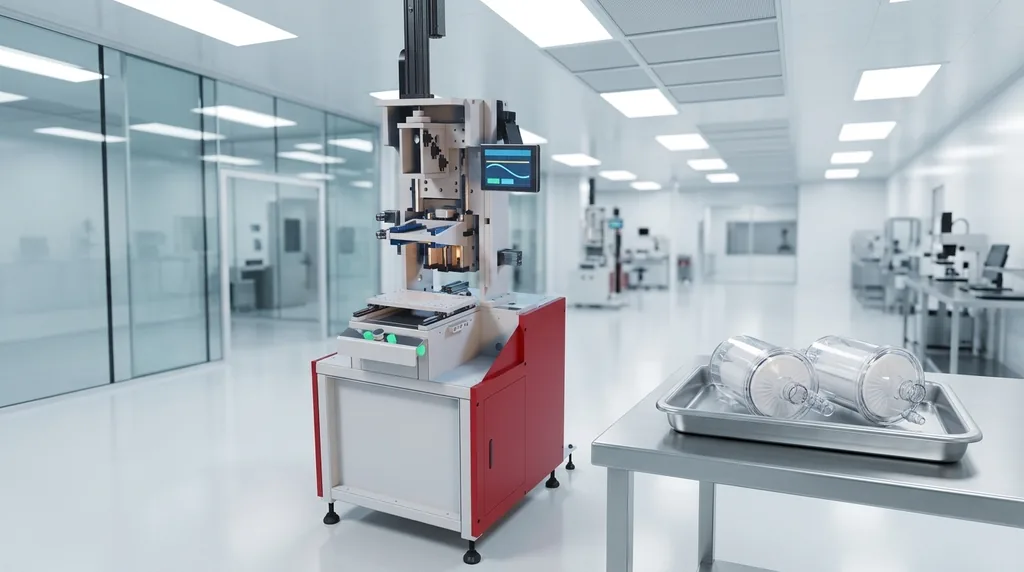
Extracorporeal blood filters, leukocyte-reduction chambers, dialysis header caps, and cardiopulmonary arterial filters demand absolute hemocompatibility and zero-leak mechanical security under continuous peristaltic or centrifugal pump pressure. Deploying hot plate welding medical blood filters joins upper and lower filter housings—and perimeter-clamped filtration media—into a continuous, adhesive-free monolithic vessel with smooth internal flow transitions. SHNEHP engineers 3-axis servo hot plate platforms (XNS2-B, XNS5-B, XNS6-B) with optional non-contact infrared (IR) heating built to DVS 2215 precision for critical blood-handling consumables.
The part and its welding challenges
Blood filtration housings are predominantly molded in medical-grade transparent polycarbonate (PC), MABS / ABS, SAN, polypropylene (PP), or polysulfone (PSU). Because blood cells are sensitive to shear turbulence and foreign particulates, joining blood filter shells creates five rigorous engineering constraints:
- Hemolysis-safe smooth internal seam: Jagged weld flash protruding into the blood path induces turbulent shear stress, fibrin clotting, and red-blood-cell hemolysis. Enclosed inner flash traps and calibrated servo meltdown stops are essential to keep wetted channels smooth.
- Zero-bypass peripheral media sealing: In flat-plate leukocyte or micro-aggregate blood filters, the multi-layer nonwoven/mesh filter sheet must stay anchored around the entire perimeter so unfiltered blood cannot channel around the edge.
- Transparent PC clarity & micro-crack prevention: Polycarbonate blood reservoirs allow clinicians to monitor priming and air-bubble purging; overheated platens, moisture foaming, or uneven clamping loads cause hazing and residual-stress crazing after sterilization.
- Sustained arterial pump pressure: Extracorporeal circuits experience elevated operating pressures and priming back-pressure; cold-weld laminations along curved ports or long oval perimeters fail hydrostatic proof verification.
- Cleanroom particulate control: Contact PTFE wear particles or resin stringing falling onto sterile filter media are unacceptable—making non-contact IR heating a high-value upgrade for high-temp PC and PSU shells.
Why hot plate welding (vs. alternatives)
| Process | Fit for medical blood filter housings | Seam smoothness & pressure safety | Typical cycle time | Engineering boundary |
|---|---|---|---|---|
| Servo hot plate — contact & non-contact IR (XNS2-B / XNS5-B / XNS6-B) | Primary choice for oval, circular, and contoured blood filter shells, multi-layer media clamping, and thicker PC/PP vessels | Uniform 360° perimeter fusion without high-frequency vibration; non-contact IR eliminates PTFE wear and melt stringing | ~20–38 s per multi-cavity cycle | Mandatory PC/MABS pre-drying; changeover must stay ≤1.5 s on fast-freezing PC |
| Ultrasonic welding (XNC-400 / XN-5) | Compact blood-line connectors, sampling ports, and rigid round mini-filters | Rapid local fusion on amorphous resins | ~0.2–1.5 s | Struggles on wide multi-layer blood filters where large media blankets dampen acoustic waves and risk dust generation |
| Spin welding (XNX-100 / XNX-200) | Strictly cylindrical dialysis end caps without directional side ports | Very high circular hoop strength (3–15 m/s surface speed) | ~0.5–3 s weld | Rotational motion shears flat filter blankets and cannot weld offset arterial/venous port angles without indexing |
| Solvent / UV adhesive bonding | Specialty low-volume assemblies | Cold process | Curing dwell | Leachable/extractable toxicology validation, inconsistent fillet thickness, and bond-line air entrapment |
Typical process window (industry ranges)
The DVS 2215 five-stage parameters below establish a repeatable baseline for transparent PC, MABS, and PP blood filter housings. Part-specific windows are confirmed during a SHNEHP weld trial.
| Parameter | Typical industry range (PC / MABS / PP / PSU) | Engineering guidance |
|---|---|---|
| Pre-drying before welding | PC: 100–120 °C; MABS / ABS: 80–90 °C; PSU: 120–140 °C | Prevents trapped moisture from flashing into micro-bubbles along clear blood-path walls |
| Heating mode & temperature | Contact platen: PP 245–275 °C, MABS 235–265 °C, PC 275–305 °C; Non-contact IR: 320–480 °C | Use non-contact IR for PC (>270 °C PTFE ceiling), PSU, or strict zero-particulate medical housings |
| Bead-up / leveling (Stage 1) | 0.3–0.7 mm displacement (contact) or 1–2 mm emitter standoff (IR) | Levels housing flatness across broad oval or disk-shaped blood chambers |
| Melt / soak phase (Stage 2) | 5–14 s at 0.05–0.09 N/mm² | Creates consistent viscous melt layer to lock outer shell and perimeter media edge |
| Changeover time (Stage 3) | ≤1.2–1.5 s (PC/PSU) / ≤2.0 s (PP) | High-speed 3-axis servo withdrawal eliminates surface cooling skin on polycarbonate |
| Joining & collapse (Stage 4) | 0.15–0.28 N/mm² to closed-loop servo hard stop (0.8–1.8 mm) | Precise displacement control traps bead inside hidden inner/outer flash pockets |
| Cooling / hold (Stage 5) | 5–12 s | Lets amorphous PC cool uniformly under controlled clamp force to prevent stress crazing |
Recommended SHNEHP machine and fixture setup
SHNEHP configures precision cleanroom-oriented hot plate welding machines matched to blood filter cavity size and throughput:
- Single & twin-cavity blood filters: XNS2-B and XNS5-B 3-axis full-servo hot plate welders offer closed-loop collapse stops, multi-zone PID thermal balance, and wipe-down stainless/anodized surfaces.
- High-output 4-cavity to 8-cavity medical lines: XNS6-B servo platform applies our +60 mm fixture clearance rule to accommodate multi-cavity tooling nests with balanced parallel guideways and per-cavity force equalization.
- Non-contact infrared heating system: Recommended for polycarbonate (PC) and polysulfone (PSU) blood reservoirs—eliminating physical platen contact, PTFE coating wear, and polymer stringing over sterile filtration media.
- Precision media-retaining fixtures & inline QA: Custom welding and testing fixtures integrate vacuum holding nests, non-marring silicone port locators, and automated downstream pressure-decay cells on customized machines.
Quality and leak testing
Medical blood filter lines verify both external pressure containment and internal filter-media integrity:
- 100% inline pneumatic leak testing: Sealed blood filter housings undergo dry-air differential pressure decay (1 Pa resolution) across a four-stage Fill → Stabilize (2–5 s) → Test → Exhaust cycle—commonly tested between 50–200 kPa depending on arterial/dialysis pump rating—with automatic NG lockout chutes.
- Internal media-seat & pressure-drop check: Inline flow/differential-pressure checks confirm the filter membrane is properly seated with zero edge bypass and zero flash blockage across inlet/outlet ports.
- Destructive burst & sterilization qualification: Periodic lot samples undergo hydrostatic burst testing, cross-section weld microscopy, and post-sterilization (EtO, gamma, or steam for PSU) stress-crack audits.
- Traceable batch telemetry: Per-cycle logging of zone temperatures, changeover time, final weld height, and leak-test value supports medical-device batch history records (DHR) and IQ/OQ/PQ audits.
FAQ
Why is non-contact infrared (IR) hot plate welding often preferred for polycarbonate blood filters? Polycarbonate melts cleanly at temperatures near or above the ~270 °C durability ceiling of PTFE contact coatings. Non-contact IR heating eliminates platen contact, prevents PTFE wear contamination, and avoids resin stringing across sterile filtration media.
How do you prevent weld flash from entering the blood flow path and causing hemolysis? Mold an enclosed inner flash trap (stepped tongue-and-groove cavity) on the wetted side and control exact collapse distance with a 3-axis closed-loop servo stop so displaced melt fills only the hidden pocket.
Can hot plate welding seal a flat filter mesh or leukocyte membrane directly between two housing halves? Yes. Contoured heating platens melt both housing rims while protective thermal reliefs shield the active filter zone; controlled servo joining then embeds the outer media skirt uniformly around the full perimeter.
What leak-test method is standard for welded medical blood filters? 100% inline dry-air differential pressure decay (1 Pa resolution) with a 2–5 s stabilization stage verifies external hermetic tightness cleanly without wetting sterile assemblies, paired with periodic offline wet burst and dye-ingress audits.
What should we provide for a SHNEHP blood filter weld trial? Send 3D STEP/X_T models of both housing shells and media clearances, exact medical resin grade, sterilization method, cavity count / target UPH, and pressure-decay and burst specifications.
Get a free weld trial
Share your blood filter housing CAD files with SHNEHP engineering to evaluate contact vs. non-contact IR servo hot plate welding, flash-trap design, and inline differential leak testing:
- 3D STEP / X_T / IGES models of upper/lower filter shells and ports
- Medical polymer grade (PC, MABS, PP, PSU) and internal filter-media layout
- Target hourly output (UPH) and pressure-decay / hydrostatic burst criteria
Email yy@nbxiaoneng.com or submit your project via our contact page.
Request a Technical Consultation & Free Weld Trial
Send your 3D STEP/X_T drawing, resin grade, target cycle time, and leak-test specification. Our engineers will evaluate the joint and recommend a practical SHNEHP machine and fixture setup.