
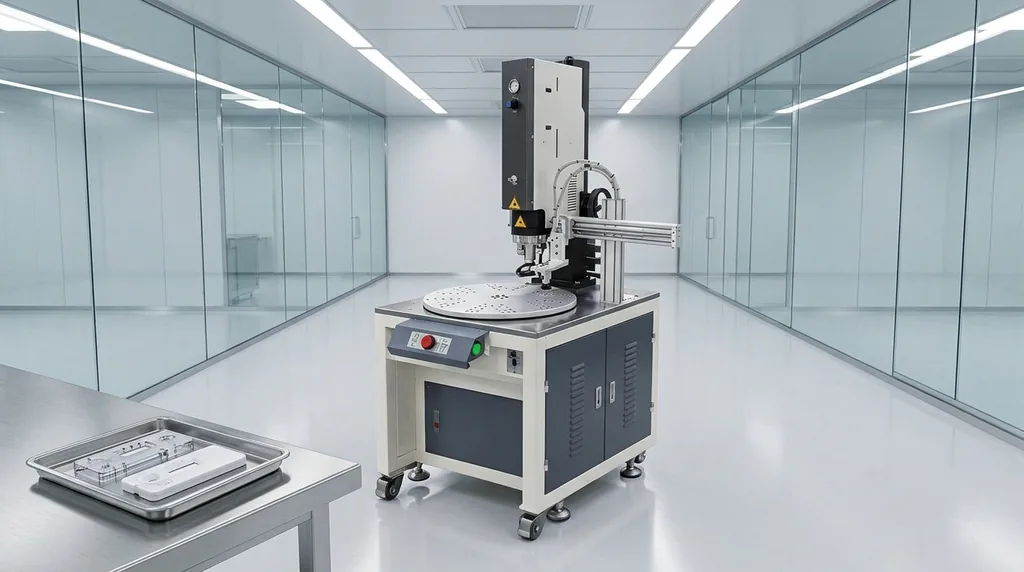
Point-of-care (POC) clinical diagnostic cartridges, lateral-flow cassettes, PCR microfluidic chips, and blood-gas assay cards combine reagent blister pockets, optical detection windows, and hair-thin fluid channels into a single disposable plastic assembly. Selecting ultrasonic welding diagnostic cartridges seals lid-to-base perimeters and individual micro-channel walls in fractions of a second without liquid adhesives that could contaminate sensitive biological reagents or auto-fluoresce under optical readers. SHNEHP engineers precision digital ultrasonic welding platforms (XNC-400, XN-3, XN-5) with tight amplitude/collapse control for diagnostic consumable production.
The part and its welding challenges
Diagnostic cartridges and microfluidic assay cassettes are typically molded from optically clear, low-autofluorescence amorphous polymers such as COC / COP (cyclic olefin copolymer/polymer), polystyrene (PS), PMMA, polycarbonate (PC), ABS, or medical PP for reagent reservoirs. Sealing functional bio-assay devices poses five exacting technical challenges:
- Protecting heat-sensitive biological reagents: Lyophilized enzymes, antibodies, nucleic-acid primers, and lateral-flow nitrocellulose strips sit millimeters from the weld track; bulk thermal soaking denatures reagents, making sub-second localized ultrasonic energy essential.
- Micro-channel flatness & zero cross-channel leakage: Microfluidic channels often measure just 100–500 µm wide; uneven horn parallelism or excessive energy collapses channel ceilings, while under-welding permits reagent cross-talk between adjacent chambers.
- Zero optical distortion over reader windows: Fluorescence and spectrophotometric analyzers read straight through clear COC/COP, PS, or PMMA detection cuvettes; acoustic contact must never mark, cloud, or warp optical zones.
- Precise collapse-height control for cartridge readers: Point-of-care benchtop instruments clamp cartridges to tight Z-height tolerances; finished cartridge thickness must stay consistent across millions of cycles to prevent instrument jams.
- Zero loose flash or particulate dust: Microscopic resin debris falling into sample-prep chambers or lateral-flow strips can clog capillaries or trigger false assay results.
Why ultrasonic welding (vs. alternatives)
| Process | Fit for diagnostic cartridges & assay cassettes | Reagent safety & speed | Typical cycle time | Engineering boundary |
|---|---|---|---|---|
| Precision ultrasonic welding (20–40 kHz: XNC-400 / XN-3 / XN-5) | Primary choice for COC/COP, PS, PMMA, PC, and ABS point-of-care cassettes, lateral-flow housings, and microfluidic lids | Sub-second localized energy keeps heat strictly on molded micro-energy directors away from reagents; adhesive-free | ~0.1–0.8 s weld + hold | Demands rigid horn parallelism, precision molded micro-energy directors, and near-field coupling (≤6 mm) |
| Laser transmission welding | Ultra-fine microfluidic chips where acoustic vibration could disturb loose lyophilized reagent beads | Zero mechanical vibration, ultra-clean optical weld | ~1.5–6 s | Higher capital cost; requires laser-absorbing layer/pigment compatible with diagnostic optical fluorescence |
| Hot staking (XNR-100 / XNRZ-100) | Mechanical closure of outer lateral-flow test cassette shells around pre-assembled strips | Quiet, vibration-free mechanical pinning | ~2–6 s | Mechanical pin closure only—not suitable for hermetic microfluidic channel sealing |
| Pressure-sensitive adhesive (PSA) films / thermal lamination | Flat 2D PCR foil sealing and low-pressure assay cards | Low thermal load | Fast roll-to-roll | Adhesive leachables can inhibit PCR/ELISA chemistry; lower burst strength on pressurized fluid cartridges |
Typical process window (industry ranges)
Microfluidic and diagnostic cartridge welding rewards precision horn leveling, higher frequency (30–40 kHz for delicate micro-channels), and strict collapse-distance termination. Exact parameters are validated during a SHNEHP part-specific weld trial.
| Parameter | Typical industry range (COC/COP / PS / PMMA / PC / ABS) | Engineering guidance |
|---|---|---|
| Ultrasonic frequency | 30–40 kHz for delicate microfluidic chips & reagent-loaded cassettes; 20 kHz for larger multi-point outer shells | Higher frequency reduces amplitude and acoustic stress on dry lyophilized reagents and thin optical windows |
| Energy director design | Miniature 60°–90° triangular micro-energy director (0.15–0.35 mm height) tracing channel dividers | Keeps melt volume tightly controlled so molten plastic seals walls without overflowing into micro-channels |
| Horn parallelism & relief | Flatness/parallelism within micron-level shimming; machined relief pockets over optical reader windows and blister wells | Prevents horn contact over optical windows and guarantees uniform pressure across all micro-channel ribs |
| Weld termination mode | Absolute distance / Collapse distance (with tight Energy and Peak Power guard windows) | Guarantees uniform finished cartridge Z-height for automated clinical instrument loading |
| Amplitude & trigger force | Moderate amplitude (15–30 µm at 35 kHz); precise low trigger force | Ensures rapid shear-thinning initiation without crushing micro-energy directors pre-weld |
| Weld / Hold duration | 0.1–0.5 s weld / 0.3–0.8 s hold | Minimal thermal soak prevents heat conduction into nearby enzymes or antibody pads |
Recommended SHNEHP machine and fixture setup
SHNEHP engineers precision ultrasonic welding machines and custom optical-safe tooling for diagnostic manufacturers:
- Precision digital ultrasonic welders: XNC-400, XN-3, and XN-5 platforms combine automatic frequency tuning, stable amplitude regulation, and programmable weld-by-distance/energy windows to detect missed reagents, warped lids, or under-welded channels in real time.
- Custom relieved titanium horns & leveling anvils: Precision-machined titanium or hardened-steel horns incorporate dedicated cut-out reliefs over optical detection windows and blister chambers, paired with micrometer-adjustable leveling base fixtures (welding and testing fixtures).
- Automated cassette assembly lines: For high-volume POC diagnostics, customized machines integrate strip/reagent placement verification, ultrasonic welding, barcode serialization, vision flatness inspection, and inline micro-leak testing.
Quality and leak testing
Diagnostic cartridge quality verification combines per-cycle ultrasonic telemetry with non-destructive micro-channel leak screening:
- 100% real-time weld envelope verification: PLC monitoring tracks collapse depth, weld energy, peak power, and weld time on every cartridge; any deviation triggers immediate automatic rejection.
- Inline micro-leak & channel-isolation testing: Pressurized microfluidic cartridges are screened via 1 Pa-resolution differential pressure decay (typically 10–30 kPa, 0.1–0.5 mL/min or tighter micro-volume thresholds) using custom multi-port silicone manifold fixtures that test both outer sealing and channel-to-channel cross-leakage.
- Optical & destructive microscopy audits: Batch samples undergo optical transmittance checks over reader windows, dyed-fluid capillary flow testing to confirm zero blocked micro-channels, and peel/burst testing.
FAQ
Can ultrasonic welding seal diagnostic cartridges that already contain dried reagents or lateral-flow strips? Yes. Because ultrasonic welding generates friction heat strictly at the microscopic molded energy director for just 0.1–0.5 seconds, bulk cartridge temperature barely rises—preserving nearby enzymes, antibodies, and test strips when horn reliefs and frequency (30–40 kHz) are engineered properly.
What plastics weld best for optically clear microfluidic diagnostic cartridges? Amorphous medical plastics—especially COC / COP, polystyrene (PS), PMMA, polycarbonate (PC), and ABS—transmit ultrasonic waves efficiently with minimal attenuation and deliver clean, adhesive-free hermetic channel seals.
How do you prevent ultrasonic welding from collapsing tiny microfluidic channels? Design precision micro-energy directors (0.15–0.35 mm tall) with calibrated relief space, shim horn-to-anvil parallelism precisely, and terminate the weld by collapse distance rather than simple weld time.
When should a diagnostic cassette use hot staking instead of ultrasonic welding? Use hot staking (XNR-100 / XNRZ-100) when simply pinning an outer two-piece lateral-flow plastic housing around an internal paper strip where no hermetic fluid-channel weld is required and acoustic vibration must be zero. Use ultrasonic welding for hermetic fluidic cartridges and rapid high-volume sealing.
What files does SHNEHP need for a diagnostic cartridge weld trial? Send 3D STEP/X_T files showing micro-channel layout, optical window keep-out zones, energy-director dimensions, exact resin grade (COC/COP/PS/PC/PMMA), target UPH, and leak/Z-height tolerances.
Get a free weld trial
Share your diagnostic cartridge CAD models with SHNEHP engineering to optimize ultrasonic frequency, relieved titanium horn design, micro-energy director geometry, and inline leak testing:
- 3D STEP / X_T / IGES models of the cartridge base, lid, and optical/reagent keep-out zones
- Polymer grade (COC/COP, PS, PMMA, PC, ABS, PP) and target finished Z-height tolerance
- Target hourly output (UPH) and micro-channel leak-test specification
Email yy@nbxiaoneng.com or reach our engineers on our contact page.
Request a Technical Consultation & Free Weld Trial
Send your 3D STEP/X_T drawing, resin grade, target cycle time, and leak-test specification. Our engineers will evaluate the joint and recommend a practical SHNEHP machine and fixture setup.