
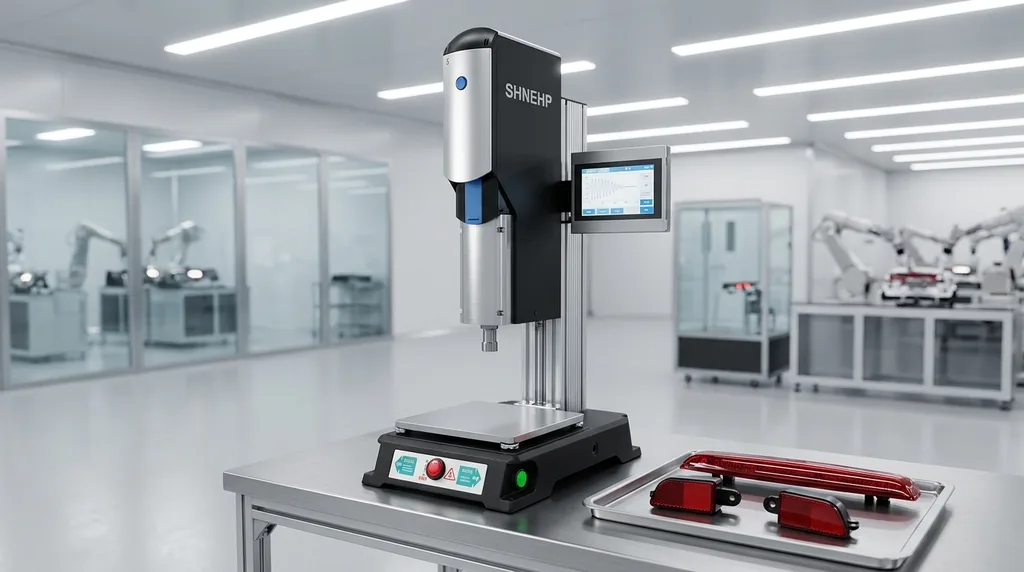
While full-width wrap-around rear combination lamps rely on hot plate or linear vibration welding, compact center high-mounted stop lamps (CHMSL), rear bumper reflex reflectors, trunk-lid auxiliary backup lamps, and internal LED diffuser sub-assemblies are ideal candidates for rapid sub-second joining. Applying ultrasonic welding automotive tail lights delivers cycle times of 0.2–1.2 seconds with zero thermal warm-up, low floor-space demand, and crisp hermetic energy-director seals on rigid PMMA, PC, ABS, and ASA components within near-field acoustic range (≤6 mm). SHNEHP builds closed-loop digital ultrasonic presses (XNC-400, XN-3, XN-5) engineered for zero-mark cosmetic lighting assembly.
The part and its welding challenges
Compact rear lighting assemblies combine clear optical lenses, snap-free moisture sealing, and delicate internal LED strips. Achieving high first-pass yield requires controlling five ultrasonic engineering factors:
- Near-field acoustic geometry (≤6 mm) and 3D contour limits: Ultrasonic energy transmits best when the horn face contacts the lens directly above the weld seam within ≤6 mm; deep recessed curves or oversized full-width lamps suffer rapid amplitude attenuation and uneven corner sealing.
- Preventing cosmetic horn marking, blush, and stress crazing on clear PMMA/PC: Acrylic (PMMA) and polycarbonate lenses are sensitive to surface friction heating and localized tensile resonance, causing milky witness marks or hairline crazes if horn contact geometry is imperfect.
- Protecting internal LED drivers, solder joints, and light pipes: High-frequency 15–20 kHz mechanical vibrations can fracture surface-mount LED solder fillets or unseat snap-in optical light blades unless the fixture isolates resonant paths and runs tightly bounded energy/collapse limits.
- Achieving continuous IP67 hermetic seals around corners: Standard triangular energy directors can leave microscopic pinholes at sharp corner transitions on brake lights unless paired with a precision step-joint or shear-lip geometry.
- Consistent amplitude across elongated CHMSL spoiler brake lamps: Long narrow spoiler-mounted brake lamps (250–450 mm) require FEA-slotted titanium or high-strength aluminum block horns (or synchronized multi-head ultrasonic banks) so left, center, and right ends weld uniformly.
Why ultrasonic welding (vs. alternatives)
| Process | Fit for compact tail lamps, CHMSLs & reflectors | Speed & thermal footprint | Typical cycle time | Engineering boundary |
|---|---|---|---|---|
| Precision ultrasonic welding (XNC-400 / XN-3 / XN-5) | Top high-speed choice for CHMSL brake lamps, bumper reflectors, license-plate lamps, and internal optical sub-assemblies | Sub-second cold cycle; zero platen heat-up; minimal energy consumption | ~0.2–1.2 s weld (~3–6 s total) | Best on rigid amorphous resins (PMMA, PC, ABS, ASA) within ≤6 mm near-field contact; oversized 3D rear combination lamps should use hot plate or vibration welding |
| Hot plate / non-contact IR welding (XNS5-B / XNS6-B) | Large wrap-around 3D rear combination lamps and deep curved tail lights | Zero mechanical vibration shock to delicate OLED/LED electronics | ~18–32 s | Overkill footprint and slower cycle for compact flat CHMSLs or reflectors |
| Linear vibration welding (XN-35 / XN-55) | Mid-to-large flatter tail lamps exceeding single ultrasonic horn capacity | Handles larger perimeter areas cleanly | ~8–15 s total | Requires ≥2.5–3.0 mm clearance and generates friction particulates inside small optical chambers |
| Laser transmission welding | Ultra-compact high-cosmetic LED blades with laser-tuned resins | Zero vibration and virtually invisible seam | ~4–10 s | Higher equipment cost and strict pigment/clamping tolerances |
Typical process window (industry ranges)
Ultrasonic tail light welding relies on rigid fixture support, matched step/energy-director joint design, and distance- or energy-mode closed-loop termination. Parameters below are industry baselines finalized during a SHNEHP FEA horn and weld trial.
| Parameter | Typical industry range (PMMA / PC + ABS / ASA) | Engineering guidance |
|---|---|---|
| Operating frequency | 20 kHz (compact reflectors, marker & license lamps) or 15 kHz (longer CHMSL brake lights & multi-chamber modules) | 15 kHz delivers higher amplitude across wider parts; 20 kHz provides gentler, lower-stress cosmetic sealing near LEDs |
| Joint geometry | Step joint with 60°–90° energy director (0.4–0.6 mm height) | Step lip traps flash away from visible lens edges and bolsters IP67 water-spray resistance |
| Weld time & control mode | 0.2–1.2 s in closed-loop collapse distance or energy mode | Eliminates part-to-part thickness variation; prevents over-welding crazes or cold leaks |
| Horn surface protection | FEA-tuned contoured titanium/aluminum horn + optional protective film / PTFE face | Prevents cosmetic scuffing and friction blush on clear red or clear PMMA lenses |
| Hold time & force | 0.3–0.8 s post-weld hold | Locks rigid amorphous PMMA/ABS seams solidly without spring-back micro-cracking |
Recommended SHNEHP machine and fixture setup
SHNEHP provides rigid digital ultrasonic welding machines plus multi-head custom stations for automotive lighting lines:
- Single-station reflectors, license lamps & internal LED bezels: XNC-400, XN-3, and XN-5 digital auto-tuning ultrasonic welders feature optical linear-encoder collapse control, energy/distance/time quality windows, and full acoustic safety enclosures.
- Elongated CHMSL spoiler brake lamps: Synchronized dual- or multi-head 15/20 kHz ultrasonic presses mounted inside rigid customized machines seal 300–500 mm spoiler lamps simultaneously in under 1 second.
- Cosmetic nests & rotary indexing: Contoured polyurethane/aluminum welding and testing fixtures support the housing perimeter directly under the weld rib while isolating internal LED driver boards from resonant nodes.
Quality and leak testing
Compact rear lamps undergo rapid inline inspection matching automotive OEM watertightness standards:
- 100% IP67 differential leak testing: Inline stations verify sealed CHMSLs and reflectors at 10–30 kPa against a 0.1–0.5 mL/min reject limit (1 Pa differential resolution, 3–5 s stabilization), using custom minimal-dead-volume sealed chambers for fully closed port-free reflectors.
- Cosmetic & environmental validation: Visual inspection under dark-room illumination verifies zero lens crazing or horn marks, backed by periodic wedge-break strength tests and -40 °C to +85 °C thermal cycling.
FAQ
Which automotive tail light components are best suited for ultrasonic welding versus hot plate welding? Ultrasonic welding excels on compact, relatively flat assemblies within near-field distance (≤6 mm)—such as CHMSL spoiler brake lamps, rear bumper reflectors, license lamps, and internal optical sub-assemblies. Large, steeply contoured full-width tail lamps are better served by hot plate or non-contact IR welding.
How do you avoid whitening or surface marks on clear red PMMA lenses during ultrasonic welding? Use an FEA-tuned contoured horn matching the exact outer lens curvature, apply fine protective horn film where appropriate, select a balanced 20 kHz amplitude profile, and terminate on precise closed-loop collapse distance rather than fixed time.
Will 15–20 kHz ultrasonic welding damage LEDs inside a CHMSL brake light? Not when properly engineered. Keeping the weld rib structurally decoupled from the PCB mounting bosses, tuning horn amplitude to the lowest effective level, and capping weld time under ~0.6–0.8 seconds protects surface-mount LED solder joints reliably.
Can ultrasonic welding seal a port-free rear bumper reflector and verify IP67 tightness? Yes. Ultrasonic step-joint welding creates continuous IP67 seals on port-free PMMA/ABS reflectors, which are then 100% leak-tested inside a form-fitting sealed pressure-decay chamber at 10–30 kPa.
What CAD details are needed for a SHNEHP ultrasonic tail light horn and weld trial? Share 3D STEP/X_T models showing lens curvature and energy-director cross-sections, exact PMMA/PC/ABS resin grades, internal LED board locations, and your target cycle time.
Get a free weld trial
Send your CHMSL, rear reflector, or compact tail light CAD models to SHNEHP engineering for FEA horn design, joint optimization, and physical ultrasonic weld testing:
- 3D STEP / X_T / IGES models of lens, housing, and internal LED module
- Polymer grades (PMMA, PC, ABS, ASA) and optical finish notes
- Target output (UPH) and OEM IP67 leak criteria
Email yy@nbxiaoneng.com or submit your project via our contact page.
Request a Technical Consultation & Free Weld Trial
Send your 3D STEP/X_T drawing, resin grade, target cycle time, and leak-test specification. Our engineers will evaluate the joint and recommend a practical SHNEHP machine and fixture setup.