
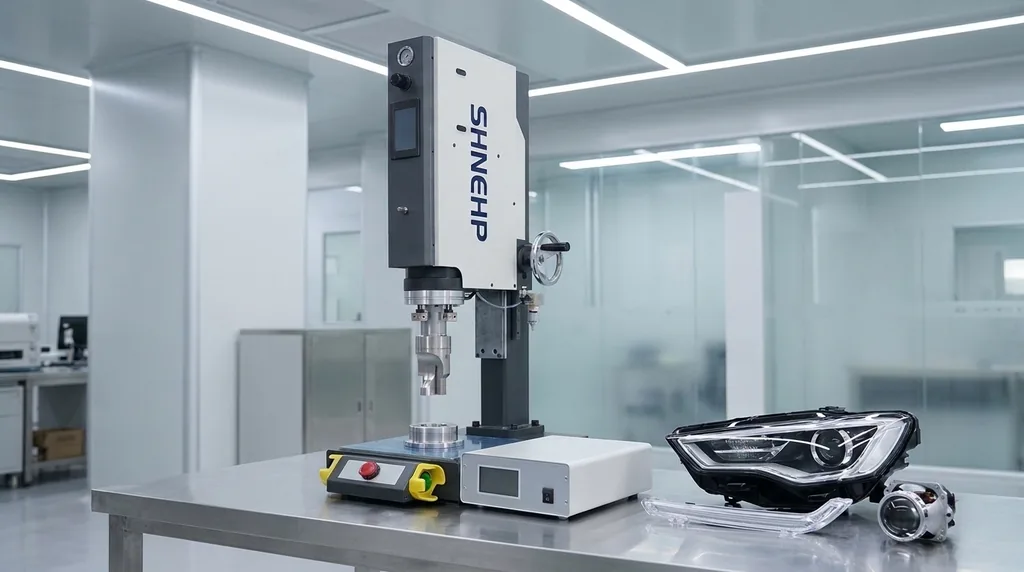
Modern matrix LED and EV headlamps contain far more than an outer lens and rear bucket—inside every headlamp sit multi-piece decorative chrome bezels, polycarbonate daytime-running-light (DRL) optical guides, actuator sensor brackets, wiring harness clips, and compact auxiliary projector modules. Applying ultrasonic welding automotive headlamps enables Tier-1 lighting sub-assembly lines to join, stake, and insert-lock these internal structural and optical components (as well as compact rigid motorcycle, ATV, and off-highway auxiliary headlamps) in 0.15–1.0 seconds with zero fasteners, zero glue vapors that fog lenses, and crisp dimensional repeatability. SHNEHP engineers precision digital ultrasonic systems (XNC-400, XN-3, XN-5) and multi-head robotic ultrasonic cells for automotive front lighting.
The part and its welding challenges
Internal headlamp sub-assemblies and compact auxiliary headlights combine heat-resistant PC, PC/ABS, PBT, PEI, and metallized ABS parts that must survive 100+ °C projector heat and continuous road vibration without rattling or outgassing:
- Zero volatile outgassing to prevent inner lens fogging: Adhesives and thread-locking fluids release vapors under LED heat-sink temperatures that condense as permanent milky film inside the sealed headlamp lens; clean ultrasonic fusion eliminates chemical fogging completely.
- Protecting aluminized vacuum-metallized bezels: Decorative headlamp bezels carry ultra-thin mirror chrome coatings that scratch or flake if clamped rigidly or struck by excessive ultrasonic energy; precision contoured nests and rear-side welding/staking keep Class-A chrome pristine.
- Multi-point fastening across 3D curved sub-frames: Large headlamp bezels often require 6 to 18 discrete ultrasonic spot-welds or boss stakes spread across different angles and heights, demanding multi-head 20–35 kHz ultrasonic tooling or robot-mounted ultrasonic guns.
- Strict acoustic near-field (≤6 mm) and outer-lens sizing boundaries: While ultrasonic welding excels on internal headlamp sub-assemblies and compact rigid auxiliary/motorcycle headlamps, large 500–800 mm passenger-car outer lenses should be sealed via non-contact IR hot plate welding or adhesive tracks rather than single-horn ultrasonics.
- Preventing vibration damage to LED PCBs and stepper aiming motors: Ultrasonic staking of brackets near populated circuit boards requires higher-frequency (20–35 kHz) low-amplitude profiles to minimize transmitted mechanical shock.
Why ultrasonic welding (vs. alternatives)
| Process | Fit for headlamp sub-assemblies & compact aux lamps | Cleanliness & speed | Typical cycle time | Engineering boundary |
|---|---|---|---|---|
| Precision ultrasonic welding & staking (XNC-400 / XN-3 / XN-5, 20–35 kHz) | Ideal high-speed choice for internal bezels, DRL diffusers, wire clips, and compact rigid off-highway/motorcycle headlamps | Zero fasteners, zero glue outgassing/fogging, instant sub-second join | ~0.15–1.0 s per weld/stake | Outer full-size passenger headlamp lenses exceed near-field (≤6 mm) span and require IR hot plate or glue dispensing |
| Hot-air / thermal cold staking | Multi-point staking of brittle glass-filled PBT/PA projector brackets right next to sensitive LED PCBs | Zero mechanical vibration shock; tight rattle-free boss clamping | ~4–10 s (all points simultaneous) | Slightly longer cycle than single ultrasonic spot, but safer directly beside fragile ceramic LEDs |
| Non-contact IR hot plate welding (XNS8-B / XNS9-B) | Full-size 3D outer lens-to-housing headlamp perimeter sealing | Zero contact stringing; full IP67 perimeter seal | ~22–38 s | Used for outer housing closure, not discrete internal bracket assembly |
| Self-tapping screws & clips | Legacy headlamp internal frames | Serviceable mechanical joint | ~10–25 s + fastener cost | Risk of loose screw rattle, plastic boss cracking, and higher BOM weight |
Typical process window (industry ranges)
Headlamp sub-assembly ultrasonic welding and boss staking prioritize gentle low-amplitude entry, exact collapse control, and zero particulate generation inside the optical chamber. Baselines below are validated during a SHNEHP trial.
| Parameter | Typical industry range (PC / PC-ABS / PBT / ABS) | Engineering guidance |
|---|---|---|
| Operating frequency | 20 kHz (compact aux lenses, thicker PC/PBT brackets) or 30–35 kHz (multi-point bezel staking, DRL diffusers near LED PCBs) | Higher 30–35 kHz frequency lowers physical amplitude, protecting delicate LED boards and thin chrome bezels |
| Joint / boss geometry | Energy director (0.35–0.55 mm) for sealed aux lenses; hollow/domed boss staking tips for bezel retention | Rear-side hidden staking prevents any front cosmetic witness marks on aluminized bezels |
| Control mode & weld time | 0.15–1.0 s in closed-loop distance or energy mode | Compensates for molding tolerances and stops over-melting flash specks inside optical chambers |
| Trigger & weld force | Soft low-force trigger + stepped amplitude profiling | Prevents cracking brittle metallized PC/ABS ribs on initial horn contact |
| Hold time | 0.25–0.6 s | Eliminates micro-rattle clearance on internal headlamp brackets under road vibration |
Recommended SHNEHP machine and fixture setup
SHNEHP supplies both standalone presses and multi-head automated stations from our ultrasonic welding machine lineup for headlamp Tier-1 plants:
- Benchtop & sub-assembly cells: XNC-400, XN-3, and XN-5 digital auto-tuning ultrasonic welders provide micron-grade collapse monitoring, soft-start amplitude ramping, and clean acoustic enclosures.
- Multi-point bezel & DRL sub-assembly machines: Custom multi-head 20–35 kHz ultrasonic fixtures inside SHNEHP customized machines fire 4 to 16 compact horns sequentially or in parallel to finish an entire headlamp bezel in a single 6–12 second cell cycle.
- Zero-scratch metallized bezel nests: Precision welding and testing fixtures use anti-static velvet/elastomer pads and pneumatic side-clamps that protect mirror-chrome surfaces while supporting weld bosses directly from behind.
Quality and leak testing
Headlamp ultrasonic sub-assemblies and compact auxiliary lamps undergo targeted quality verification before final outer-lens closure:
- 100% process-window monitoring & boss pull testing: Every ultrasonic cycle logs peak power, energy, and exact collapse distance against upper/lower limits to reject short shots or cracked bosses automatically, backed by periodic pull-off and vibration-rattle audits.
- IP67 leak testing on compact sealed headlamps: For compact ultrasonically sealed auxiliary, off-highway, or motorcycle headlamps, automated stations run 10–30 kPa differential pressure-decay leak checks to 0.1–0.5 mL/min (1 Pa resolution, 3–5 s stabilization).
FAQ
Can ultrasonic welding seal a full-size passenger-car headlamp outer lens? Usually no—large 500–800 mm 3D curved passenger headlamp lenses exceed ultrasonic near-field acoustic limits (≤6 mm) and risk stress crazing. Ultrasonic welding is widely used for internal headlamp bezels, DRL light guides, brackets, and compact rigid motorcycle/off-highway headlamps, while full-size outer lenses use non-contact IR hot plate welding or adhesive tracks.
Why use 30–35 kHz instead of 20 kHz for internal headlamp bezel staking near LED modules? Higher frequencies (30–35 kHz) deliver smaller mechanical oscillation amplitudes and use compact slender horns that reach tight 3D angles inside headlamp buckets while sharply reducing vibration stress on nearby LED PCBs.
When should we choose hot-air cold staking instead of ultrasonic staking for headlamp brackets? If glass-filled PBT/PA brackets sit directly adjacent to ultra-sensitive ceramic LEDs, optical sensors, or stepper motors that cannot tolerate any ultrasonic vibration, hot-air cold staking provides zero-vibration retention.
How do you keep ultrasonic welding from scratching vacuum-metallized chrome headlamp bezels? All horns contact the hidden rear face of the bezel rather than the chrome front surface, while custom elastomer-lined nests cradle the Class-A chrome finish gently without sliding friction.
What files should we send for a SHNEHP headlamp ultrasonic sub-assembly review? Share 3D STEP/X_T models showing all weld/stake points and LED clearances, exact resin grades (PC, PBT, ABS, PC/ABS), target cycle time, and whether single-press or multi-head automation is needed.
Get a free weld trial
Send your headlamp bezel, DRL diffuser, or compact auxiliary lamp CAD files to SHNEHP engineering to optimize horn frequencies, stake geometry, and multi-head cell layout:
- 3D STEP / X_T / IGES models of internal bezels, brackets, or compact aux lamp
- Polymer grades (PC, PC/ABS, PBT, ABS) and metallized finish zones
- Target output (UPH) and vibration/pull-test specifications
Email yy@nbxiaoneng.com or connect through our contact page.
Request a Technical Consultation & Free Weld Trial
Send your 3D STEP/X_T drawing, resin grade, target cycle time, and leak-test specification. Our engineers will evaluate the joint and recommend a practical SHNEHP machine and fixture setup.