
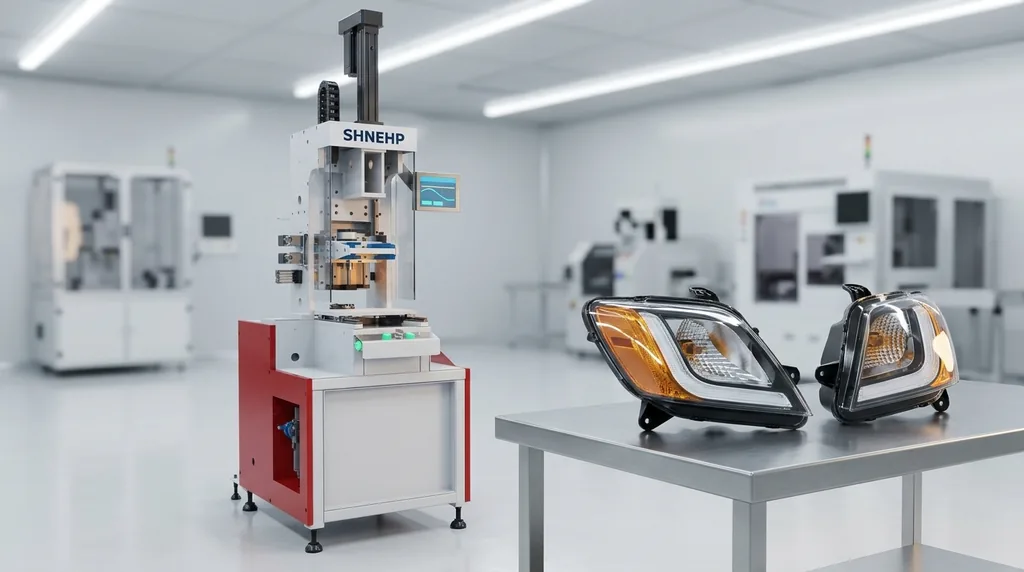
Automotive turn signal lamps, fender side-marker lamps, mirror puddle repeaters, and bumper daytime running lights (DRLs) sit directly in the wheel-spray and pressure-wash impact zone where moisture ingress immediately causes condensation, LED driver corrosion, and regulatory inspection failure. Applying hot plate welding signal lamps permanently fuses transparent PMMA (acrylic) or polycarbonate (PC) outer lenses to ABS, ASA, PBT, or PC/ABS housings across complex 3D curved perimeters without glue cure ovens or solvent outgassing. SHNEHP engineers 3-axis servo and compact vertical hot plate platforms (XNS2-B, XNS5-B, XN-300C) tailored to high-mix automotive lighting Tier-1 and Tier-2 plants.
The part and its welding challenges
Signal and marker lamps combine compact optical geometry with strict automotive exterior durability standards (ECE / SAE / GB photometric compliance and IP67 / IP69K washdown resistance). Manufacturing lines typically overcome five production hurdles:
- Dissimilar lens-to-housing melt temperatures: Pairing an optical PMMA or PC lens with an opaque ABS, ASA, or PC/ABS housing creates a 20–45 °C softening-point differential; a single-temperature platen overheats the housing while leaving the PC lens under-melted.
- Zero-scratch cosmetic lenses and micro-crazing prevention: Clear and amber signal lenses display every clamp scuff or pinpoint stress mark under headlamp inspection tunnels, requiring contoured soft-touch elastomer nests and vacuum hold-downs.
- Zero internal stringing inside narrow reflector cavities: Compact turn indicators and sequential LED light-blade DRLs have tight clearances between the weld flange and internal chrome bezels; a single resin thread pulled from an overheated PTFE surface creates a cosmetic reject.
- Moisture outgassing on hygroscopic PC and PMMA: Un-dried polycarbonate or acrylic absorbs ambient humidity and forms micro-bubbles at the heated weld lip, which later appear as hazy fogging or leak channels during high-pressure car washes.
- Left/right dual-cavity synchronization: Most exterior signal lamps are produced in matched left-hand and right-hand pairs, demanding rigid parallel clamping and balanced dual-zone heating so both lenses finish to identical overall stack height.
Why hot plate welding (vs. alternatives)
| Process | Fit for automotive signal & marker lamps | Optical cleanliness & 3D contour reach | Typical cycle time | Engineering boundary |
|---|---|---|---|---|
| Dual-temp servo hot plate welding (XNS2-B / XNS5-B / XN-300C) | Primary production choice for curved PMMA/PC lenses joined to ABS, ASA, or PC/ABS housings | Contoured 3D heating faces track steep bumper sweeps; hidden dual flash traps keep internal reflectors clean | ~18–32 s (single or L/R pair) | Keep contact PTFE below ~270 °C; upgrade to non-contact IR above 270–300 °C |
| Non-contact infrared hot plate welding | High-temp PC-to-PBT/PC signal lamps with zero-stringing cosmetic requirements | Zero platen contact eliminates PTFE wear and resin threads completely | ~18–30 s | Higher tooling engineering cost; best justified on high-volume LED blades or >270 °C resins |
| Ultrasonic welding (XNC-400 / XN-3) | Small flat side-marker lamps and compact rigid reflectors within near-field (≤6 mm) | Fast sub-second weld; zero thermal radiant exposure to nearby LEDs | ~0.3–1.2 s | Risk of cosmetic horn marking on clear PMMA/PC, weld-line crazing, and LED driver vibration shock |
| Laser transmission welding | Premium slimline LED light-guide DRLs with IR-transparent lens and IR-absorbent housing | Virtually zero flash and minimal thermal footprint | ~4–12 s | Sensitive to tight part-to-part clamping gap tolerances and high diode/scanner capital cost |
Typical process window (industry ranges)
Signal lamp welding follows DVS 2215 five-stage thermal control with independent upper (lens) and lower (housing) heating zones. Exact parameters are validated on actual molded parts during a SHNEHP weld trial.
| Parameter | Typical industry range (PMMA / PC + ABS / ASA) | Engineering guidance |
|---|---|---|
| Pre-weld resin conditioning | PC / PC-ABS / PBT: 100–120 °C; PMMA / ABS: 75–85 °C | Eliminates moisture bubbles and cloudy interface seams in clear outer lenses |
| Independent platen temperatures | ABS / ASA / PMMA side: 235–265 °C; PC side: 265–295 °C (or non-contact IR 320–450 °C) | Dual-face independent PID heating balances dissimilar lens/housing viscosities; switch to IR above ~270 °C PTFE ceiling |
| Bead-up / leveling (Stage 1) | 0.3–0.6 mm displacement at 0.12–0.20 N/mm² | Seats 3D contoured lens flange evenly across the heated face |
| Melt / soak phase (Stage 2) | 6–15 s at 0.02–0.05 N/mm² | Builds uniform 0.7–1.2 mm molten layer while internal heat shields protect LED PCBs |
| Changeover time (Stage 3) | ≤1.4–2.0 s | Fast 3-axis servo platen retraction prevents cold-skinning on thin PMMA/PC edges |
| Joining & cooling (Stages 4–5) | 0.15–0.25 N/mm² to closed-loop servo hard stop (1.0–1.8 mm total collapse); hold 6–12 s | Closed-loop collapse preserves mounting-tab alignment and bumper flushness |
Recommended SHNEHP machine and fixture setup
SHNEHP configures compact and mid-size hot plate welding machines for signal lamp cells using our standard +60 mm platen clearance margin around the tooling envelope:
- Compact single-lamp or L/R side-marker cells: XNS2-B 3-axis full-servo hot plate welder or compact vertical XN-300C / XN-400P pneumatic units provide cleanroom-ready enclosures, dual-side independent PID temperature control, and fast mold changeover.
- Wide sequential DRL & multi-cavity signal lamp pairs: XNS5-B and XNS6-B servo platforms accommodate wide dual-cavity L/R nests with servo-controlled joining profiles and non-contact IR upgrade modules.
- Optical-grade fixtures: Custom welding and testing fixtures integrate non-marring polyurethane lens cradles, vacuum retention cups, internal LED PCB thermal shields, and quick-change multi-model baseplates.
Quality and leak testing
Exterior automotive signal lamps require 100% end-of-line leak verification before breathable ePTFE vent membranes are applied:
- Differential pressure-decay IP67 testing: Automated fixtures seal the vent-patch port and inspect every welded lamp at 10–30 kPa with an acceptance threshold of 0.1–0.5 mL/min (1 Pa differential resolution, 3–5 s stabilization stage) to catch micro-pinholes invisible to visual checks.
- Photometric & cross-section qualification: First-article audits verify zero lens warpage in CMM check fixtures, clean double-trap flash containment, and thermal shock cycling (-40 °C to +85 °C) without condensation fogging.
FAQ
Can hot plate welding join a clear PMMA or PC signal lens to an ABS or ASA housing without yellowing? Yes. By using a dual-face hot plate with independent upper and lower PID temperature zones, the ABS/ASA housing runs cooler while the PMMA/PC lens reaches optimal melt viscosity without thermal scorching or yellowing.
When should signal lamp lines switch from contact PTFE hot plates to non-contact infrared heating? Whenever required platen temperatures exceed the practical ~270 °C ceiling of PTFE anti-stick coatings—common on pure PC lenses joined to PBT or PC/PBT housings—or when optical interiors demand strictly zero stringing risk.
How are internal LED circuit boards protected from heat during signal lamp hot plate welding? Custom upper and lower tooling incorporates recessed thermal shield plates that block radiant heat from reaching LED strips, light pipes, and reflector bezels while exposing only the perimeter weld rib.
Can one SHNEHP machine weld both left-hand and right-hand signal lamps simultaneously? Yes. XNS5-B and XNS6-B servo hot plate machines routinely run mirrored L/R dual-cavity tooling in a single 20–30 second cycle, balancing output directly to vehicle assembly demand.
What CAD data is needed for a SHNEHP signal lamp weld trial? Provide 3D STEP/X_T assemblies of the lens and housing (showing flash traps and LED clearances), exact lens/housing resin grades, target hourly output, and your OEM IP67 leak specification.
Get a free weld trial
Send your automotive signal lamp, DRL, or side-marker CAD files to SHNEHP engineering to evaluate dual-temp contact vs. non-contact IR hot plate welding and review flash-trap geometry:
- 3D STEP / X_T / IGES models of lens, housing, and internal bezel
- Resin combination (PMMA, PC, ABS, ASA, PBT, PC/ABS)
- Target L/R cycle time and IP67 pressure-decay acceptance limits
Email yy@nbxiaoneng.com or submit your project via our contact page.
Request a Technical Consultation & Free Weld Trial
Send your 3D STEP/X_T drawing, resin grade, target cycle time, and leak-test specification. Our engineers will evaluate the joint and recommend a practical SHNEHP machine and fixture setup.