
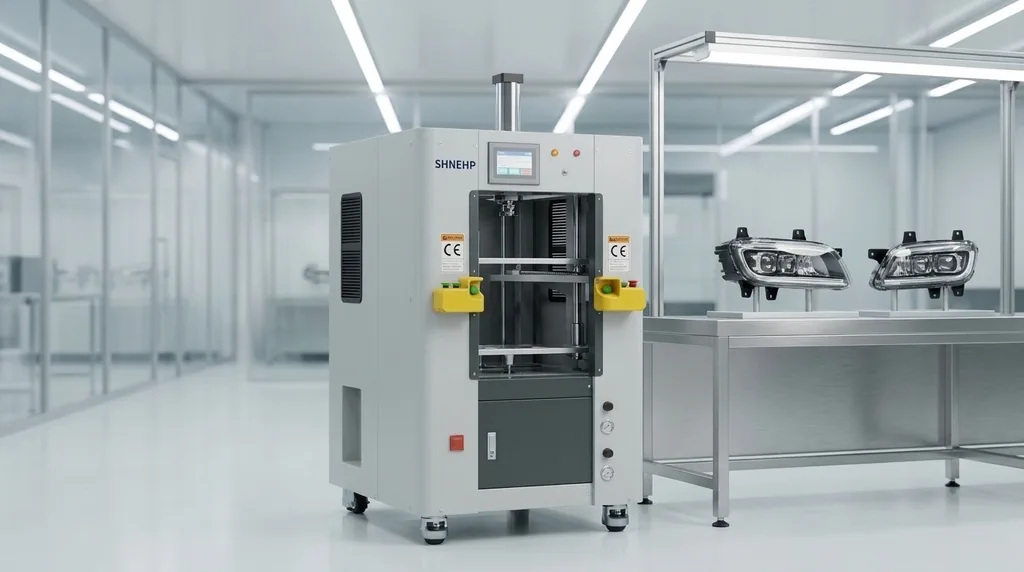
Mounted low in the front bumper fascia, automotive LED fog lamps and cornering lights take the worst road abuse on the vehicle—direct puddle submersion, gravel impact, de-icing salt spray, and rapid thermal shock when cold splash water hits a hot LED heatsink housing. Applying hot plate welding fog lamps fuses clear polycarbonate lenses onto rugged matched-chemistry lamp housings in a single compact multi-cavity cycle, locking out condensation without messy silicone adhesives or curing racks. SHNEHP engineers 3-axis servo hot plate platforms (XNS2-B, XNS5-B, XNS6-B) with optional non-contact infrared (IR) heating built to DVS 2215 precision.
The part and its welding challenges
Automotive fog lights typically join a hard-coated optical polycarbonate (PC) outer lens to a compatible PC/ABS, PC-GF, PBT, or ASA rear housing (matched polymer chemistry is mandatory; incompatible resin pairs such as PC-to-PP cannot directly fuse). Sealing compact bumper-level optical lamps presents five distinct hurdles:
- Severe road-splash & condensation resistance (IP67/IP6K9K): Bumper-mounted lamps endure high-pressure wash jets and standing puddle water; any micro-porosity along the lens perimeter admits humid air and causes immediate lens fogging.
- Optical PC lens clarity & hard-coat protection: Scratches, clamping witness marks, or melt stringing across the compact optical beam zone scatter light and fail ECE/SAE photometric beam-pattern audits.
- Steep angled bumper-contour lens bezels: Modern sculpted bumper openings give fog lamps sharply raked 3D elliptical or trapezoidal bezels that require precision CNC-contoured heating shoes.
- Pre-drying hygroscopic polycarbonate lenses: Un-dried PC lenses release steam micro-bubbles inside the weld bead, creating both cosmetic clouding and field moisture channels.
- Left/right dual-cavity production economics: Tier-1 lighting plants normally weld LH + RH fog lamps simultaneously on twin-cavity fixtures to cut labor and balance line takt times.
Why hot plate welding (vs. alternatives)
| Process | Fit for automotive fog lamps & cornering lights | Optical clarity & IP sealing | Typical cycle time | Engineering boundary |
|---|---|---|---|---|
| Servo hot plate — contact & non-contact IR (XNS2-B / XNS5-B / XNS6-B) | Primary choice for raked 3D PC/PC-ABS and PC/PBT fog lamps and LH+RH dual-cavity runs | Follows steep bumper angles evenly; non-contact IR eliminates PTFE sticking and stringing over clear lenses | ~18–32 s (2-cavity LH+RH simultaneous) | Pre-dry PC (100–120 °C); keep servo changeover ≤1.5 s; use non-contact IR above ~270 °C PTFE ceiling |
| Ultrasonic welding (XNC-400 / XN-5) | Small, strictly planar circular fog lamps with rigid energy directors | Fast sub-second local welds | ~0.2–1.2 s | Struggles with steeply raked 3D elliptical bezels and risks crazing hard-coated PC lenses or vibrating internal LED drivers |
| Linear vibration friction (XN-35) | Flat rectangular auxiliary work lamps | Strong structural weld | ~5–12 s total | Linear motion creates fine particulate dust inside the optical reflector cavity and cannot follow steep raked curves |
| Silicone / PU adhesive dispensing | Incompatible PC-lens to aluminum-heatsink rear housings | Joins plastic to die-cast metal | Long cure ovens & VOC | High adhesive/primer BOM and curing space; all-thermoplastic fog lamps weld far faster and cleaner via hot plate |
Typical process window (industry ranges)
The conservative DVS 2215 five-stage baselines below guide PC-to-PC/ABS and PC-to-PC fog lamps. Exact upper/lower zone temperatures and collapse stops are confirmed during a SHNEHP part-specific weld trial.
| Parameter | Typical industry range (PC lens + PC/ABS or PC housing) | Engineering guidance |
|---|---|---|
| Pre-drying before welding | PC & PC/ABS: 100–120 °C | Essential to eliminate steam micro-porosity and internal lens fogging |
| Heating mode & temperature | Contact platen: PC/ABS 265–290 °C, PC 275–305 °C; Non-contact IR: 300–480 °C | Independent upper/lower PID zones match lens vs. housing melt rates; non-contact IR prevents stringing above ~270 °C |
| Bead-up / leveling (Stage 1) | 0.3–0.7 mm (contact) or 1–2 mm emitter standoff (IR) | Levels raked 3D bezel contours uniformly prior to soak |
| Melt / soak phase (Stage 2) | 5–14 s at 0.05–0.09 N/mm² | Localizes melt strictly to the perimeter rib behind the dark decorative bezel |
| Changeover time (Stage 3) | ≤1.4–1.8 s | High-speed 3-axis servo retraction prevents cold-weld lines on fast-freezing PC |
| Joining & collapse (Stage 4) | 0.15–0.25 N/mm² to closed-loop servo hard stop (1.0–1.8 mm) | Conceals weld flash completely inside enclosed optical flash traps |
| Cooling / hold (Stage 5) | 5–12 s | Preserves beam-aiming mounting-tab geometry cleanly upon release |
Recommended SHNEHP machine and fixture setup
Applying our +60 mm clearance rule across our compact-to-mid-size 3-axis servo hot plate welding machines:
- Single-cavity compact fog lamps: XNS2-B and XNS5-B 3-axis full-servo hot plate welders offer micron-grade collapse precision, independent upper/lower PID control, and small assembly-line footprints.
- Dual-cavity LH + RH fog lamp production: XNS6-B servo platform runs left-hand and right-hand fog lamps simultaneously in one synchronized stroke.
- Non-contact IR & scratch-free optical tooling: Custom welding and testing fixtures pair soft polyurethane/acetal lens cradles and vacuum retention with optional non-contact IR emitters—integrating seamlessly with inline leak testing on customized machines.
Quality and leak testing
Bumper-level fog lamps undergo 100% dry-air inline airtightness verification through the open ePTFE breather-membrane port:
- 100% inline differential pressure leak testing: Fog lamps are tested at 10–30 kPa against tight 0.1–0.5 mL/min pass limits using 1 Pa differential pressure transducers and a 3–5 s stabilization stage prior to breather-patch application.
- Photometric & thermal-shock audits: Periodic batch audits test optical beam pattern, gravel impact, and cold-water splash thermal shock to guarantee zero condensation.
FAQ
Can a single SHNEHP hot plate welder seal both left-hand and right-hand fog lamps at once? Yes. On XNS5-B or XNS6-B 3-axis servo platforms, dual-cavity (LH + RH) fixtures weld matched bumper pairs simultaneously in ~18–32 seconds with independent thermal zone tuning.
When should automotive fog lamps switch from contact hot plate to non-contact IR welding? Choose non-contact infrared (IR) heating when welding optical polycarbonate above the ~270 °C PTFE contact ceiling or whenever strict zero-stringing cleanliness inside a compact clear reflector bowl is required.
Why is hot plate welding safer than ultrasonic welding for LED fog lamps? Hot plate welding introduces zero high-frequency mechanical vibration that could fracture internal LED driver solder joints, shake optical projectors out of aim, or stress-craze hard-coated polycarbonate lenses.
What leak-test pressure validates waterproof automotive fog lamps? Inline dry-air testing through the breather port typically runs at 10–30 kPa with 0.1–0.5 mL/min acceptance thresholds on a 1 Pa-resolution differential tester and a 3–5 s stabilization period.
What files should we send for a fog lamp weld trial? Share frozen 3D STEP/X_T models of the lens and housing, exact PC / PC-ABS / PBT grades, optical beam keep-out zones, LH+RH cavity targets, and OEM leak-test specs.
Get a free weld trial
Send your fog lamp CAD drawings to SHNEHP engineering to evaluate contact vs. non-contact IR dual-cavity tooling and inline differential leak testing:
- Frozen 3D STEP / X_T / IGES models of the lens, bezel, and lamp housing
- Polymer grades (optical PC lens + compatible PC/ABS, PC, or PBT housing)
- Target hourly output (UPH) and condensation/IP leak specification
Email yy@nbxiaoneng.com or connect through our contact page.
Request a Technical Consultation & Free Weld Trial
Send your 3D STEP/X_T drawing, resin grade, target cycle time, and leak-test specification. Our engineers will evaluate the joint and recommend a practical SHNEHP machine and fixture setup.