
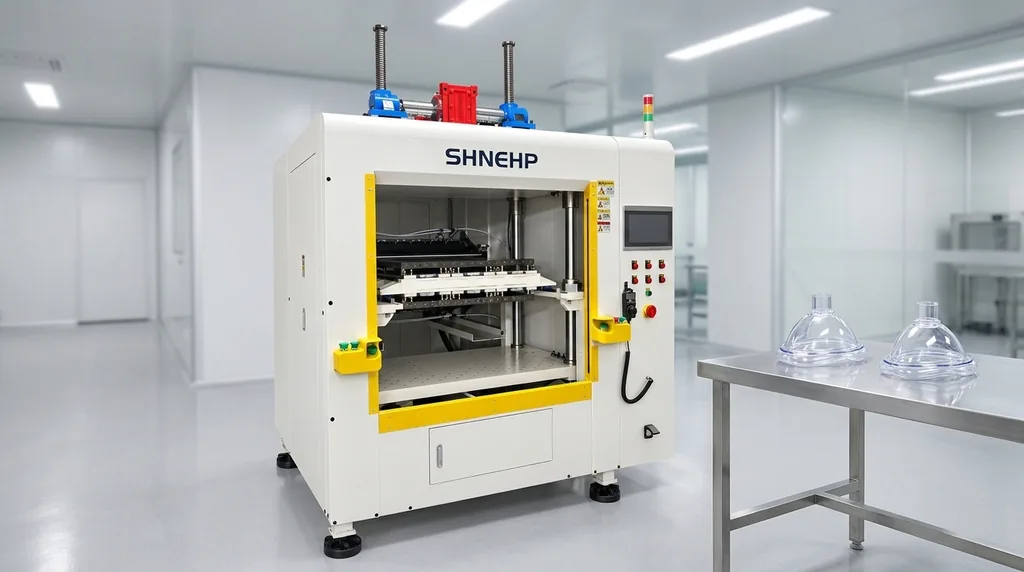
Hospital anesthesia face masks, non-invasive ventilation (CPAP/BiPAP) hard shells, oxygen-therapy manifolds, and reusable half-face/full-face industrial respirators feature steep 3D anatomical contours that must maintain an airtight seal across every exhalation valve, bayonet filter port, and perimeter rim. Utilizing hot plate welding respiratory masks fuses multi-plane rigid mask shells, translucent visors, and dual-port valve cartridges in a single gentle cycle without ultrasonic cracking or solvent fumes. SHNEHP builds 3-axis servo hot plate platforms (XNS2-B, XNS5-B, XNS6-B) with CNC-contoured heating platens engineered to DVS 2215 displacement control.
The part and its welding challenges
Rigid respiratory mask frames, oxygen manifolds, and filter-cartridge housings are typically molded from medical/respiratory-grade polycarbonate (PC), polypropylene (PP), ABS, PVC, or PC/ABS (note: soft silicone or TPE face cushions are mechanically overmolded or snap-locked rather than direct-welded to rigid shells, since soft elastomers like silicone/TPE cannot be vibration or standard-welded to incompatible rigid substrates). Welding rigid mask shells poses five practical hurdles:
- Steep 3D ergonomic face contours: Mask frames curve simultaneously along the nose bridge, cheeks, and chin; flat welding processes cannot contact or transmit uniform energy across steep multi-axis curves.
- Transparent visor & mask optics: Clear PC anesthesia domes and full-face respirator lenses must stay optically distortion-free with zero hazing, clamp witness marks, or melt stringing in the clinician's or wearer's line of sight.
- Bayonet filter ports & exhalation valve concentricity: Rigid respirator shells carry precise circular bayonet mounts and silicone flapper-valve seats; weld collapse must maintain tight axial height so inhalation/exhalation valves seal cleanly at low breathing pressures.
- Zero sharp exterior flash: Any protruding sharp plastic bead near the face-cushion groove or strap lug creates wearer discomfort or tears soft silicone seals during assembly.
- Odor-free medical cleanliness: Respiratory devices sit directly over the airway—chemical adhesives risk lingering volatile odors and biocompatibility failures, making clean thermal fusion the preferred joining method.
Why hot plate welding (vs. alternatives)
| Process | Fit for rigid respiratory mask shells & manifolds | 3D contour & optical capability | Typical cycle time | Engineering boundary |
|---|---|---|---|---|
| Servo hot plate — contact & non-contact IR (XNS2-B / XNS5-B / XNS6-B) | Primary choice for 3D-curved rigid mask frames, visor-to-frame joints, and dual-port respirator filter cartridges | CNC-contoured 3D heating platens follow steep nose-bridge curves evenly; non-contact IR protects optical PC clarity | ~18–35 s (2-cavity or 4-cavity nests scale output) | Requires rigid matching thermoplastic grades (PC-to-PC, PP-to-PP); soft silicone/TPE cushions are assembled separately |
| Ultrasonic welding (XNC-400 / XN-3 / XN-5) | Small circular exhalation valve rings, swivel elbow ports, and nonwoven disposable N95/FFP2 fabric mask bonding | Sub-second local welds on small circular rings and fabric ear-loops | ~0.1–1.2 s | Struggles with deep 3D curved rigid mask perimeters and risks micro-cracking thin transparent PC visors |
| Spin welding (XNX-100 / XNX-200) | Strictly cylindrical screw-on respirator filter canisters and round valve housings | Strong airtight circular weld at 3–15 m/s surface speed | ~0.5–3 s weld | Limited to rotationally symmetrical round parts; cannot join contoured mask shells |
| Solvent / adhesive bonding | Low-volume specialty visors | No molten flash | Slow curing & outgassing | Volatile odors directly in breathing zone, adhesive consistency issues, and regulatory validation overhead |
Typical process window (industry ranges)
The conservative DVS 2215 five-stage baselines below guide rigid respiratory mask shells and filter-cartridge bodies. Exact heating profiles and collapse stops are finalized during a SHNEHP weld trial.
| Parameter | Typical industry range (PP / ABS / PC) | Engineering guidance |
|---|---|---|
| Pre-drying before welding | PC: 100–120 °C; ABS / PC-ABS: 80–100 °C | Mandatory for transparent PC anesthesia domes and visors to eliminate steam bubbles |
| Heating mode & temperature | Contact platen: PP 245–275 °C, ABS 235–265 °C, PC 275–305 °C; Non-contact IR: 300–450 °C | Use non-contact IR on optical PC visors or when temperature exceeds ~270 °C PTFE ceiling |
| Bead-up / leveling (Stage 1) | 0.4–0.8 mm displacement | Compensates for molded 3D warp along curved nose-bridge and cheek flanges |
| Melt / soak phase (Stage 2) | 5–15 s at 0.05–0.09 N/mm² | Independent upper/lower PID zones balance thin visors against thicker manifold frames |
| Changeover time (Stage 3) | ≤1.5 s (PC) / ≤2.2 s (PP) | Rapid 3-axis servo retraction prevents cold-weld lines at steep contour corners |
| Joining & meltdown (Stage 4) | 0.15–0.25 N/mm² to closed-loop servo hard stop (1.0–2.0 mm) | Enclosed flash traps keep both breathing interior and outer cushion groove smooth |
| Cooling / hold (Stage 5) | 5–12 s | Preserves 3D facial geometry and bayonet port concentricity upon demolding |
Recommended SHNEHP machine and fixture setup
SHNEHP tailors vertical 3-axis servo hot plate welding machines for contoured respiratory mask shells and multi-cavity cartridge runs:
- Single/dual-cavity anesthesia & CPAP masks: XNS2-B or XNS5-B compact 3-axis servo hot plate welders provide smooth acceleration profiles and micron-class collapse stops for fragile clear domes.
- Multi-cavity respirator frames & full-face visor housings: XNS6-B servo platform (sized using our +60 mm fixture clearance rule) runs twin- or quad-cavity CNC-contoured fixtures to meet high-volume PPE and hospital supply schedules.
- Scratch-free 3D contour tooling: Custom welding and testing fixtures feature non-marring polyurethane/acetal optical nest cradles, vacuum retention cups that protect clear PC surfaces, and precision bayonet-port alignment pins.
- Turnkey weld-and-test stations: For automated mask/cartridge production, customized machines pair hot plate welding with inline pneumatic airtightness testing, valve-cracking-pressure checks, and automatic reject sorting.
Quality and leak testing
Respiratory masks and filter housings undergo low-pressure airtightness verification aligned with breathing-circuit safety demands:
- 100% inline low-pressure leak testing: Rigid mask assemblies and valve chambers are typically screened at low pneumatic pressures (5–30 kPa, positive or vacuum) with tight pass thresholds (0.1–0.5 mL/min) using 1 Pa differential pressure decay and a 3–5 s stabilization stage to absorb thin-shell flexing.
- Inhalation / exhalation valve verification: Integrated test fixtures can simultaneously check silicone flapper-valve seating leak rate and opening pressure alongside perimeter weld integrity.
- Optical & tactile edge audit: Visual inspection checks transparent domes for zero stress hazing, zero stringing inside the breathing chamber, and smooth exterior cushion-groove seating.
- Batch traceability: Per-cycle logging of zone temperatures, changeover duration, meltdown depth, and leak-test outcome supports hospital/PPE quality audits.
FAQ
Can hot plate welding join soft silicone mask cushions directly to rigid PC/PP respiratory shells? No. Soft silicone and incompatible TPE elastomers cannot be directly hot-plate welded to rigid PC or PP frames. Hot plate welding joins the rigid thermoplastic shell halves, visors, valve housings, and filter cartridges, while soft face cushions are overmolded or mechanically locked onto the welded groove.
Why choose hot plate welding over ultrasonic welding for 3D-curved rigid respiratory masks? 3D ergonomic mask frames curve steeply across multiple planes where ultrasonic horns struggle to couple energy evenly without marring or cracking clear PC visors. CNC-contoured servo hot plate platens heat the entire 3D perimeter uniformly with zero acoustic stress.
How do you protect clear polycarbonate respiratory visors from scratches and hazing during welding? Pre-dry PC parts thoroughly (100–120 °C), use non-contact IR heating (or clean contoured platens) to prevent stringing, and cradle the visor in vacuum-assisted soft polyurethane/acetal fixtures that never contact the optical viewing area.
What leak-test setup works best for welded respiratory mask shells? Low-pressure dry-air differential pressure decay (5–30 kPa, 0.1–0.5 mL/min, 3–5 s stabilization) using soft contoured silicone sealing gaskets verifies hermetic integrity cleanly without moisture exposure.
What should we send for a SHNEHP respiratory mask weld trial? Share 3D STEP/X_T models of the rigid shell and visor/manifold, exact resin grade, optical keep-out zones, target hourly output (UPH), and breathing-circuit leak-test criteria.
Get a free weld trial
Send your respiratory mask shell or filter-housing CAD models to SHNEHP engineering to evaluate 3D-contoured servo hot plate welding and inline low-pressure leak testing:
- 3D STEP / X_T / IGES models of the rigid mask frame, visor, and valve ports
- Polymer grade & optical requirements (PC, PP, ABS, PC/ABS)
- Target hourly output (UPH) and breathing-circuit leak specification
Email yy@nbxiaoneng.com or connect through our contact page.
Request a Technical Consultation & Free Weld Trial
Send your 3D STEP/X_T drawing, resin grade, target cycle time, and leak-test specification. Our engineers will evaluate the joint and recommend a practical SHNEHP machine and fixture setup.