
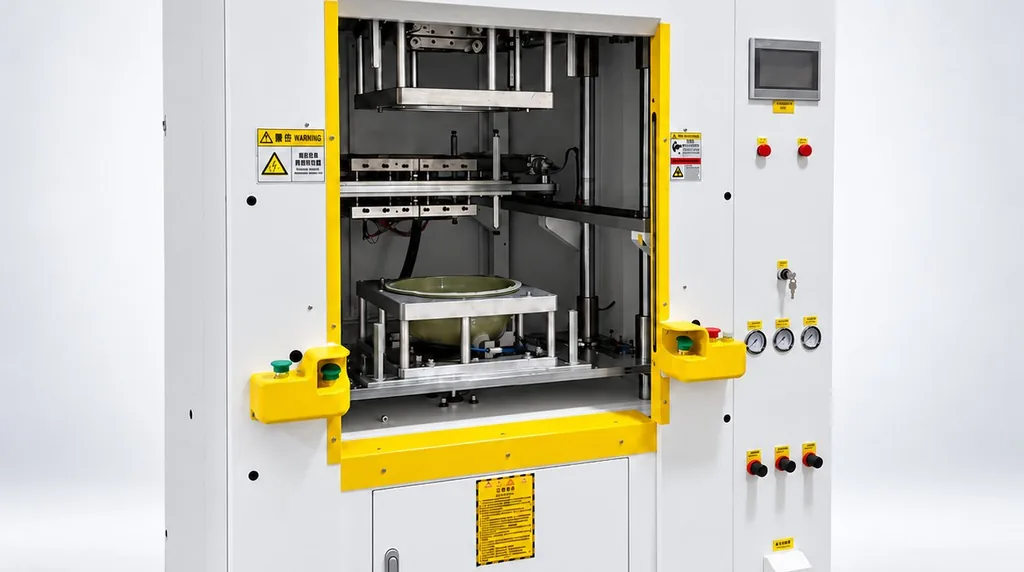
Automatic transmission oil-pan filter modules, EV drive-unit electric oil-pump filters, dual-clutch (DCT) hydraulic filter sumps, and integrated engine oil-filter cooler housings operate continuously in 120–150 °C hot engine/transmission oil under 500–1,000 kPa pressure pulsations. Because integrated oil-pan filters and asymmetric transmission filter modules feature complex 3D stepped flanges, recessed pick-up snorkels, and high-glass-fiber PA66-GF30/35/40, PPA-GF, or PPS shells, hot plate welding oil filters—particularly non-contact infrared hot plate welding—creates clean, zero-debris, high-burst-strength molecular seams that never shed abrasive fibers into precision transmission valve bodies or bearings. SHNEHP builds 3-axis servo and non-contact IR hot plate platforms (XNS5-B, XNS6-B, XNS8-B) engineered for Tier-1 powertrain filtration lines.
The part and its welding challenges
Automotive engine and automatic-transmission plastic oil filters combine extreme thermal/hydraulic loads with ultra-strict clean-side ISO 16232 particulate limits, presenting five manufacturing hurdles:
- High-temp, high-glass-fiber PA66-GF35/40 and PPS exceed PTFE durability: Oil-resistant polyamides and polyphenylene sulfide require melt temperatures well above the ~270 °C operating ceiling of contact PTFE coatings, and GF≥40% rapidly abrades coated contact surfaces; non-contact infrared heating (300–500 °C) eliminates coating wear, sticking, and carbon flakes completely.
- Zero clean-side flash or glass-fiber debris inside hydraulic oil galleries: Even a single 0.3 mm loose nylon bead or fiber bundle downstream of a DCT/AT oil filter can jam solenoid spool valves or score turbocharger bearings; zero-contact IR fusion paired with enclosed inner flash traps guarantees spotless clean-side passages.
- Sealing deep 3D stepped transmission-filter profiles: Integrated transmission-pan filters have offset oil pickup snorkels, bypass valves, and multi-plane bolt flanges that cannot be vibration-welded along a flat plane—requiring contoured 3D heating faces.
- High hydraulic burst & hot-oil thermal-shock fatigue: Oil filter modules must survive cold-start viscosity spikes (1.5–2.5+ MPa hydrostatic burst requirements) and continuous -40 °C to +150 °C hot-oil cycling without creep cracking.
- Mandatory polyamide drying prior to welding: Hygroscopic PA66-GF and PA6-GF absorb ambient humidity quickly; welding wet nylon generates micro-void steam bubbles that weep hot oil under pressure spikes.
Why hot plate welding (vs. alternatives)
| Process | Fit for engine & transmission oil filters / pan modules | Zero debris & 3D contour reach | Typical cycle time | Engineering boundary |
|---|---|---|---|---|
| Non-contact IR / servo hot plate welding (XNS5-B / XNS6-B / XNS8-B) | Optimal choice for asymmetric transmission oil-pan filters, EV e-axle oil filters, and 3D stepped PA66-GF35/40 or PPS filter housings | Zero friction dust, zero PTFE flaking, handles steep 3D oil pickup snorkels and bypass ports cleanly | ~20–36 s (single or 2-up) | Requires mandatory 80–100 °C polyamide drying and fast ≤1.5–2.0 s servo changeover |
| Linear vibration friction welding (XN-35 / XN-55 / XN-70) | High-volume flat-flange transmission oil filter boxes (with enclosed dust traps) | Fast 2–5 s weld cycle with two-stage pressure control for PA-GF | ~10–18 s total | Generates fine dry glass-fiber friction powder during startup (strict dust-trap needed) and requires flat/gentle plane + ≥2.5–3.0 mm clearance |
| Spin welding (XNX-100 / XNX-200) | Purely cylindrical screw-on plastic oil filter canisters | Ultra-fast 0.5–3 s circular seal | ~0.5–3 s | Limited exclusively to symmetric circular joints |
| Ultrasonic welding | Compact internal bypass check-valve caps only | Sub-second auxiliary sub-assembly | ~0.3–1.0 s | Insufficient continuous hydraulic burst strength on large glass-filled PA66 oil sumps |
Typical process window (industry ranges)
Powertrain oil-filter sealing adheres to DVS 2215 displacement-controlled thermal fusion, shifting directly to non-contact infrared heating whenever resin melt temperatures exceed ~270 °C or glass loading hits ≥40%. Exact windows are validated during a SHNEHP trial.
| Parameter | Typical industry range (PA66-GF30/35/40 / PA6-GF / PPS) | Engineering guidance |
|---|---|---|
| Pre-weld resin drying | PA66-GF / PA6-GF: 80–100 °C; PPS / PPA: 100–120 °C | Mandatory to prevent steam micro-porosity under rapid 300–500 °C IR heating |
| Heating mode & temperature | Non-contact infrared (recommended >270 °C or GF≥40%): 320–500 °C; contact PTFE (lower-temp grades only): ≤265 °C | Non-contact IR guarantees zero PTFE degradation and zero stringing inside clean-side oil passages |
| Radiant gap / soak phase | Uniform 1.0–2.0 mm air gap; soak 8–18 s | Local reflective shields protect internal pleated synthetic filter media and rubber check valves |
| Servo changeover time | ≤1.4–2.0 s | Fast 3-axis servo retraction prevents rapid crystallization cold-welds on high-GF nylon |
| Joining & hold phase | 0.25–0.40 N/mm² to closed-loop servo hard stop (1.5–2.5 mm collapse); hold 8–16 s | Enclosed double flash traps lock minimal melt beads safely away from hydraulic flow channels |
Recommended SHNEHP machine and fixture setup
SHNEHP builds heavy-rigidity 3-axis servo hot plate welding machines equipped with non-contact IR radiant modules (+60 mm platen margin rule):
- Compact transmission & EV drive-unit oil filters: XNS5-B and XNS6-B 3-axis servo hot plate welders offer micron-accurate closed-loop collapse stops, multi-zone non-contact IR emitters, and rigid parallel clamping.
- Large integrated transmission oil-pan filter modules & 2-up cells: XNS8-B wide-bed servo platforms support heavy multi-cavity contoured IR tooling with rolling quick-change carts and robotic load/unload inside customized machines.
- Clean-side poka-yoke tooling: Custom welding and testing fixtures verify internal pleated media and silicone bypass-valve placement before welding and transfer parts directly to high-pressure dry-air leak stations.
Quality and leak testing
Engine and transmission oil filters enforce rigorous pressure, cleanliness, and burst qualification:
- 100% inline pressure-decay leak testing: Automated fixtures seal the oil pickup snorkel and outlet port to verify weld airtightness at 100–300 kPa against a 1–5 mL/min limit (or OEM hydraulic proof pressure up to 500+ kPa), linking every serialized filter to MES.
- ISO 16232 cleanliness & burst audits: Periodic batch samples undergo clean-side gravimetric/microscopic particulate wash tests confirming zero loose fibers, plus hydrostatic burst (1.5–2.5+ MPa) and hot-oil pressure-pulsation cycling.
FAQ
Why is non-contact IR hot plate welding strongly recommended for PA66-GF35/40 automotive oil filters? Glass-filled PA66-GF35/40 and PPS require melt temperatures above PTFE's ~270 °C durability limit and rapidly abrade contact coatings. Non-contact IR heats cleanly across a 1–2 mm air gap at 300–500 °C—eliminating PTFE flaking, stringing, and clean-side particulate debris.
When should a transmission oil filter use hot plate welding instead of linear vibration welding? Choose non-contact IR / servo hot plate welding when the filter features stepped 3D pickup snorkels, complex multi-plane flanges, or ultra-strict ISO 16232 clean-side cleanliness rules where friction dust cannot be risked; choose linear vibration welding for flat-plane high-volume housings with enclosed dust traps.
How are internal pleated filter media and elastomer bypass valves protected during IR hot plate welding? Precision contoured fixture masks and reflective metal heat shields sit immediately inside the weld rib, directing infrared radiation strictly onto the plastic joining flange while shielding media pleats and seals.
What inline leak test pressure applies to welded plastic oil filters? Inline dry-air differential pressure-decay fixtures typically verify welded oil filters at 100–300 kPa / 1–5 mL/min (or higher OEM proof pressures), backed by periodic 1.5–2.5+ MPa hydrostatic burst audits.
What CAD data is needed for an oil-filter hot plate / IR weld trial? Share 3D STEP/X_T models showing flange steps, media clearances, and port datums, exact resin grade and glass-fiber percentage (PA66-GF30/35/40, PPS), burst/cleanliness specs, and target hourly volume.
Get a free weld trial
Send your transmission, EV drive-unit, or engine oil-filter CAD assemblies to SHNEHP engineering to evaluate zero-debris non-contact IR hot plate welding vs. vibration welding and test burst strength on real moldings:
- 3D STEP / X_T / IGES models of oil filter shell, cover, and media clearance
- Resin & GF% spec (PA66-GF30/35/40, PA6-GF, PPA, PPS)
- Burst pressure, ISO 16232 cleanliness criteria, and target UPH
Email yy@nbxiaoneng.com or connect through our contact page.
Request a Technical Consultation & Free Weld Trial
Send your 3D STEP/X_T drawing, resin grade, target cycle time, and leak-test specification. Our engineers will evaluate the joint and recommend a practical SHNEHP machine and fixture setup.