
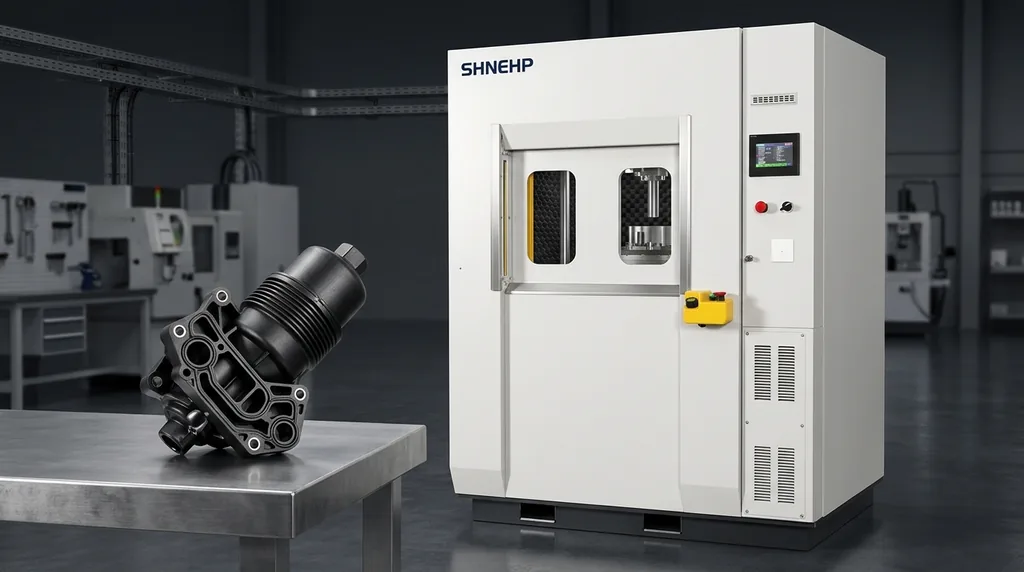
Under-hood engine oil filter modules, integrated oil-cooler manifolds, and sealed transmission-oil canisters endure severe cold-start oil pressure spikes (up to 10+ bar in extreme winter starts), continuous 130–150 °C hot-oil immersion, and direct engine-block vibration. Deploying vibration welding oil filters joins heavy glass-filled polyamide housing shells and internal oil-gallery partitions with near-parent-material structural strength in a single rapid cycle. SHNEHP engineers high-frequency (210–270 Hz) linear vibration welders (XN-35, XN-40, XN-55, XN-70) built to DVS 2217 displacement precision for automotive powertrain suppliers.
The part and its welding challenges
Thermoplastic automotive oil filter modules and transmission-fluid canisters are almost universally molded from heat-stabilized PA66-GF30 / PA66-GF35, PA6-GF30, or PPS-GF to replace die-cast aluminum. Joining thick, high-pressure engine oil housings involves five severe mechanical and metallurgical challenges:
- Extreme cold-start hydraulic burst spikes: Thick cold engine oil generates intense instantaneous pressure pulses during winter startups; weld-seam tensile strength must survive high-pressure cyclic fatigue without delaminating along sharp corner radii.
- Glass-fiber orientation at the weld interface: High clamping pressure during the final vibration phase pushes molten nylon out sideways while aligning glass fibers parallel to the joint plane—weakening perpendicular pull strength unless multi-stage pressure profiling is used.
- Complex multi-gallery internal walls: Integrated oil filter modules combine dirty-oil inlet, clean-oil outlet, pressure-relief bypass valves, and cooler passages inside one cast-style polymer block; outer flanges and internal divider walls must fuse uniformly on the same plane.
- Zero-debris clean-oil gallery protection: Any loose glass-reinforced nylon flash shedding into the post-filter clean-oil gallery flows directly into crankshaft bearings and turbocharger journals—making enclosed double flash traps mandatory.
- Moisture & molding warpage in thick PA66-GF blocks: Thick-walled reinforced nylon housings warp slightly out of flat across cooling ribs; rigid CNC-machined steel nests must clamp and flatten the housing without cracking bosses.
Why vibration friction welding (vs. alternatives)
| Process | Fit for engine oil filter modules & canisters | High-pressure burst & thermal endurance | Typical cycle time | Engineering boundary |
|---|---|---|---|---|
| Linear vibration friction (210–270 Hz: XN-35 / XN-55 / XN-70) | Industry standard for thick PA66-GF30/35 oil filter modules, integrated oil-cooler housings, and multi-gallery blocks | Highest burst and cyclic pressure-fatigue strength on glass-filled nylon; fuses outer perimeter + internal oil dividers simultaneously | ~6–15 s total (2–6 s weld) | Requires planar/gently curved joint, ≥2.5–3.0 mm clearance, and enclosed clean-side flash traps |
| Spin welding (XNX-100 / XNX-200) | Strictly circular single-cavity transmission or engine oil filter canisters | Fast circular hermetic seam at 3–15 m/s surface speed | ~0.5–3 s weld | Cannot weld rectangular oil-cooler manifolds, mounting ears, or multi-port block geometries |
| Servo hot plate welding — non-contact IR (XNS6-B / XNS8-B) | Deep 3D-contoured oil reservoirs or high-GF (≥40%) / PPS housings where in-plane oscillation is blocked | Zero particulate dust and handles deep 3D multi-plane seams cleanly | ~25–45 s total | Longer cycle time; high-temp PA66-GF / PPS requires non-contact IR above ~270–300 °C PTFE ceiling |
| Die-cast aluminum + bolted elastomer gaskets | Legacy heavy-duty commercial diesel housings | Metal heat dissipation | Slow machining & bolt assembly | Heavier part weight, higher machining/gasket BOM cost, and elastomer gasket compression-set leaks over time |
Typical process window (industry ranges)
Achieving high cold-start burst resistance on PA66-GF30/35 requires controlled two-stage pressure profiling (higher initial friction pressure to melt cleanly, reduced final pressure to preserve random fiber entanglement and rich molten film). Exact settings are validated during a SHNEHP weld trial.
| Parameter | Typical industry range (PA66-GF30 / GF35 / PA6-GF30) | Engineering guidance |
|---|---|---|
| Operating frequency | 210–270 Hz (high-frequency electromagnetic drive) | Delivers tight 0.6–1.0 mm peak-to-peak amplitude for crisp clean-side flash control |
| Wall & rib thickness | Outer flange ≥3.0–5.0 mm; internal oil-divider ribs ≥2.5–3.5 mm | Provides generous structural cross-section for high-pressure hydraulic pulse endurance |
| Weld pressure profile | Stage 1 friction: 2.0–4.5 N/mm²; Stage 2 final collapse: reduced to 1.0–2.0 N/mm² | Stepping down final pressure avoids squeezing all resin out of the glass-fiber matrix |
| Weld time & meltdown | 2.0–6.0 s to closed-loop meltdown target 1.2–2.2 mm | Meltdown-controlled stopping guarantees uniform finished height across all oil-gallery walls |
| Hold / cooling dwell | 2.0–5.0 s under clamping force | Solidifies semi-crystalline PA66-GF cleanly under zero relative motion |
| Pre-drying / conditioning | Freshly molded dry-as-molded parts or dried at 80–90 °C | Excess absorbed moisture causes steam voids that slash hydrostatic burst strength |
Recommended SHNEHP machine and fixture setup
SHNEHP matches linear vibration friction welding machines to your oil module's total joint area (including internal gallery ribs) and upper-tool mass:
- Compact oil canisters & single-cavity modules (area ≤250–300 cm², upper tool ≤35–40 kg): XN-35 or XN-40 high-frequency platforms with precision linear guides and closed-loop meltdown encoders.
- Integrated oil filter/cooler modules & multi-cavity lines (area ≤400–450 cm², upper tool ≤55–70 kg): XN-55 (18.5 kW, 2500 kgf clamp) or XN-70 (30 kW) high-frequency heavy-duty platforms deliver the clamping tonnage needed for thick PA66-GF35 flanges.
- High-rigidity steel tooling: Custom welding and testing fixtures use hardened tool-steel nests with zero-slip lateral ribs, balanced upper-tool mass verified by empty-run frequency testing, and automatic pneumatic clamping for heavy cast-like nylon blocks.
- Integrated powertrain cells: Combine vibration welding, ultrasonic insert/valve sub-assembly, 100% inline high-pressure leak testing, and MES traceability via customized machines.
Quality and leak testing
Engine oil filter modules require both 100% inline airtightness screening and strict periodic hydraulic endurance testing:
- 100% inline pneumatic pressure-decay testing: Modules are sealed across block-mounting ports and filter-cap threads and tested at 100–300 kPa (1.0–3.0 bar) with pass limits of 1–5 mL/min across a 4-stage Fill / Stabilize (2–5 s) / Test / Exhaust cycle, using heavy pneumatic locking cylinders to prevent port blow-off.
- Internal gallery bypass screening: Dual-circuit test fixtures verify that dirty-oil and clean-oil internal divider walls are sealed completely with zero cross-gallery leakage.
- Hydrostatic burst & hot-oil pressure pulsation: Periodic lot audits subject welded housings to high-pressure hydraulic burst tests (often exceeding 15–25+ bar depending on OEM spec) and tens of thousands of hot-oil pressure-pulsation cycles, alongside cross-section microscopy.
FAQ
Why is two-stage pressure control important when vibration welding PA66-GF35 oil filter housings? Applying high pressure throughout the entire weld forces molten nylon out of the seam and aligns glass fibers flat along the weld plane, reducing burst strength. Lowering pressure during the final meltdown stage keeps a resin-rich fusion layer with better fiber interlocking.
Can linear vibration welding seal both the outer shell and internal oil-bypass ribs in one shot? Yes. Provided the outer flange and internal oil-gallery divider walls lie on a common planar (or gently contoured) weld plane with balanced rib thickness, high-frequency vibration fuses every wall simultaneously in under 10 seconds.
How do you protect clean engine oil passages from loose nylon vibration particles? Design an enclosed stepped flash trap along the clean-side rib edge, dry PA66-GF parts cleanly before welding, and run high-frequency small-amplitude vibration (210–270 Hz) with tuned initial trigger pressure.
What SHNEHP machine size fits an automotive engine oil filter module? Single-cavity canisters typically run on XN-35 or XN-40 (≤250–300 cm² weld area), while large integrated oil-filter/cooler modules or twin-cavity fixtures step up to XN-55 (≤400 cm², 2500 kgf) or XN-70 (≤450 cm², 30 kW).
What information should we send for an oil filter vibration weld trial? Provide 3D STEP/X_T models showing all outer and internal gallery ribs, exact PA66-GF or PPS resin grade, target hourly output (UPH), and OEM burst/pulsation and inline leak-test specifications.
Get a free weld trial
Share your oil filter housing CAD models with SHNEHP engineering to calculate weld area, optimize glass-filled nylon pressure staging, and run a physical burst-tested weld trial:
- 3D STEP / X_T / IGES models of the housing, cover, and internal oil galleries
- Resin & glass-fiber grade (PA66-GF30/35, PA6-GF30, PPS-GF)
- Target hourly output (UPH), hydrostatic burst target, and inline leak-test spec
Email yy@nbxiaoneng.com or reach our team via the contact page.
Request a Technical Consultation & Free Weld Trial
Send your 3D STEP/X_T drawing, resin grade, target cycle time, and leak-test specification. Our engineers will evaluate the joint and recommend a practical SHNEHP machine and fixture setup.