
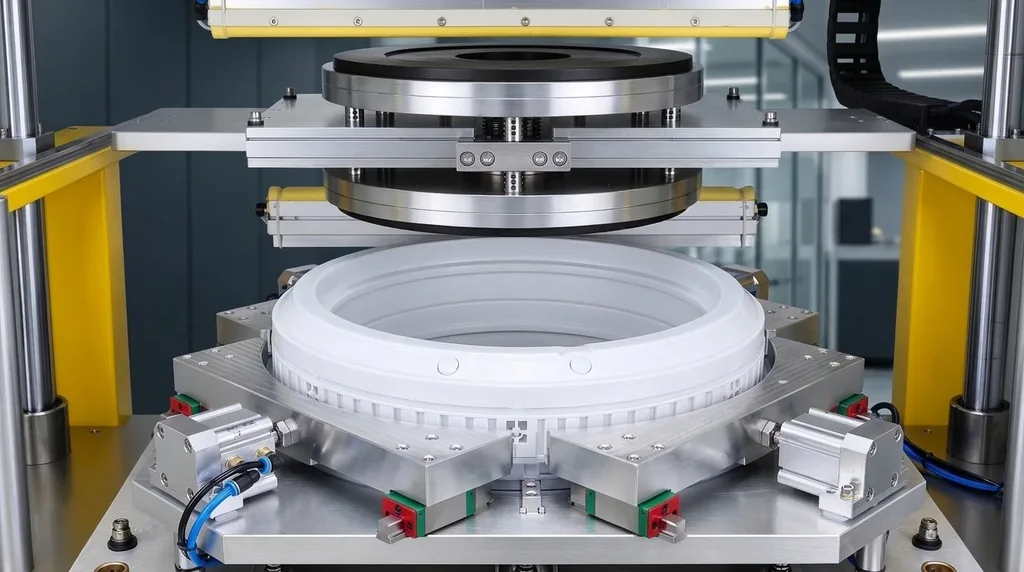
Top-load and front-load washing machines depend on fluid-filled annular rings mounted to the spin tub to counter unbalanced laundry loads at high RPM. Manufacturers evaluating vibration welding washing machine balance rings need a continuous, zero-leak seal around both inner and outer concentric circular perimeters that withstands years of centrifugal force and saturated brine exposure. SHNEHP engineers linear vibration friction welders (XN-55, XN-70, XN-100), high-torque rotary spin welders (XNX-100, XNX-200), and 3-axis servo hot plate welders (XNS6-B, XNS8-B) specifically sized for Ø400–650 mm appliance balance rings.
The part and its welding challenges
Washing machine balance rings consist of a deep-channel annular housing and a mating flat or contoured lid, typically injection-molded from homopolymer or copolymer polypropylene (PP) (occasionally talc-filled PP for stiffness). After welding, the hollow channel is vacuum-filled with saturated brine (salt water) or steel-ball-and-fluid damping media and sealed permanently.
Key engineering challenges include:
- Dual concentric weld seams: Both the inner diameter and outer diameter rings (often Ø410–640 mm) must fuse uniformly in a single cycle; even a pinhole along either ring causes brine seepage during high-speed spin cycles.
- Internal baffle ribs: Many rings include radial anti-slosh baffles inside the channel that must either fuse cleanly or maintain precise clearance without obstructing brine filling.
- Molding out-of-roundness and warpage: Large thin-walled PP rings readily distort after ejection. Without rigid circular nest locating and controlled collapse depth, ovality creates localized cold spots.
- Polypropylene melt behavior: Molten PP has moderate-to-low viscosity; excessive welding pressure squeezes melt out of the weld plane, leaving weak interfaces or loose internal flash that interferes with brine fill ports.
- Corrosive brine testing environment: Downstream vacuum filling and leak-detection stations handle saturated salt water, demanding corrosion-resistant polymer fluid paths and coated electronics.
Why vibration friction welding (vs. alternatives)
Appliance OEMs typically choose among linear vibration friction welding, rotary spin welding, and servo hot plate welding depending on ring geometry, internal baffles, and cycle-time targets.
| Process | Fit for washing machine balance rings | Dual-seam & baffle capability | Typical cycle time | Engineering boundary |
|---|---|---|---|---|
| Linear vibration friction | Strong for rigid PP rings with planar inner/outer seams and radial baffles | Joins inner ring, outer ring, and aligned baffles simultaneously | ~5–15 s total (1–8 s weld, 1–5 s hold) | Requires ≥2.5–3.0 mm in-plane clearance and rigid circular fixture support |
| Rotary spin welding | Excellent for strictly circular concentric PP rings (Ø12–450+ mm) | High-strength concentric seal; drives via molded anti-slip ribs | ~0.5–3 s weld time | Circular symmetry required; requires proper surface speed (3–15 m/s) and drive torque |
| Servo hot plate welding | Strong for large or 3D-contoured rings (Ø450–640 mm) with complex fill bosses | Seals complex stepped contours and internal baffles simultaneously | ~25–45 s total | Changeover must stay ≤2.5 s; pure PP may use auto-oiling anti-stick platen |
| Ultrasonic welding | Fill-port plug sealing only | Fast plug/cap weld after brine filling | ~0.1–1.5 s | Cannot seal Ø400–640 mm dual-perimeter balance rings in one shot |
Typical process window (industry ranges)
The table below reflects DVS 2217 four-stage linear vibration welding ranges for PP washing machine balance rings. Exact settings depend on ring diameter, wall thickness, and resin grade, and are validated on frozen production parts during a SHNEHP weld trial.
| Parameter | Typical industry range (PP balance rings) | Engineering guidance |
|---|---|---|
| Vibration frequency | 210–270 Hz (standard Ø400–550 mm) or 70–120 Hz (oversized >600 mm rings) | High frequency achieves rapid film formation; low frequency drives larger heavy tooling |
| Amplitude (peak-to-peak) | 0.8–1.6 mm (high-freq) / 1.5–2.5 mm (low-freq) | Moderate amplitude on PP limits stringing and internal particulate flash |
| Weld pressure | 0.5–3.0 MPa (two-stage pressure control) | Lower initial pressure prevents dry-friction fuzz; steady pressure ensures full perimeter fusion |
| Weld time | 1–6 s | Terminated automatically by closed-loop meltdown displacement |
| Meltdown / collapse depth | 0.8–1.8 mm | Compensates for molding ovality across both concentric seams |
| Hold / cooling time | 1–5 s | Maintains clamp force after centering to prevent crystallization micro-cracks |
| Total machine cycle | ~5–15 s (excluding load/unload) | Compatible with automated conveyor transfer to brine filling |
Recommended SHNEHP machine and fixture setup
SHNEHP supplies both standalone balance-ring welders and multi-model export production lines:
- Linear vibration welding: XN-55 (≤400 cm² weld area, ≤55 kg upper tool, 18.5 kW) or XN-70 (≤450 cm², ≤70 kg, 30 kW) via our vibration friction welding machine range for Ø410–580 mm PP balance rings; XN-100 for oversized heavy-duty drums.
- Rotary spin welding alternative: For concentric circular rings where spin welding offers lower tooling cost and ultra-fast cycles, evaluate our XNX-100 or XNX-200 spin welding machine (sized via surface speed formula
v = D × n / 19,099to stay within 3–15 m/s). - Servo hot plate alternative: For stepped contours or multi-size 550/580/601/640 mm balance rings, SHNEHP builds XNS6-B and XNS8-B hot plate welding machines.
- Precision fixtures & multi-model changeover: Custom welding and testing fixtures center out-of-round PP moldings evenly across inner and outer grooves, with quick-change locating nests for 550/580/601/640 mm families.
- Full-line integration: Connect directly to 8-station vacuum brine filling, ultrasonic plug sealing, negative-pressure leak testing, and weight sorting via customized machines.
Quality and leak testing
Because a leaking balance ring ruins washing-machine electronics and flooring, 100% inline verification is mandatory:
- Pre-fill air-decay / gross leak check: Typical appliance baselines run at 30–100 kPa (positive or vacuum, leak limit 10–50 mL/min) immediately after welding to reject cracked or under-melted rings before brine filling.
- Post-fill negative-pressure & liquid-leak testing: After saturated brine filling and ultrasonic port sealing, rings enter a vacuum/negative-pressure chamber with moisture-detection sensors and automated check-weighing to verify both seal integrity and exact brine mass.
- Corrosion protection & export compliance: Control cabinets and sensors on brine-line equipment feature anti-corrosion coatings, spare salt-resistant boards, and optional CE / IEC 60204 / NR10-NR12-NR15 compliance with bilingual HMI interfaces.
FAQ
Should I use linear vibration, spin welding, or hot plate welding for PP washing machine balance rings? All three are proven on PP balance rings: spin welding (XNX-100/200) is fastest for strictly circular rings; linear vibration (XN-55/70) excels on planar rings with aligned internal baffles; servo hot plate (XNS6-B/8-B) handles complex 3D stepped contours and large Ø600+ mm rings.
How do you ensure both the inner and outer seams weld evenly on a large PP ring? Precision CNC circular nests correct molding ovality during clamping, while closed-loop meltdown depth (0.8–1.8 mm) ensures full interfacial flow across both concentric diameters before the vibration head centers and holds.
Can one SHNEHP machine weld multiple washing machine ring sizes such as 550, 580, 601, and 640 mm? Yes. SHNEHP designs quick-change fixture sets with keyed locators and stored PLC/HMI parameter recipes so operators can switch between ring models safely in minutes.
How is the brine filling port sealed after balance-ring welding? Once the main ring is welded and vacuum-filled with brine, a compact ultrasonic welding machine (XNC-400) welds the fill plug cleanly in under 1 second before negative-pressure leak testing and check-weighing.
What files should I send SHNEHP to evaluate our balance ring program? Share frozen 3D STEP/X_T files of the ring housing and lid, PP resin grade, all diameter variants to run on the same line, target hourly output, and factory electrical/safety standards.
Get a free weld trial
Send our engineering team your balance ring package for a side-by-side comparison of linear vibration, spin, and servo hot plate options:
- Frozen 3D STEP / X_T / IGES models (housing, lid, internal baffles, fill plug)
- PP resin grade and list of ring diameters (e.g., Ø410–640 mm)
- Target output (UPH) and whether you need brine filling + leak testing integrated
Email yy@nbxiaoneng.com or contact our team on our contact page.
Request a Technical Consultation & Free Weld Trial
Send your 3D STEP/X_T drawing, resin grade, target cycle time, and leak-test specification. Our engineers will evaluate the joint and recommend a practical SHNEHP machine and fixture setup.