
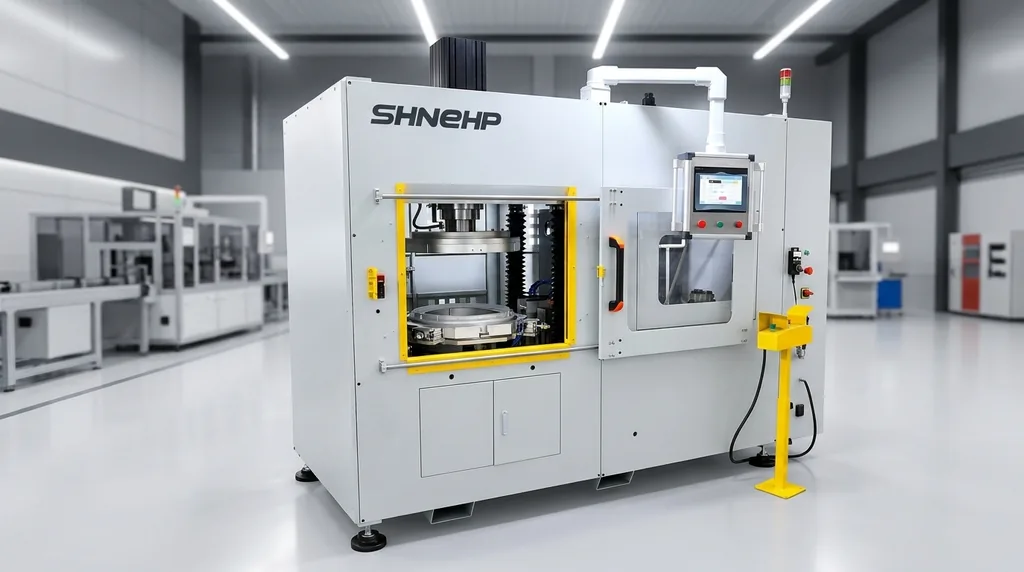
Home-appliance OEMs producing high-volume top-load and front-load washers rarely stop at a standalone welder—they need custom automation washing machine balance rings systems that connect shell welding, precision brine filling, fill-port sealing, negative-pressure leak inspection, and automated weight sorting into a single traceable line. SHNEHP engineers complete balance-ring turnkey cells and export-ready dedicated machines covering Ø410–640 mm polypropylene rings, built for corrosion resistance, multi-model compatibility, and international plant safety compliance.
The part and its welding challenges
A washing machine balance ring is an annular PP container filled with a precise weight of saturated brine (salt water) that dynamically offsets eccentric drum loads during high-speed spin extraction. Automating the full sequence introduces mechanical, fluid-handling, and corrosion challenges beyond plastic welding alone:
- Air-pocket and fill-weight accuracy: Gravity filling leaves trapped air bubbles inside internal baffles, causing inconsistent brine mass and loud washer vibration in the field. Vacuum-assisted differential filling is required to evacuate internal air before dosing.
- Saturated brine corrosion and salt crystallization: Salt water rapidly destroys ordinary carbon-steel valves, brass fittings, and unprotected PCBs. Wetted components must use all-plastic / corrosion-resistant paths and mechanical shutoff designs that minimize solenoid-valve wear.
- Wet fill-port sealing: Any brine film splashed onto the fill-port weld zone compromises ultrasonic plug sealing; controlled vacuum retraction and dry-port nozzle geometry are critical.
- Multi-model line changeover: Appliance factories routinely run four or more ring diameters (such as 550, 580, 601, and 640 mm) across the same conveyor line, requiring fast fixture swaps and recipe-driven PLC control.
- Export factory compliance: Overseas appliance plants require strict electrical and guarding standards (CE, IEC 60204, Brazil NR10/NR12/NR15) along with bilingual HMI screens (English/Chinese/Portuguese/Spanish).
Why custom automation (vs. alternatives)
| Production approach | Best fit | Throughput & quality consistency | Brine handling & traceability | Key boundary |
|---|---|---|---|---|
| SHNEHP turnkey balance-ring automation line | High-volume OEM & overseas appliance plants running 550–640 mm families | Synchronized welding + 8-station vacuum brine filling + ultrasonic sealing + negative-pressure leak & weight sorting | All-plastic wetted path, automated NG lockout, MES data interface | Requires upfront frozen ring list and plant utility confirmation |
| Semi-automatic standalone machines | Medium volume or multi-plant phased investment | Independent hot plate, spin, or vibration welder plus standalone negative-pressure leak tester | Manual transfer between stations | Lower initial capex; higher operator count and WIP handling |
| Manual gravity filling & immersion test | Low-volume prototyping only | Inconsistent fill weight and high operator fatigue | High risk of brine spills and missed micro-leaks | Unsuitable for modern OEM zero-defect warranty targets |
Typical process window (industry ranges)
An integrated SHNEHP balance-ring production cell combines four validated process stages:
| Line station | Core process & typical industry window | Engineering control point |
|---|---|---|
| Station 1: Ring shell welding | Spin welding (~0.5–3 s), linear vibration (~5–15 s), or servo hot plate (~25–45 s) on PP | Closed-loop meltdown depth (DVS 2215/2217) to ensure uniform inner & outer perimeter fusion |
| Station 2: 8-station synchronous vacuum brine filling | Evacuate ring cavity → differential-pressure brine injection → vacuum drip-back | All-plastic wetted manifold prevents salt crystallization; mechanical shutoff cuts solenoid wear |
| Station 3: Fill-port ultrasonic sealing | 15–20 kHz ultrasonic plug weld (~0.1–1.0 s) | Dry-port filling + energy/time dual monitoring prevents wet-interface weak seals |
| Station 4: Negative-pressure leak & weight sorting | Vacuum/negative-pressure chamber (typically 30–100 kPa equiv. / moisture-leak sensors) + inline check-weighing | Automated NG chute with keyed lockout prevents leaking or underweight rings from reaching final assembly |
Recommended SHNEHP machine and fixture setup
SHNEHP tailors balance-ring automation lines to factory floor layout, existing conveyors, and target takt time (customized machines):
- Main ring welder: Integrate an XNS6-B / XNS8-B hot plate welding machine, XNX-100 / XNX-200 spin welding machine, or XN-55 / XN-70 vibration friction welding machine matched to ring diameter and baffle design.
- 8-station synchronous vacuum brine filling machine: Evacuates and fills Ø410–640 mm rings simultaneously with corrosion-proof polymer wetted components and recipe-controlled fill volumes.
- Ultrasonic port sealer: Integrated XNC-400 ultrasonic welding machine with quick-change locating nest.
- Export negative-pressure & liquid-leak inspection unit: Directly bridges belt conveyors across multi-size families (e.g., 550 / 580 / 601 / 640 mm), equipped with corrosion-protected spare control boards, spare blowers, and automated NG rejection (welding and testing fixtures).
- Controls & MES connectivity: PLC control with safety light curtains, interlocked doors, dual-language HMI, recipe storage, and MES data upload for serial-level traceability.
Quality and leak testing
Turnkey balance-ring cells follow strict FAT (Factory Acceptance Test) and SAT (Site Acceptance Test) qualification gates:
- Continuous run stability: Sustained dry-run and loaded-production validation with zero unscheduled alarms and verified cycle time.
- Golden-part leak verification: Periodic checks with a sealed non-porous master ring confirm vacuum chamber seals, manifold integrity, and sensor calibration.
- Brine-weight & leakage zero-escape control: Inline check-weighers catch under-fill or over-fill tolerances automatically; NG bins require supervisor key unlock to prevent accidental mix-ups.
- Safety interlock verification: 100% validation of light curtains, emergency stops, door interlocks, and export electrical codes (CE / IEC 60204 / NR10-NR12-NR15).
FAQ
Can SHNEHP supply standalone vacuum brine filling or negative-pressure leak-testing machines without a new welder? Yes. Many appliance OEMs already own welders and integrate SHNEHP's 8-station vacuum brine filler or export negative-pressure leak-detection machine directly onto their existing belt conveyor line.
How does SHNEHP prevent salt water from corroding valves and electronics? All fluid-contact manifolds and nozzles use corrosion-resistant engineering plastics, mechanical shutoff architecture reduces electromagnetic valve wear, and electrical enclosures feature protective coatings plus optional spare boards and blowers for overseas plants.
How many balance ring sizes can run on a single automated line? Lines are engineered to accommodate multi-size families—such as 550, 580, 601, and 640 mm—using quick-change locating nests and HMI-selectable recipes.
Why use vacuum filling instead of gravity brine filling? Pulling a vacuum inside the welded balance ring before injecting brine removes trapped air pockets around internal baffles, cutting fill time and maintaining tight weight repeatability.
Does SHNEHP support overseas electrical and safety compliance for appliance factories? Yes. SHNEHP delivers export equipment compliant with CE, IEC 60204, and regional standards such as Brazil NR10/NR12/NR15, complete with bilingual HMI interfaces, water/air utility diagrams, and remote commissioning support.
Get a free weld trial
Request a turnkey line layout, station cycle-time balance, and weld-trial proposal by sharing:
- Frozen 3D STEP / X_T files for all balance-ring diameters and fill plugs
- PP resin grade, target brine fill weight & tolerance, and required UPH
- Factory electrical voltage/frequency, air supply, and safety compliance standard (CE / IEC 60204 / NR12)
Email yy@nbxiaoneng.com or submit your project via our contact page.
Request a Technical Consultation & Free Weld Trial
Send your 3D STEP/X_T drawing, resin grade, target cycle time, and leak-test specification. Our engineers will evaluate the joint and recommend a practical SHNEHP machine and fixture setup.