
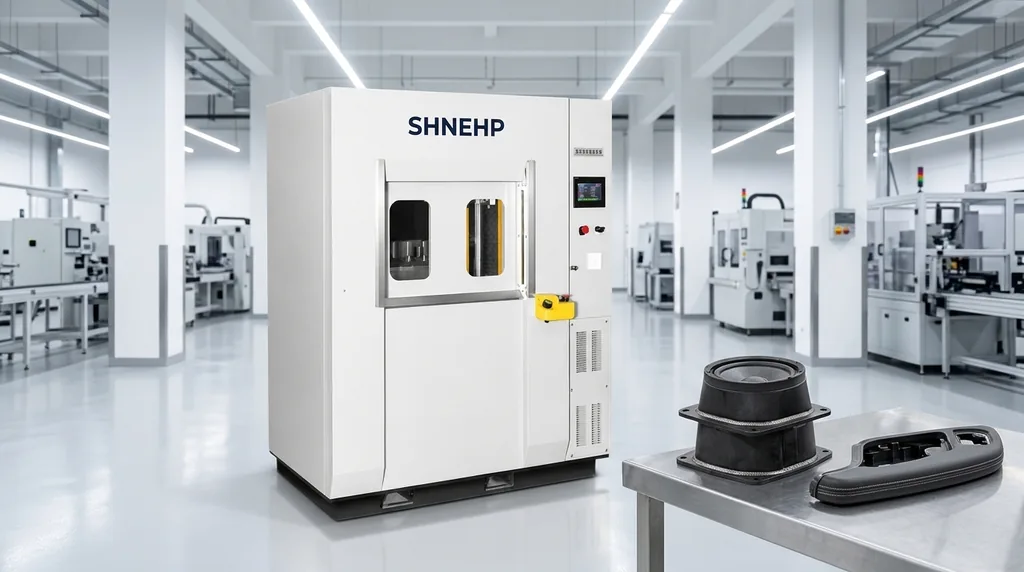
Inside modern vehicle doors sit structural thermoplastic door-module carrier plates, sealed acoustic subwoofer and woofer speaker enclosures, rigid map-pocket bins, pull-handle armrest reinforcement housings, and wet-side/dry-side water-barrier modules molded from PP-T20, PP-GF30, ABS, or PC/ABS. These structural door sub-assemblies must endure 100,000+ door slams, heavy speaker bass pressure without acoustic buzz-squeak-rattle (BSR), and strict wet-side water sealing—all at high automotive line speeds. Applying vibration welding automotive door housings fuses long, continuous structural and acoustic perimeters in 2–5 seconds with zero platen warm-up, low energy usage, and parent-strength cohesion. SHNEHP engineers high-frequency (XN-55, XN-70, XN-100) and low-frequency (XN-200) linear vibration friction welding machines built to DVS 2217 standards for Tier-1 automotive interior plants.
The part and its welding challenges
Structural door housings, speaker boxes, and armrest reinforcements combine large flat-to-gently-curved footprints with demanding acoustic and crash-safety requirements:
- Acoustic airtightness and zero buzz-squeak-rattle (BSR) on door speaker boxes: Premium EV and luxury audio systems enclose door woofers in tuned rigid PP-GF or ABS acoustic housings; even a short un-fused rib segment causes audible cabin buzz and bass distortion under road vibration.
- Managing heavy upper tooling mass and large weld areas: Full-width door map-pocket housings and structural carrier sub-modules span 400–900 mm with weld areas reaching 200–450 cm², requiring rigid, properly sized drive heads so full amplitude is maintained cleanly under high clamping pressure.
- Enforcing ≥2.5–3.0 mm lateral clearance across multi-rib interiors: Door housings contain internal wiring channels, clip bosses, and acoustic ribs; every non-welding vertical feature must maintain ≥2.5–3.0 mm unilateral clearance along the vibration axis so walls never scuff or clash mid-cycle.
- Controlling glass-fiber dust and cosmetic edge cleanliness: On PP-GF30 carrier plates and speaker boxes, initial dry friction generates fine white polymer/glass powder that must be trapped inside enclosed double-wall flash traps so debris never falls onto speaker cones or power-window tracks.
- Protecting adjacent Class-A textured exterior zones: Where a map-pocket or armrest sub-housing shows on the cabin side, contoured urethane-lined nests must grip structural ribs firmly so the oscillating upper half transfers motion cleanly without marring textured grain.
Why vibration friction welding (vs. alternatives)
| Process | Fit for structural door housings, speaker boxes & armrest cores | Speed, strength & BSR durability | Typical cycle time | Engineering boundary |
|---|---|---|---|---|
| Linear vibration friction welding (XN-55 / XN-70 / XN-100) | Primary high-speed choice for sealed door speaker enclosures, structural armrest housings, map-pocket bins, and PP-GF carrier plates | Continuous 360° high-strength molecular fusion in 2–5 s weld time; zero preheat standby power; superior door-slam fatigue life | ~10–18 s total cycle | Requires flat or gently curved parting plane and ≥2.5–3.0 mm lateral oscillation clearance |
| Multi-point hot-air / thermal staking | Attaching decorative trim inserts, leather-wrapped armrests, and switch bezels onto the main door panel | Ideal for multi-point dissimilar materials and wrapped Class-A trims | ~10–18 s | Discrete boss fastening only; cannot form airtight acoustic speaker box perimeters |
| Servo hot plate welding (XNS6-B / XNS8-B) | Deeply 3D-contoured door pockets or soft TPO trims where ≥2.5 mm lateral motion is impossible | Handles extreme 3D height changes cleanly | ~22–36 s | Slower cycle and higher continuous standby heater power than vibration welding |
| Ultrasonic welding | Compact tweeter grilles, switch bezels, or small wire clips | Sub-second discrete joining | ~0.3–1.2 s | Exceeded by large 400–900 mm PP-GF door housings and acoustic enclosures |
Typical process window (industry ranges)
Linear vibration welding of automotive door housings follows DVS 2217 displacement-controlled joining, utilizing two-stage pressure control on glass-filled PP-GF30/PA-GF grades to prevent dry-fiber brittle joints. Exact settings are verified during a SHNEHP trial.
| Parameter | Typical industry range (PP-T20 / PP-GF30 / ABS / PC-ABS) | Engineering guidance |
|---|---|---|
| Frequency & amplitude | High-frequency 210–270 Hz (amplitude 1.0–1.8 mm peak-to-peak); low-frequency 70–120 Hz only for extra-large >1.5 m modules | High frequency lowers part-travel excursion, protecting internal ribs and minimizing particulate dust |
| Two-stage weld pressure | Stage 1 initiation 1.8–3.5 N/mm² → Stage 2 melt flow 0.8–1.5 N/mm² (essential on PP-GF30 / PA-GF) | Prevents squeezing all molten resin out of glass-filled ribs, maximizing door-slam impact toughness |
| Meltdown depth & weld time | 1.2–2.2 mm closed-loop linear displacement (2.0–5.0 s weld time) | Real-time meltdown curve catches warped moldings or short shots automatically |
| Lateral clearance design | ≥2.5–3.0 mm unilateral clearance on non-welded walls | Prevents unintended wall contact, squeak-causing scuffs, or cracked locator pins |
| Hold & alignment cooling | Precision zero-center stop + 2.0–4.0 s hold | Guarantees accurate BIW clip datum alignment and airtight speaker-box seams |
Recommended SHNEHP machine and fixture setup
SHNEHP sizes linear vibration friction welding machines directly from your door housing's total weld area and upper-tooling mass:
- Medium door speaker enclosures, armrest cores & map pockets: XN-40 (≤300 cm² / 40 kg upper tool) and XN-55 (≤400 cm² / 55 kg upper tool, 18.5 kW, 2,500 kgf) high-frequency 210–270 Hz platforms provide fast quiet production inside sound-insulated enclosures.
- Large full-door structural housings & dual-cavity L+R pairs: XN-70 (≤450 cm² / 70 kg, 30 kW) and XN-100 (≤490 cm² / 100 kg, 65 kW) deliver massive clamping rigidity for mirrored left/right door housings welded together in a single ~12–16 second cycle.
- Anti-slip, zero-mar tooling: Precision welding and testing fixtures integrate contoured cast-aluminum and urethane nests, retractable datum pins, enclosed flash-trap geometry reviews, and quick-change multi-model baseplates.
Quality and leak testing
Door housing lines pair 100% process-curve monitoring with acoustic and structural qualification:
- Acoustic & wet-side airtightness verification: Sealed door speaker boxes and wet-side/dry-side carrier housings undergo rapid inline low-pressure air-leak testing (10–30 kPa) to guarantee airtight bass response and zero cabin water leaks during vehicle monsoon shower tests.
- Door-slam fatigue, pull-strength & BSR checks: Batch audits verify weld meltdown uniformity, pull-off strength across mounting brackets, and acoustic buzz-squeak-rattle silence on multi-axis shaker tables after -40 °C to +85 °C conditioning.
FAQ
How do you choose between vibration welding and hot staking for automotive door assemblies? Use linear vibration friction welding to create continuous, high-strength structural or airtight seams on rigid door sub-housings—such as sealed speaker boxes, armrest structural cores, and map-pocket bins. Use multi-point hot-air or thermal staking to attach leather-wrapped inserts, switches, and decorative trim onto the outer Class-A door card.
What SHNEHP vibration welder size fits automotive door speaker boxes and map-pocket housings? Single-cavity speaker boxes and armrest cores typically run on XN-40 (≤300 cm²) or XN-55 (≤400 cm²), while mirrored L+R dual-cavity door housings and large PP-GF carrier modules step up to XN-70 (≤450 cm²) or XN-100 (≤490 cm²).
Why is two-stage pressure important when vibration-welding PP-GF30 door housings? Holding high pressure throughout the weld squeezes molten polypropylene out of the joint, leaving dry glass fibers that crack under 100,000-cycle door-slam impacts. Dropping to a lower Stage-2 pressure preserves a rich polymer matrix across the seam.
How much side clearance is required inside a door housing for linear vibration welding? All internal non-welding ribs, wiring bosses, and alignment stops must maintain at least 2.5–3.0 mm of unilateral clearance in the oscillation direction so they never collide during the 1.0–1.8 mm peak-to-peak stroke.
What files should we send for a SHNEHP automotive door housing weld trial? Share 3D STEP/X_T models showing weld-rib cross-sections and part flatness, exact resin grade (PP-T20, PP-GF30, ABS, PC/ABS), total weld area, and whether single or L+R dual-cavity production is required.
Get a free weld trial
Send your automotive door module, speaker enclosure, or armrest housing CAD models to SHNEHP engineering to size the optimal vibration platform, review flash traps and clearances, and validate cycle speed on a physical weld trial:
- 3D STEP / X_T / IGES models of upper and lower door housing halves
- Polymer grade (PP-T20, PP-GF30, ABS, PC/ABS) and cosmetic zones
- Target L/R hourly output (UPH) and acoustic/airtightness specifications
Email yy@nbxiaoneng.com or connect through our contact page.
Request a Technical Consultation & Free Weld Trial
Send your 3D STEP/X_T drawing, resin grade, target cycle time, and leak-test specification. Our engineers will evaluate the joint and recommend a practical SHNEHP machine and fixture setup.