
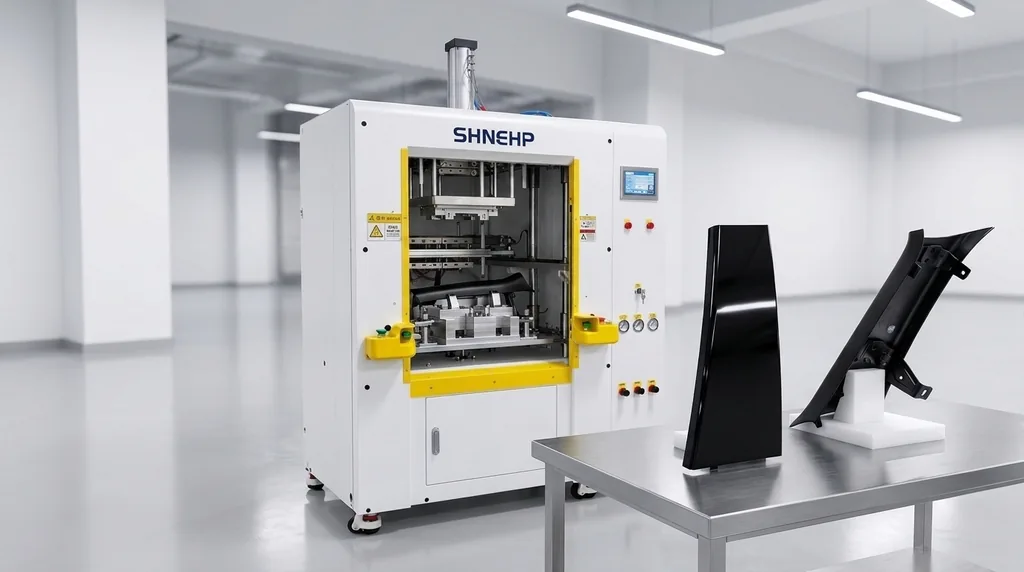
Automotive interior A-, B-, C-, and D-pillar garnish trims, piano-black exterior B-pillar appliqués, and integrated curtain-airbag deployment covers combine long slender 3D curvature with zero-tolerance Class-A visual scrutiny. Joining rear mounting brackets, clip towers, acoustic-foam retainers, and energy-absorbing ribs onto thin textured or high-gloss PP-T20, TPO, ABS, PC/ABS, or PMMA/ASA pillar covers without inducing front-side sink marks, gloss distortion, or squeak-and-rattle (BSR) looseness is a demanding Tier-1 interior challenge. Applying hot plate welding automotive pillar trim assemblies delivers quiet, high-strength multi-point structural bonding across long 3D contours with gentle low clamping force. SHNEHP engineers wide-bed 3-axis servo hot plate platforms (XNS6-B, XNS8-B, XNS9-B) tailored to automotive interior and exterior trim plants.
The part and its welding challenges
Pillar trim covers sit directly at eye level for drivers and passengers while also interfacing with life-critical side curtain airbags and body-in-white sheet-metal clips. Five engineering hurdles govern pillar-trim welding quality:
- Zero Class-A read-through or sink marks on thin grained or piano-black skins: Pillar outer skins are frequently only 2.0–2.8 mm thick and finished in leather grain, fabric wrap, or high-gloss piano-black PMMA/ABS; excessive melt depth or high joining pressure creates visible dimples or gloss ripples on the show surface.
- Controlled strength for curtain-airbag deployment seams: Interior A- and B-pillar trims that conceal side curtain airbags require repeatable, calibrated weld-retention strength—strong enough to prevent buzz-squeak-rattle (BSR) for ten years yet predictable in pull-off force during millisecond airbag inflation.
- Long slender 3D warping (600–1,200 mm span): Long narrow pillar moldings warp easily out of the injection mold; vacuum-assisted contoured soft nests must support the entire show surface evenly without marring grain texture or gloss finish.
- Multi-point discrete rib welding across varying Z-axis heights: Rather than a single flat perimeter, pillar trims typically join 4 to 14 angled clip brackets, locator bosses, and acoustic ribs at different depths—requiring precision-machined multi-zone 3D heating blades or non-contact infrared emitters.
- Left/right pair synchronization and high-mix trim variants: Interior suppliers routinely weld matched L+R pillar pairs simultaneously while accommodating sunroof/non-sunroof and speaker-grille trim derivatives on one press.
Why hot plate welding (vs. alternatives)
| Process | Fit for automotive pillar trim & glossy B-pillar appliqués | Class-A surface safety & 3D reach | Typical cycle time | Engineering boundary |
|---|---|---|---|---|
| 3-axis servo hot plate welding (XNS6-B / XNS8-B / XNS9-B) | Strong choice for long 3D pillar covers, glossy exterior B-pillar appliqués, and structural clip-tower bonding in PP-T20, ABS, PC/ABS, and ASA | Gentle low joining pressure (0.10–0.20 N/mm²) minimizes Class-A read-through; welds all 3D brackets across 1+ meter spans simultaneously | ~18–32 s (L+R pair) | Must limit melt soak depth on thin 2.0 mm skins to avoid show-surface heat witness marks; use IR above ~270 °C |
| Multi-head ultrasonic welding / punching | Discrete clip towers on rigid ABS/PC-ABS trim with thicker wall sections | Very fast cycle (1–4 s) | ~6–12 s total | High-frequency energy frequently causes gloss-surface dimpling, witness rings, or micro-cracking on thin piano-black PMMA/ABS pillars |
| Hot-air / thermal cold staking | Retaining distinct metal clip brackets or fabric-wrapped pillar sub-pieces via molded bosses | Ultra-low read-through risk on wrapped trims | ~8–16 s | Requires through-holes in the mating bracket; cannot form long continuous structural rib bonds |
| Linear vibration welding | Thick structural door/console housings | High structural shear strength | ~10–18 s | Lateral 1.0–1.8 mm oscillation scratches Class-A piano-black/grained surfaces and cannot follow steep 3D pillar twists |
Typical process window (industry ranges)
Pillar trim hot plate welding prioritizes minimal heat-affected zone on the Class-A show wall paired with micron-accurate closed-loop servo joining force per DVS 2215. Exact thermal balance and shallow meltdown depths are verified on grained/gloss sample moldings during a SHNEHP weld trial.
| Parameter | Typical industry range (PP-T20 / ABS / PC-ABS / ASA) | Engineering guidance |
|---|---|---|
| Heating face temperature | PP-T20 / TPO: 220–250 °C; ABS / ASA / PC-ABS: 245–270 °C (or non-contact IR 320–440 °C for high-gloss PC/PMMA) | Independent multi-zone PID control prevents overheating thin show-wall ribs while fully melting thicker clip brackets |
| Shallow bead-up / soak | Shallow contact 0.25–0.5 mm; soak 5–12 s (low pressure ≤0.05 N/mm²) | Short, controlled soak keeps back-side heat from telegraphing to Class-A piano-black or grained surfaces |
| Servo changeover time | ≤1.4–2.0 s | Fast 3-axis servo platen exit prevents cold-skinning on thin discrete bracket legs |
| Gentle closed-loop joining | 0.10–0.20 N/mm² to closed-loop servo hard stop (0.6–1.2 mm collapse); hold 5–10 s | Low controlled clamping force prevents skin dimpling while guaranteeing consistent airbag-clip pull strength |
Recommended SHNEHP machine and fixture setup
SHNEHP builds wide-opening, Class-A-safe 3-axis servo hot plate welding machines for interior and exterior automotive trim plants (+60 mm tooling envelope rule):
- A- and B-pillar L+R dual-cavity pairs: XNS6-B and XNS8-B servo hot plate welders offer wide horizontal bed spans, ultra-smooth closed-loop low-force joining profiles, and optional non-contact IR radiant heads for high-gloss piano-black PMMA/PC exterior appliqués.
- Extra-long C/D-pillar & SUV full-length trim modules: XNS9-B wide-bed servo platforms support 1.2–1.6 m trim nests with quick-change rolling tooling carts for rapid model changeovers.
- Class-A cosmetic nests: Custom welding and testing fixtures feature felt/urethane-lined vacuum nests, cooled backing blocks directly behind weld ribs (pulling excess heat away from the show face), and integrated clip-presence poka-yoke sensors.
Quality and leak testing
Interior and exterior pillar trim lines focus on cosmetic zero-defect appearance, dimensional fit, and structural safety pull-strength:
- Class-A light-booth & dimensional check-fixture audit: 100% visual inspection under raking light confirms zero gloss distortion, grain flattening, or witness sink marks, paired with CMM / go-no-go check fixtures validating every body-in-white clip datum.
- Calibrated bracket pull-off & BSR vibration testing: Batch destructive pull tests confirm that mounting brackets meet OEM minimum retention strength (and remain within maximum release windows where airbag tether/deployment clearances apply), alongside -40 °C to +90 °C thermal-aging BSR audits.
FAQ
How does SHNEHP prevent sink marks or gloss distortion on piano-black B-pillar trim during hot plate welding? By combining shallow, short-duration melt soak cycles, low closed-loop servo joining force (0.10–0.20 N/mm²), and actively cooled Class-A urethane/aluminum nest backing directly opposite the rear weld ribs so heat never telegraphs to the visible surface.
Can hot plate welding join rear clip brackets onto fabric- or leather-wrapped A-pillar trims? For raw injection-molded PP-T20, ABS, PC/ABS, or glossy PMMA/ASA pillars, servo hot plate welding excels. If a trim is already fabric- or leather-wrapped prior to bracket attachment, localized hot-air cold staking or low-heat rear ultrasonic welding is often evaluated alongside hot plate welding to protect the wrap adhesive.
Why use hot plate welding instead of ultrasonic welding on glossy exterior B-pillar appliqués? Ultrasonic vibration frequently leaves circular cosmetic witness rings, micro-crazing, or surface gloss distortion on thin high-gloss PMMA/PC/ABS exterior trim; gentle low-pressure servo hot plate (or non-contact IR) welding keeps the exterior gloss mirror-flat.
Can one SHNEHP machine weld left-hand and right-hand pillar trims simultaneously? Yes. Wide-bed XNS6-B, XNS8-B, and XNS9-B servo machines routinely weld mirrored L+R pillar pairs in a single ~20–30 second cycle with individual clip-presence poka-yoke verification on both nests.
What CAD details do you need for an automotive pillar trim weld trial? Share 3D STEP/X_T models showing Class-A show surfaces, wall thickness behind every bracket, exact resin grade (PP-T20, ABS, PC/ABS, PMMA/ASA), and OEM pull-force/cosmetic standards.
Get a free weld trial
Send your A/B/C/D-pillar trim CAD models to SHNEHP engineering to evaluate low-force servo hot plate or non-contact IR welding and verify zero Class-A read-through on physical trial moldings:
- 3D STEP / X_T / IGES models of pillar cover and rear brackets/clips
- Polymer grade & Class-A finish (grained PP-T20, piano-black PMMA/ABS, PC/ABS)
- Target L/R cycle time and bracket pull-off / airbag deployment requirements
Email yy@nbxiaoneng.com or connect through our contact page.
Request a Technical Consultation & Free Weld Trial
Send your 3D STEP/X_T drawing, resin grade, target cycle time, and leak-test specification. Our engineers will evaluate the joint and recommend a practical SHNEHP machine and fixture setup.