
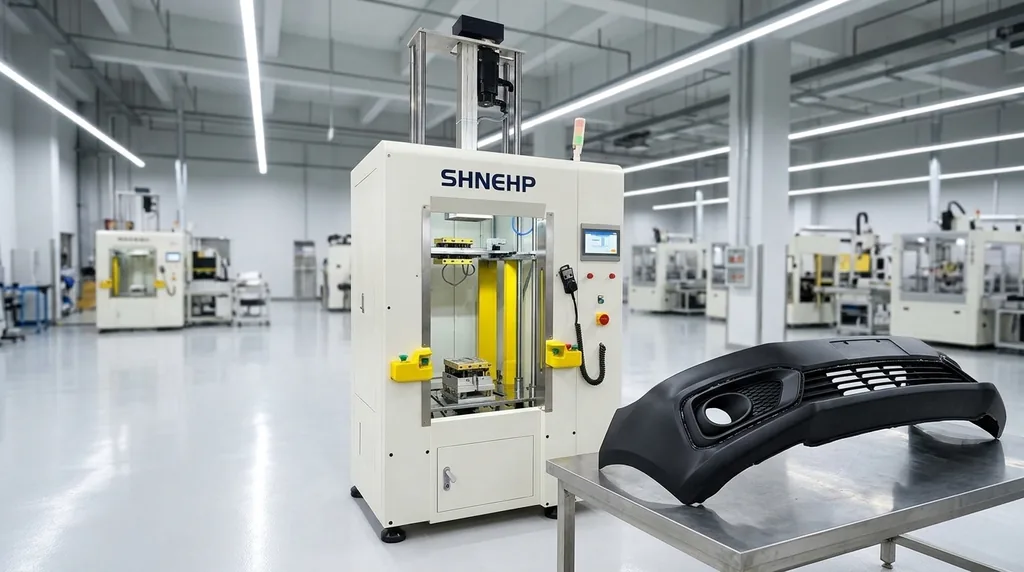
Modern vehicle front and rear bumper systems are complex multi-piece exterior assemblies combining unpainted lower skid-plate valances, structural fog-lamp and ADAS radar housings, active-grille-shutter (AGS) carrier frames, pedestrian-impact energy absorbers, and heavy reinforcement brackets molded from impact-modified PP/EPDM (TPO), PP-T20, PP-GF20, or PC/PBT. Unlike thin painted PDC sensor tabs welded ultrasonically, structural bumper housings and lower cover assemblies span 500–1,600 mm across compound 3D sweeps and must survive curb strikes, cold-weather impact tests, and car-wash wind loads without snapping loose. Applying hot plate welding bumper covers and structural bumper housings fuses long, curved thermoplastic ribs into a single high-strength monolithic module. SHNEHP engineers heavy-frame wide-bed servo hot plate machines (XNS6-B, XNS8-B, XNS9-B) built for Tier-1 exterior fascia plants.
The part and its welding challenges
Structural bumper covers, lower valances, and integrated radar/lamp housings push exterior welding equipment hard across five dimensions:
- Large 3D aerodynamic curvature and deep Z-axis height changes: Bumper corners sweep sharply rearward toward the wheel arches, creating 50–180 mm height drops that require 5-axis machined contoured hot plate tooling with evenly spaced multi-zone PID heaters.
- High-impact TPO / PP-EPDM melt ductility and stringing control: Soft elastomer-modified TPO resins tend to cling and pull long resin threads from heated platens if PTFE coatings degrade or break-away retraction profiles are sluggish; precise 220–255 °C PID control and crisp servo break-away keep seams clean.
- Correcting molded warpage on wide exterior shells: Large injection-molded lower bumper valances and spoiler housings routinely warp 3–6 mm after cooling; synchronized multi-point pneumatic clamping and vacuum nests straighten parts gently onto datum pins before heating starts.
- Protecting visible textured Class-A exterior edges: Textured matte-black lower valances, wheel-arch flares, and splitter edges cannot be crushed or scuffed during clamping, requiring urethane-lined non-marring contours and recessed outer flash grooves.
- Cold-temperature (-30 °C) pedestrian & low-speed impact toughness: Bumper assemblies undergo OEM low-speed pendulum impact tests (ECE R42 / FMVSS) at sub-zero temperatures; weak cold-welds shatter along the seam whereas properly soaked hot-plate seams flex with parent-resin toughness.
Why hot plate welding (vs. alternatives)
| Process | Fit for structural bumper covers, valances & carrier housings | Structural impact strength & 3D contour reach | Typical cycle time | Engineering boundary |
|---|---|---|---|---|
| Large-bed 3-axis servo hot plate welding (XNS6-B / XNS8-B / XNS9-B) | Top structural choice for unpainted/textured lower bumper valances, spoiler housings, grille carriers, and heavy TPO/PP-GF brackets | Full-perimeter or multi-rib 3D molecular fusion delivering near-parent cold-impact toughness across 1+ meter spans | ~22–38 s | Best suited to unpainted/textured structural housings and reinforced ribs; thin painted Class-A PDC tabs use 30–35 kHz ultrasonics |
| Multi-head 30–35 kHz ultrasonic welding | Small painted-surface PDC parking sensor holders and light clips | Sub-second low-heat localized weld on painted skins | ~0.2–0.7 s/point | Insufficient continuous weld strength for long structural lower valances or high-load tow/skid housings |
| Hot-air / thermal cold staking | Multi-point fastening of dissimilar decorative chrome/gloss grille inserts onto PP bumper covers | Handles dissimilar plastics cleanly with zero vibration | ~10–18 s | Discrete boss strength only; cannot seal long structural box sections |
| Linear vibration friction welding (XN-70 / XN-100) | Heavy flat structural reinforcement beams or enclosed bumper cross-boxes | Very fast high-area structural bond | ~12–20 s total | Requires flat/gently curved plane and ≥2.5–3.0 mm clearance; cannot follow steep bumper corner wrap-arounds |
Typical process window (industry ranges)
Structural bumper housing hot plate welding follows DVS 2215 five-stage control tuned for elastomer-modified TPO and filled polypropylene. Exact temperatures, dwell times, and clamping sequences are validated during a SHNEHP trial on production moldings.
| Parameter | Typical industry range (PP/EPDM / TPO / PP-T20 / PC-PBT) | Engineering guidance |
|---|---|---|
| Platen heating temperature | TPO / PP-EPDM / PP-T20: 220–255 °C; PC/PBT: 270–295 °C (switch to non-contact IR 320–460 °C above ~270 °C) | Multi-zone PID heating (8–16+ zones on wide bumper platens) balances corner heat loss against center ribs |
| Bead-up / warpage leveling (Stage 1) | 0.5–0.9 mm displacement at 0.15–0.25 N/mm² | Seats warped long exterior moldings evenly across contoured 3D heating faces |
| Melt / soak phase (Stage 2) | 8–18 s at low pressure (0.02–0.05 N/mm²) | Builds 1.0–1.5 mm ductile melt depth for high -30 °C impact toughness |
| Servo changeover time (Stage 3) | ≤1.6–2.4 s | Fast heavy-duty servo platen withdrawal prevents cold-skinning on wide TPO flanges |
| Joining & cooling (Stages 4–5) | 0.15–0.25 N/mm² to closed-loop servo hard stop (1.4–2.4 mm total meltdown); cool 8–15 s | Locks bumper mounting datums precisely within body-in-white check-fixture tolerances |
Recommended SHNEHP machine and fixture setup
SHNEHP manufactures heavy-frame wide-bed 3-axis servo hot plate welding machines engineered for Tier-1 exterior automotive trim facilities (+60 mm platen margin rule):
- Bumper corner housings, fog-lamp/radar pods & L+R lower valances: XNS6-B and XNS8-B servo hot plate platforms deliver rigid four-post guidance, balanced multi-zone PID control, and quick-change rolling fixture carts.
- Full-width front/rear lower bumper spoilers & fascia carriers: XNS9-B wide-format horizontal/vertical servo hot plate welders handle oversized 1.4–1.8+ meter exterior modules cleanly with safety light curtains and automatic sliding doors.
- Precision anti-warp exterior fixtures: Custom welding and testing fixtures pair vacuum-cupped urethane Class-A nests with sequential pneumatic side clamps and poka-yoke part-orientation sensors.
Quality and leak testing
Exterior bumper housing and valance lines validate geometric body-fit, cold-impact weld toughness, and cosmetic cleanliness:
- Body-in-white (BIW) check-fixture & CMM auditing: Welded bumper assemblies drop straight into dedicated OEM dimensional check fixtures confirming every clip tower, radar aiming boss, and fender-flush gap holds specification.
- Cold-temperature impact & pull-off qualification: Periodic sub-zero (-30 °C) pendulum impact tests, pull-apart destructive checks verifying cohesive parent-material tearing, and high-pressure car-wash jet audits guarantee long-term exterior durability.
FAQ
When should bumper assembly lines use hot plate welding versus ultrasonic welding? Use servo hot plate welding for structural unpainted/textured lower bumper valances, spoiler housings, active-grille-shutter carriers, and heavy TPO/PP-GF brackets requiring long 3D seams and sub-zero impact strength. Use 30–35 kHz ultrasonic welding for small PDC sensor holders welded behind thin painted Class-A bumper skins.
Can SHNEHP hot plate welders handle curved bumper housings up to 1.5 meters wide? Yes. SHNEHP XNS8-B and XNS9-B wide-bed 3-axis servo hot plate machines accommodate long curved bumper housings and lower valances with multi-zone 5-axis machined contoured heating plates and quick-change rolling tooling carts.
How do you stop soft TPO / PP-EPDM bumper plastics from stringing on the hot plate? By keeping PTFE-coated platens cleanly within 220–255 °C (well below PTFE's ~270 °C limit), programming a brief crisp servo break-away stroke at the end of soak, and integrating enclosed flash traps along exposed cosmetic edges.
Can one SHNEHP machine switch quickly between front and rear bumper housing models? Yes. Standardized quick-change tooling carts with multi-pin pneumatic/thermocouple quick-disconnects and stored HMI recipes allow exterior trim plants to swap heavy bumper fixtures in 10–15 minutes.
What CAD details do you need for a bumper cover or housing hot plate weld trial? Send 3D STEP/X_T models of the bumper housing and mating valance/brackets, exact TPO/PP/PC-PBT resin grade, overall L×W×H envelope, and OEM cold-impact or check-fixture tolerances.
Get a free weld trial
Share your automotive bumper cover, lower valance, or radar/grille housing CAD files with SHNEHP engineering to design 3D contoured hot plate tooling and verify cold-impact weld toughness on real moldings:
- 3D STEP / X_T / IGES models of bumper housing, valance, and mating brackets
- Polymer grade (PP/EPDM, TPO, PP-T20, PP-GF, PC/PBT)
- Overall part dimensions, target UPH, and BIW dimensional specs
Email yy@nbxiaoneng.com or connect through our contact page.
Request a Technical Consultation & Free Weld Trial
Send your 3D STEP/X_T drawing, resin grade, target cycle time, and leak-test specification. Our engineers will evaluate the joint and recommend a practical SHNEHP machine and fixture setup.