
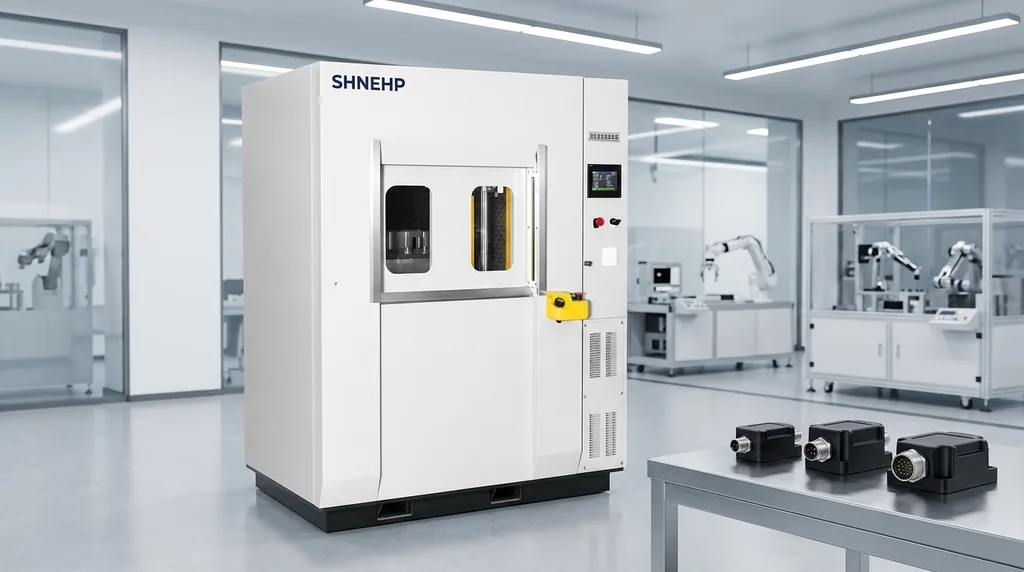
Heavy-duty automotive radar/ADAS brackets, under-hood pressure/NOx sensor sub-housings, industrial proximity switches, and ruggedized factory-automation enclosures operate in oil mist, road spray, washdown chemicals, and continuous mechanical vibration. Deploying vibration friction welding sensor housings fuses glass-filled engineering polymer shells (prior to final electronics potting or on rugged potted/empty sub-assemblies) into high-strength, IP67-ready structural cases in 5–12 seconds. SHNEHP engineers compact high-frequency (210–270 Hz) linear vibration platforms (XN-15, XN-35, XN-40) calibrated to DVS 2217 meltdown control.
The part and its welding challenges
Rugged industrial and automotive sensor housings are typically molded from chemical- and heat-resistant PBT-GF15–30, PA6/PA66-GF30, PPS-GF, or PC/ABS. Joining compact thick-walled sensor covers demands disciplined attention to five engineering realities:
- Protecting sensitive electronics (when to choose vibration vs. hot plate): Linear vibration generates strong horizontal acceleration and fine solid-friction dust—so vibration welding is best suited to empty sensor sub-housings, rugged pre-potted modules, or robust automotive connectors/brackets. Whenever un-potted delicate MEMS sensors, quartz crystals, or exposed SMD PCBs sit inside the cavity, servo contact or non-contact IR hot plate welding is the safer vibration-free choice.
- Zero particulate intrusion over optical/radar windows: Automotive radar/LiDAR covers and optical industrial sensor lenses must stay spotless inside; enclosed inner labyrinth flash traps and high-frequency small-amplitude vibration (210–270 Hz) are critical.
- Tight dimensional alignment for connector pins & mounting bores: Sensor housings integrate overmolded metallic lead-frames or M12 connector threads; upper and lower steel nests must hold tight positional tolerances across the entire oscillation stroke without micro-slip.
- Hygroscopic PBT-GF & PA-GF moisture discipline: Un-dried PBT and glass-filled nylon release steam micro-voids at the weld seam, compromising IP67/IP68 moisture ingress protection.
- Multi-cavity high-volume sensor output: Compact sensor covers (40–150 mm) run efficiently in 4-cavity to 8-cavity fixtures where balanced upper-tool mass ensures identical meltdown across every nest.
Why vibration friction welding (vs. alternatives)
| Process | Fit for rugged sensor housings & covers | Strength, cleanliness & PCB safety | Typical cycle time | Engineering boundary |
|---|---|---|---|---|
| Linear vibration friction (210–270 Hz: XN-15 / XN-35 / XN-40) | Strong choice for rugged PBT-GF, PA-GF, and PPS sensor sub-housings, potted modules, and thick-walled multi-cavity sensor covers | High structural & chemical-resistant weld strength; fast multi-cavity output | ~5–12 s per multi-cavity cycle | Requires ≥2.5–3.0 mm planar clearance; avoid on delicate un-potted MEMS/quartz PCBs (use hot plate instead) |
| Servo hot plate — contact & non-contact IR (XNS2-B / XNS5-B) | Best choice for populated PCB / delicate MEMS sensor boxes and 3D-contoured IP67 enclosures | Zero mechanical vibration; non-contact IR eliminates particulate fuzz and PTFE sticking on PBT/PA-GF | ~18–35 s total | Longer cycle time than vibration, but unmatched PCB safety |
| Ultrasonic welding (XNC-400 / XN-3) | Small rigid empty ABS/PC sensor caps and connector shrouds | Rapid sub-second localized welds | ~0.1–1.2 s | High-frequency energy risks cracking internal SMD components; lower consistency on semi-crystalline PBT-GF30/PA-GF |
| Epoxy potting + screws | Ultra-rugged submersible industrial probes | Encapsulates electronics completely | Long curing ovens & VOC | High resin BOM weight, slow cure bottlenecks, and difficult rework |
Typical process window (industry ranges)
The conservative DVS 2217 linear vibration baselines below cover PBT-GF, PA66-GF, and PC/ABS rugged sensor housings. Final meltdown stops and pressure profiles are verified during a SHNEHP part-specific weld trial.
| Parameter | Typical industry range (PBT-GF / PA66-GF / PC-ABS) | Engineering guidance |
|---|---|---|
| Pre-drying discipline | PBT-GF & PC/ABS: 100–120 °C; PA66-GF: 80–90 °C | Mandatory for IP67 hermeticity and void-free glass-filled seams |
| Operating frequency | 210–270 Hz (high-frequency electromagnetic drive) | Short amplitude (0.5–0.8 mm) keeps particulate shedding minimal and fits tight multi-cavity layouts |
| Joint & flash-trap design | Wall ≥2.0–3.0 mm with enclosed inner/outer stepped flash traps; ≥2.5–3.0 mm planar clearance | Traps glass-filled flash cleanly away from internal PCB/connector zones |
| Two-stage weld pressure | Initial friction 1.5–3.5 N/mm²; reduced final collapse 1.0–1.8 N/mm² | Preserves molten polymer richness in glass-filled PBT/PA seams |
| Weld time & meltdown | 1.0–4.0 s to closed-loop meltdown target 0.8–1.5 mm | Displacement stop guarantees exact finished sensor height for automated bracket mounting |
| Hold / cooling dwell | 1.5–3.5 s under clamping force | Solidifies semi-crystalline PBT/PA flat with zero cover warp |
Recommended SHNEHP machine and fixture setup
SHNEHP sizes compact high-frequency vibration friction welding machines specifically for multi-cavity sensor housing production:
- Single to 4-cavity sensor housings (area ≤120 cm², upper tool ≤15 kg): XN-15 compact high-frequency vibration welder delivers tight closed-loop meltdown accuracy with minimal clean-floor footprint.
- 4-to-8 cavity high-volume automotive sensor lines (area ≤250–300 cm², upper tool ≤35–40 kg): XN-35 and XN-40 high-frequency platforms offer rigid linear guides, acoustic sound enclosures, and per-cycle traceability.
- Precision connector-safe tooling & inline IP67 testers: Custom welding and testing fixtures protect overmolded connector pins via relief pockets while locating firmly on housing datums, seamlessly paired with downstream 10–30 kPa differential leak stations on customized machines.
Quality and leak testing
Rugged sensor enclosures combine 100% real-time vibration telemetry with sensitive dry-air IP67 verification:
- 100% inline IP67 / IP68 differential leak testing: Sensor housings are screened at 10–30 kPa (positive pressure, vacuum, or inside a sealed-volume chamber for 100% portless sensors) with 0.1–0.5 mL/min pass limits using 1 Pa differential pressure transducers and a 3–5 s stabilization stage.
- Thermal-shock & vibration qualification: Periodic batch audits subject welded sensors to -40 °C to +125 °C thermal shock, chemical washdown soak, and cross-section seam microscopy.
FAQ
When should sensor housings use vibration welding versus hot plate welding? Use linear vibration friction welding (XN-15 / XN-35) for empty sensor sub-housings, rugged potted assemblies, or thick glass-filled PBT/PA covers needing rapid 5–12 s cycles. Switch to servo contact or non-contact IR hot plate welding (XNS2-B / XNS5-B) whenever delicate un-potted PCBs, MEMS sensors, or quartz oscillators sit inside the housing during welding.
Can glass-filled PBT (PBT-GF30) and PA66-GF30 sensor covers achieve IP67 seals via vibration welding? Yes. Provided parts are properly dried before welding, inner flash traps isolate the cavity, and two-stage pressure profiling is used with closed-loop meltdown stops, PBT-GF and PA66-GF achieve repeatable IP67/IP68 seals.
How do you protect delicate automotive connector pins during high-frequency vibration welding? Design precision CNC-machined steel/PEEK fixtures with full relief pockets around connector shrouds and terminals, clamping strictly on reinforced housing shoulders and mounting bosses.
What inline leak-test parameters validate IP67 sensor housings? Standard IP67/IP68 sensor testing uses 10–30 kPa (positive/vacuum or sealed dosing chamber) with 0.1–0.5 mL/min limits on a 1 Pa-resolution differential pressure tester and a 3–5 s stabilization stage.
What files should we send for a SHNEHP sensor housing weld trial? Share 3D STEP/X_T models showing internal electronics status (empty, potted, or populated PCB), exact PBT-GF/PA-GF/PC-ABS grade, target UPH, and IP67/IP68 leak-test specification.
Get a free weld trial
Share your sensor housing CAD models with SHNEHP engineering to evaluate XN-15 / XN-35 linear vibration welding versus vibration-free servo hot plate welding and inline IP67 leak testing:
- 3D STEP / X_T / IGES models of the sensor case, cover, and connector pins
- Resin & glass-fiber grade (PBT-GF, PA66-GF, PPS-GF, PC/ABS) and PCB assembly stage
- Target hourly output (UPH) and IP67/IP68 leak threshold
Email yy@nbxiaoneng.com or connect through our contact page.
Request a Technical Consultation & Free Weld Trial
Send your 3D STEP/X_T drawing, resin grade, target cycle time, and leak-test specification. Our engineers will evaluate the joint and recommend a practical SHNEHP machine and fixture setup.