
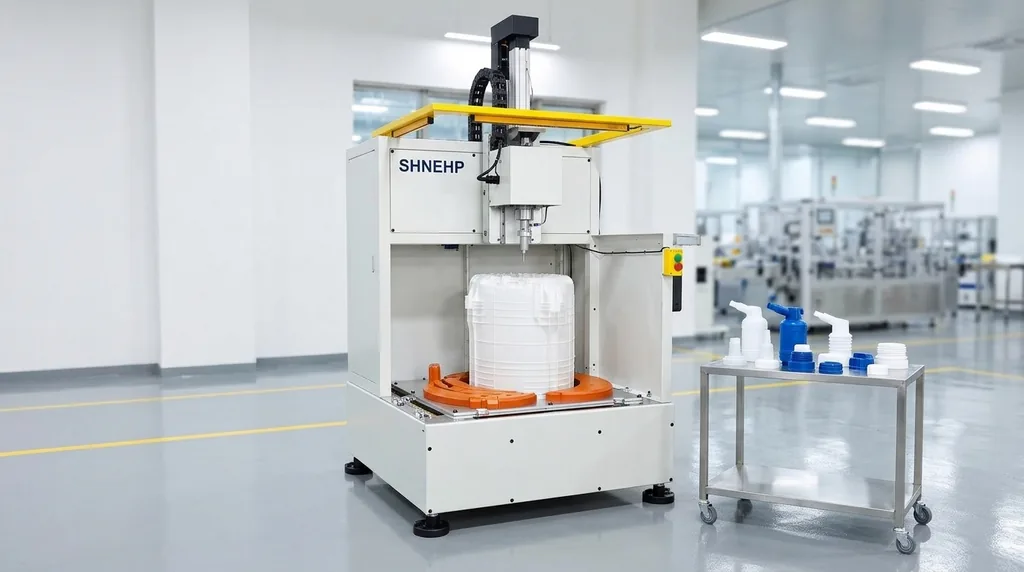
Industrial liquid jerrycans, laundry-detergent dispensing spouts, agricultural chemical pouring nozzles, IBC valve adapters, and non-circular dual-chamber packaging caps endure aggressive chemicals, stacking drop impacts, and repeated pour-and-seal handling. Choosing a plastic spout welding machine based on high-frequency linear vibration friction fuses oval, rectangular, angled, or multi-cavity HDPE and PP spout assemblies in 5–12 seconds without rotational symmetry limits or hot-plate warm-up delays. SHNEHP engineers high-frequency (210–270 Hz) linear vibration platforms (XN-15, XN-35, XN-40) built to DVS 2217 meltdown precision for high-volume packaging converters.
The part and its welding challenges
Rigid pouring spouts, anti-glug jerrycan nozzles, and heavy chemical dispensing caps are predominantly molded from HDPE, PP, LDPE, or EVOH-barrier polyolefins. Joining semi-crystalline packaging spouts at high commercial output introduces five practical hurdles:
- Non-circular & angled pouring geometries: Anti-glug pouring spouts, ergonomic flip-spout housings, and oval detergent-bottle fitments cannot be spin welded—requiring linear motion that seals irregular perimeters evenly.
- High-cavitation multi-up tooling (4-up to 12-up): Rigid packaging closures demand low per-part conversion cost, making balanced multi-cavity fixtures with uniform clamping pressure across every nest essential.
- Chemical stress-crack & drop-impact toughness: Surfactants, bleaches, motor oils, and agrochemicals accelerate environmental stress cracking (ESC) along weak cold welds; full molecular fusion across semi-crystalline HDPE/PP is mandatory.
- Clean interior flow path & thread protection: Excess molten flash squeezed into narrow pour spouts traps liquid drips or flakes into consumer products, while upper tooling must drive the spout without marring external cap threads.
- Rapid alignment across slippery polyolefins: Low-friction HDPE and PP spouts tend to slip inside smooth nests unless CNC-machined locating ribs and textured gripping pockets lock both halves firmly.
Why vibration friction welding (vs. alternatives)
| Process | Fit for non-round pouring spouts & multi-cavity caps | Speed & chemical durability | Typical cycle time | Engineering boundary |
|---|---|---|---|---|
| Linear vibration friction (210–270 Hz: XN-15 / XN-35 / XN-40) | Primary choice for oval, angled, anti-glug, and multi-cavity HDPE/PP pouring spouts and thick chemical closures | High ESC/drop strength on semi-crystalline HDPE/PP; multi-cavity fixtures (4–12 up) deliver massive hourly output | ~5–12 s per multi-cavity stroke | Requires planar joint, ≥2.5–3.0 mm clearance, and matched compatible polyolefins (HDPE-to-HDPE or PP-to-PP) |
| Servo spin welding (XNX-100 / XNX-200) | Strictly axisymmetric circular caps and round spouts (Ø12–450 mm) | Ultra-fast 0.5–3 s circular fusion at 3–15 m/s surface speed | ~0.5–3 s weld | Impossible on oval, square, or non-symmetrical angled pouring spouts |
| Servo hot plate welding (XNS2-B / XNS5-B) | Deep 3D-contoured spout bodies or flexible blow-molded jerrycan wall attachments | Zero particulate dust; handles 3D contours cleanly | ~18–35 s total | Slower per stroke than high-frequency vibration on planar spout assemblies |
| Ultrasonic welding (XNC-400) | Thin flexible pouch fitments or small rigid amorphous ABS caps | Sub-second local welds | ~0.1–1.2 s | Lower hermetic burst consistency on thick semi-crystalline HDPE/PP liquid-chemical spouts |
Typical process window (industry ranges)
The conservative DVS 2217 linear vibration baselines below support multi-cavity HDPE and PP pouring spouts and chemical closures. Final parameters are confirmed during a SHNEHP part-specific weld trial.
| Parameter | Typical industry range (HDPE / PP) | Engineering guidance |
|---|---|---|
| Operating frequency | 210–270 Hz (high-frequency electromagnetic drive) | Short amplitude (0.5–0.9 mm) fits compact multi-cavity spout nests cleanly |
| Wall & flash-trap design | Flange rib ≥2.0–3.0 mm with enclosed inner/outer flash-trap lips | Prevents molten bead from obstructing anti-glug air-return channels or showing on exterior cap skirts |
| Weld pressure | 0.8–2.2 N/mm² (balanced across total multi-cavity weld area) | Avoids over-compressing soft HDPE spouts while ensuring full perimeter melt |
| Weld time & meltdown | 1.0–4.0 s to closed-loop meltdown target 0.8–1.6 mm | Meltdown-distance stopping compensates for cavity-to-cavity molding tolerance |
| Hold / cooling dwell | 1.0–3.0 s under clamping force | Solidifies HDPE/PP seams cleanly so spouts pass drop-impact and ESC tests |
| Multi-cavity cycle time | ~5–12 s for 4–12 spouts per stroke | Easily matches high-speed rigid packaging production schedules |
Recommended SHNEHP machine and fixture setup
SHNEHP sizes compact-to-medium linear vibration friction welding machines directly to your multi-cavity spout footprint and upper-tool weight:
- Compact 2–6 cavity spout fixtures (area ≤120 cm², upper tool ≤15 kg): XN-15 high-frequency vibration welder offers compact floor space and crisp meltdown repeatability.
- High-output 6–12 cavity spout & closure lines (area ≤250–300 cm², upper tool ≤35–40 kg): XN-35 and XN-40 high-frequency platforms deliver ample clamping tonnage and rapid cycling across large multi-cavity plates.
- Non-marring anti-slip fixtures & automated packaging cells: Custom welding and testing fixtures protect threaded cap necks while locking spouts rigidly, scalable into automated bowl-fed weld-and-test lines via customized machines.
Quality and leak testing
Packaging spouts and chemical dispensing closures verify liquid-tight containment and drop-impact resilience:
- 100% inline pressure/vacuum leak testing: Multi-cavity test fixtures screen welded spouts at 30–150 kPa (4-stage Fill / Stabilize 2–4 s / Test / Exhaust) to guarantee zero weeping during shipping and warehousing.
- Drop-impact & chemical ESC audits: Periodic lot testing fills containers with test liquid, performs UN-packaging drop tests from standard heights, and conducts accelerated surfactant environmental stress-crack checks.
FAQ
When should plastic spouts use vibration friction welding instead of spin welding? Choose linear vibration friction welding (XN-15 / XN-35 / XN-40) whenever the spout has an oval, rectangular, angled, or anti-glug non-circular flange—or when you want to weld 4 to 12 spouts simultaneously in one multi-cavity stroke. Use spin welding (XNX-100) for strictly circular single-cavity caps.
How do you prevent thread damage when gripping threaded plastic spouts in a vibration welder? CNC-machined steel or urethane-insert fixtures engage molded knurls, anti-rotation flats, or collar shoulders rather than gripping directly on the sealing thread crests.
Can you vibration weld an HDPE spout directly onto a PP container neck? No. Linear vibration welding requires chemically compatible resins—HDPE must weld to HDPE (or compatible PE grades), and PP must weld to PP. Incompatible families such as HDPE and PP will not form a leak-proof structural weld.
How many plastic spouts can one SHNEHP vibration welder produce per cycle? Depending on spout flange area, XN-15 typically runs 2–6 cavities per stroke while XN-35 / XN-40 run 6–12 cavities per stroke in ~5–12 seconds total.
What files should we send for a plastic spout weld trial? Share 3D STEP/X_T models of the spout and mating neck/base, exact HDPE/PP resin grade, cavity count or target hourly output (UPH), and drop/leak-test criteria.
Get a free weld trial
Send your plastic spout or closure CAD models to SHNEHP engineering to size multi-cavity linear vibration tooling (XN-15 / XN-35 / XN-40) and verify chemical-resistant weld integrity on a free weld trial:
- 3D STEP / X_T / IGES models of the spout, flange, and thread clearances
- Polymer grade (HDPE, PP, LDPE, EVOH-barrier blend)
- Target hourly output (UPH) and UN drop/leak-test specification
Email yy@nbxiaoneng.com or connect through our contact page.
Request a Technical Consultation & Free Weld Trial
Send your 3D STEP/X_T drawing, resin grade, target cycle time, and leak-test specification. Our engineers will evaluate the joint and recommend a practical SHNEHP machine and fixture setup.