
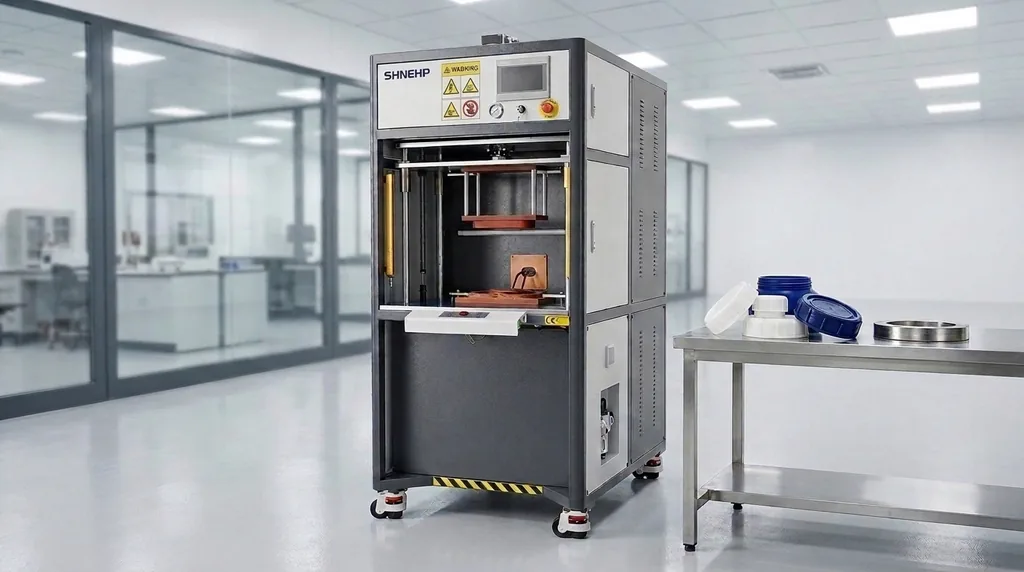
Specialty chemical drums, thick-walled composite caps, tamper-evident industrial closures, and complex 3D-contoured closure assemblies that cannot be rotated, vibrated, or opened for a contact hot plate require contactless internal heat generation right at the joint interface. Deploying a uhf induction welding machine for caps energizes a thin ferromagnetic or metallic susceptor implant (foil, mesh, or polymer-loaded ferromagnetic gasket) placed between mating plastic halves—melting strictly the buried seam from the inside out without marring exterior cap surfaces. SHNEHP engineers ultra-high-frequency induction welding platforms (XNY-20, XNY-30, XNY-45, XNY-75) paired with precision non-magnetic bakelite and PEEK tooling.
The part and its welding challenges
UHF induction welding joins HDPE, PP, PA, PC, ABS, and multi-layer barrier thermoplastics whenever a compatible metallic or ferromagnetic implant sits inside the closure joint. Unlike simple low-power aluminum-foil bottle-cap induction sealers, structural UHF electromagnetic welding creates thick, high-strength fusion seams across demanding closures—introducing five critical engineering constraints:
- Mandatory metallic/ferromagnetic susceptor implant: Pure thermoplastics are transparent to electromagnetic fields; UHF induction welding only works when a compatible ferromagnetic/metallic implant (stamped stainless/steel ring, wire mesh, aluminum foil liner, or ferromagnetic-filled polymer gasket) is trapped at the joint interface.
- Strictly non-magnetic fixture construction: Any steel bolts, aluminum plates, or metallic locating pins near the UHF induction coil will heat up rapidly via eddy currents and melt the fixture or distort the cap—tooling in the coil zone must be built from non-magnetic, heat-resistant bakelite (phenolic) or PEEK.
- Tight ±0.5 mm coil-to-implant coupling tolerance: Electromagnetic field intensity drops sharply with distance; consistent ±0.5 mm coupling alignment between the copper induction coil and the buried susceptor is essential to avoid hot spots on one side and cold un-fused arcs on the opposite side.
- Preventing exterior surface scorching & sink: Over-energizing the susceptor conducts heat all the way through thin cap crowns, blistering textured logos or warping tamper-evident skirts.
- Uniform clamping pressure during & after energization: Because the buried implant expands slightly as it melts the surrounding polymer, steady pneumatic/servo clamping throughout heating and cooling is vital to squeeze out air voids and achieve hermetic fusion.
Why UHF induction welding (vs. alternatives)
| Process | Fit for specialty closures, thick caps & 3D barriers | Contactless & cosmetic capability | Typical cycle time | Engineering boundary |
|---|---|---|---|---|
| UHF induction welding (XNY-20 / 30 / 45 / 75) | Specialized choice for non-circular caps, thick multi-layer chemical closures, 3D-contoured lids, and zero-motion hermetic sealing | Heats purely from inside the joint with zero mechanical motion, zero exterior platen marks, and ability to weld pre-assembled closed joints | ~2–12 s energize + hold (implant dependent) | Requires metallic/ferromagnetic implant, non-magnetic bakelite/PEEK tooling, and ±0.5 mm coil coupling precision |
| Servo spin welding (XNX-100 / XNX-200) | Purely circular PP/HDPE caps without susceptor consumables | Zero implant BOM cost; 0.5–3 s weld | ~0.5–3 s weld | Strictly limited to rotationally symmetrical round closures that can tolerate rotary drive engagement |
| Servo hot plate welding (XNS2-B / XNS5-B) | Open two-piece closures without metallic implants | Zero implant cost; handles 3D contours | ~18–35 s total | Requires open access to insert/withdraw a heated platen; cannot re-seal or weld pre-closed joints |
| Ultrasonic welding (XNC-400) | Small rigid amorphous ABS/PS caps | Sub-second, zero consumables | ~0.1–1.2 s | Poor hermetic repeatability on thick semi-crystalline HDPE/PP chemical closures |
Typical process window (industry ranges)
UHF induction welding parameters depend tightly on coil geometry, susceptor material, and wall thickness between coil and implant. The engineering baselines below are validated during a SHNEHP part-specific weld trial.
| Parameter | Typical industry range | Engineering guidance |
|---|---|---|
| Implant / susceptor requirement | Ferromagnetic polymer gasket, metallic mesh, stamped steel ring, or barrier foil liner | Implant must match the base resin's melt chemistry (for polymer-loaded susceptors) or feature perforations for mechanical polymer lock-through |
| Coil-to-implant coupling | ±0.5 mm positional repeatability (constant air gap across full closure perimeter) | Precision CNC-milled non-magnetic nests keep coupling distance uniform 360° around the cap |
| Fixture materials in RF zone | Bakelite (phenolic), PEEK, G10/FR4, or engineering ceramics (zero metal hardware near coil) | Prevents parasitic eddy-current heating and fixture distortion |
| Power & energize duration | Matched across XNY-20 / XNY-30 / XNY-45 / XNY-75 power tiers; typical 2–10 s energize | Short, crisp high-frequency pulses localize melt strictly at the implant boundary before heat reaches the cap exterior |
| Clamping & cooling hold | Continuous non-magnetic pressure during energize + 3–10 s cooling hold | Eliminates void formation and guarantees leak-tight bond around the susceptor |
Recommended SHNEHP machine and fixture setup
SHNEHP builds dedicated ultra-high-frequency induction welding machines engineered around repeatable RF power delivery and custom water-cooled copper coils:
- Small-to-medium caps & precision closures: XNY-20 and XNY-30 UHF induction platforms offer stable high-frequency solid-state generators, closed-loop power/time control, and rigid vertical pressing frames.
- Large chemical drum closures, thick multi-layer lids & multi-cavity nests: XNY-45 and XNY-75 high-power UHF platforms deliver ample electromagnetic energy across wide perimeter coils and multi-cap fixtures.
- Custom water-cooled coils & bakelite/PEEK tooling: Purpose-built welding and testing fixtures pair CNC-formed water-cooled copper induction coils with non-magnetic bakelite/PEEK alignment nests holding ±0.5 mm coupling accuracy, scalable into automated closure lines via customized machines.
Quality and leak testing
UHF induction-welded closures verify both electromagnetic energy consistency and airtight chemical containment:
- 100% per-cycle RF telemetry: Solid-state generator logs forward power, frequency stability, energize duration, and clamping pressure—flagging missing metallic implants or misaligned caps automatically via load-impedance alarms.
- Inline pressure/vacuum leak testing: Sealed closures and container necks undergo dry-air decay screening (30–150 kPa for packaging caps, up to 100–300 kPa for heavy chemical closures) across a 4-stage Fill / Stabilize / Test / Exhaust cycle, backed by periodic peel-apart implant bond checks and hydrostatic burst audits.
FAQ
Can UHF induction welding fuse plain HDPE or PP caps without a metallic or ferromagnetic implant? No. Standard thermoplastics do not heat directly in an induction field. UHF induction welding requires a compatible metallic foil, perforated steel/stainless mesh, or ferromagnetic-filled polymer susceptor placed at the weld interface.
Why must UHF induction welding fixtures be made from bakelite or PEEK instead of aluminum or steel? Any metallic tooling components placed inside the ultra-high-frequency electromagnetic field absorb eddy currents and heat up rapidly—warping the fixture, wasting generator power, and melting the cap exterior. Non-magnetic bakelite, PEEK, and G10 stay cool and dimensionally stable.
How tight must the alignment be between the induction coil and the buried susceptor implant? Maintain ±0.5 mm coil-to-implant coupling consistency around the entire closure perimeter so electromagnetic heating stays uniform without localized scorching or cold un-fused spots.
How do I choose between SHNEHP XNY-20, XNY-30, XNY-45, and XNY-75 models? Model selection scales with total coil perimeter length, susceptor material, wall standoff thickness, and cavity count—XNY-20/30 fit compact single/dual caps, while XNY-45/75 handle large chemical closures and multi-cavity nests.
What files should we send for a SHNEHP UHF induction weld trial? Share 3D STEP/X_T models of the cap, container neck, and implant pocket, exact plastic resin and susceptor/foil specification, wall thickness above the implant, and target hourly output (UPH).
Get a free weld trial
Send your closure and susceptor drawings to SHNEHP engineering to design the water-cooled copper coil, specify non-magnetic bakelite/PEEK tooling, and validate sealing on an XNY-20 / 30 / 45 / 75 weld trial:
- 3D STEP / X_T / IGES models of the closure, container neck, and susceptor geometry
- Polymer grade & implant/foil spec plus wall thickness between exterior and implant
- Target hourly output (UPH) and leak/burst acceptance criteria
Email yy@nbxiaoneng.com or connect through our contact page.
Request a Technical Consultation & Free Weld Trial
Send your 3D STEP/X_T drawing, resin grade, target cycle time, and leak-test specification. Our engineers will evaluate the joint and recommend a practical SHNEHP machine and fixture setup.