
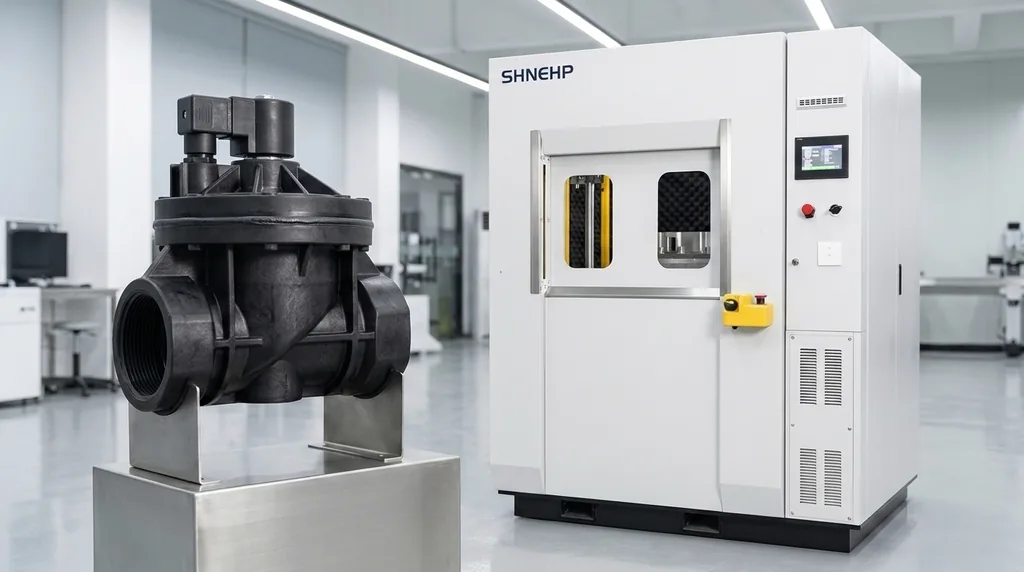
Commercial turf solenoid valves, agricultural hydraulic diaphragm valves, fertilizer-injection manifolds, and automated farm pressure regulators operate outdoors for years under 6–10+ bar water-hammer spikes, sandy irrigation water, and extreme UV/freeze-thaw cycles. Applying vibration welding irrigation valves fuses thick-walled glass-filled thermoplastic valve bodies, bonnet caps, and multi-port headers with near-parent-material structural burst strength in under 15 seconds. SHNEHP engineers high-frequency (210–270 Hz) linear vibration friction platforms (XN-35, XN-40, XN-55, XN-70) built to DVS 2217 meltdown precision.
The part and its welding challenges
Heavy-duty irrigation valves and manifold blocks are commonly molded from PA6/PA66-GF30 (glass-filled nylon), PP-GF20–30, POM (acetal), or rigid PVC to replace expensive brass and cast-iron castings. Joining thick-walled pressurized hydraulic valve bodies presents five core engineering challenges:
- High water-hammer burst & cyclic fatigue resistance: Rapid solenoid valve shut-off generates sharp hydraulic pressure surges far above steady line pressure; weld seams must withstand tens of thousands of hammer cycles without stress cracking.
- Thick-walled flange flatness & high clamping loads: 1-inch to 3-inch irrigation valve bodies carry heavy 4–6 mm wall sections and wide structural flanges that require rigid high-tonnage clamping and balanced drive power to initiate uniform melt.
- Internal diaphragm seat & pilot-port alignment: Solenoid valves contain tiny pilot bleed passages and precision elastomer diaphragm seats; weld collapse must maintain strict axial height while enclosing inner flash away from pilot orifices.
- Threaded BSP/NPT port protection: Molded male/female inlet and outlet pipe threads sit close to the weld plane; lower steel nests must locate on rigid structural flats rather than loading pipe threads under high oscillation forces.
- Glass-fiber orientation at the weld line: On PA66-GF30 and PP-GF30 valves, excessive final weld pressure squeezes out molten resin and leaves weak parallel glass fibers unless staged two-step pressure profiling is used.
Why vibration friction welding (vs. alternatives)
| Process | Fit for thick-walled irrigation valves & manifolds | Burst strength & cycle speed | Typical cycle time | Engineering boundary |
|---|---|---|---|---|
| Linear vibration friction (210–270 Hz: XN-35 / XN-55 / XN-70) | Primary choice for thick PA66-GF, PP-GF, and POM irrigation valve bodies, multi-port manifold headers, and pressure regulators | Highest hydrostatic burst and cyclic water-hammer endurance on glass-filled engineering plastics | ~6–15 s total (2–6 s weld) | Requires planar/gently contoured joint, ≥2.5–3.0 mm clearance, and enclosed pilot-port flash traps |
| Servo hot plate welding (XNS6-B / XNS8-B) | Complex 3D-contoured valve housings or deep internal hydraulic channels blocking in-plane motion | Zero particulate fuzz; handles steep 3D contours and high-GF non-contact IR cleanly | ~25–45 s total | Longer cycle time; POM requires strict overheat interlocks and fume extraction |
| Spin welding (XNX-100 / XNX-200) | Strictly cylindrical inline check valves or round pressure-regulator caps | Fast 0.5–3 s circular fusion at 3–15 m/s surface speed | ~0.5–3 s weld | Cannot join T-shaped, Y-shaped, or multi-port threaded valve bodies |
| Bolted stainless-steel screws + elastomer O-rings | Serviceable commercial diaphragm bonnets needing field diaphragm replacement | Field-openable | High bolt/insert BOM & torque labor | Higher BOM cost; permanent valve sub-bodies, manifolds, and sealed pressure regulators weld faster and eliminate fastener leak paths |
Typical process window (industry ranges)
The conservative DVS 2217 linear vibration parameters below support high-burst PA66-GF30, PP-GF30, and POM irrigation valves. Final parameters are confirmed during a SHNEHP part-specific weld trial.
| Parameter | Typical industry range (PA66-GF30 / PP-GF30 / POM) | Engineering guidance |
|---|---|---|
| Operating frequency | 210–270 Hz (high-frequency electromagnetic drive) | Compact amplitude (0.6–1.0 mm) minimizes pilot-port clearance needs and limits particulate dust |
| Flange wall & rib thickness | Outer flange ≥3.5–5.5 mm; internal divider ribs ≥2.5–3.5 mm | Delivers structural safety margin for repeated hydraulic water-hammer surges |
| Two-stage weld pressure | Stage 1 friction: 2.0–4.0 N/mm²; Stage 2 final collapse: reduced to 1.0–2.0 N/mm² | Lowering final pressure preserves molten resin richness and fiber interlocking on PA-GF/PP-GF |
| Weld time & meltdown | 2.0–6.0 s to closed-loop meltdown target 1.2–2.2 mm | Displacement stop holds exact diaphragm seat height and overall valve dimensions |
| Hold / cooling dwell | 2.0–5.0 s under clamping force | Solidifies crystalline PA66/PP-GF/POM cleanly with zero flange recoil |
| Pre-drying discipline | Freshly molded dry PA66-GF or dried at 80–90 °C | Prevents moisture micro-voids that slash hydrostatic burst ratings |
Recommended SHNEHP machine and fixture setup
SHNEHP matches linear vibration friction welding machines to your valve body's effective weld area and upper-tool mass:
- 1-inch to 2-inch residential/commercial valves (area ≤250–300 cm², upper tool ≤35–40 kg): XN-35 or XN-40 high-frequency platforms with precision closed-loop meltdown control.
- Large 2–3 inch agricultural valves & multi-cavity manifold lines (area ≤400–450 cm², upper tool ≤55–70 kg): XN-55 (18.5 kW, 2500 kgf clamp) or XN-70 (30 kW) heavy-duty platforms deliver the clamping force required for thick glass-filled flanges.
- Zero-slip steel fixtures & locking test cells: Custom welding and testing fixtures support threaded ports safely while gripping structural bosses firmly, paired with automated high-pressure leak testing on customized machines.
Quality and leak testing
Pressurized irrigation valves require 100% inline pneumatic screening paired with periodic hydrostatic water-hammer qualification:
- 100% inline high-pressure air-decay testing: Water valves are screened at 100–300 kPa (1.0–3.0 bar) against 1–5 mL/min pass limits across a 4-stage Fill / Stabilize (2–5 s) / Test / Exhaust cycle, using heavy pneumatic locking cylinders across threaded ports to resist axial blow-off.
- Pilot-channel & seat-seal verification: Dual-mode test stations simultaneously check external body weld tightness and internal diaphragm/pilot flow clearance.
- Hydrostatic burst & water-hammer sampling: Lot samples undergo wet hydraulic burst tests (often 20–30+ bar proof targets) and multi-thousand-cycle pressure-pulsation endurance audits.
FAQ
Why is two-stage pressure control recommended when vibration welding glass-filled irrigation valves? Running high pressure to the very end squeezes molten nylon/PP out of the joint and aligns glass fibers flat along the seam. Stepping pressure down during final collapse leaves a resin-rich fusion zone with stronger fiber interlocking and higher hydrostatic burst pressure.
How do you protect molded BSP/NPT pipe threads during high-force vibration welding? Machine the lower and upper steel fixtures to clamp firmly against structural housing flats, hexagonal wrench pads, and reinforcing ribs directly beneath the weld flange—leaving delicate pipe threads completely unloaded.
What inline leak-test pressure is standard for plastic water and irrigation valves? Production lines typically screen plastic water valves with dry air at 100–300 kPa (1.0–3.0 bar) with 1–5 mL/min acceptance thresholds using high-pressure locking cylinders, backed by periodic wet hydrostatic burst testing.
When should an irrigation valve use hot plate welding instead of vibration welding? Choose linear vibration welding (XN-35 / XN-55 / XN-70) for planar/gently contoured thick-walled valves where fast 6–15 s cycles and high burst strength matter. Switch to servo hot plate welding (XNS6-B / XNS8-B) when complex 3D internal chambers block 2.5–3.0 mm of planar oscillation.
What files does SHNEHP need for an irrigation valve weld trial? Share 3D STEP/X_T models showing all outer flanges and internal pilot dividers, exact PA66-GF/PP-GF/POM grade, target hourly output (UPH), and burst/inline leak-test specs.
Get a free weld trial
Send your irrigation valve or manifold CAD files to SHNEHP engineering to calculate weld area, optimize two-stage pressure staging, and verify burst strength on a physical weld trial:
- 3D STEP / X_T / IGES models of the valve body, bonnet, and internal channels
- Polymer & glass-fiber grade (PA66-GF30, PP-GF30, POM, rigid PVC)
- Target hourly output (UPH), hydrostatic burst target, and inline leak-test spec
Email yy@nbxiaoneng.com or reach our team via the contact page.
Request a Technical Consultation & Free Weld Trial
Send your 3D STEP/X_T drawing, resin grade, target cycle time, and leak-test specification. Our engineers will evaluate the joint and recommend a practical SHNEHP machine and fixture setup.