
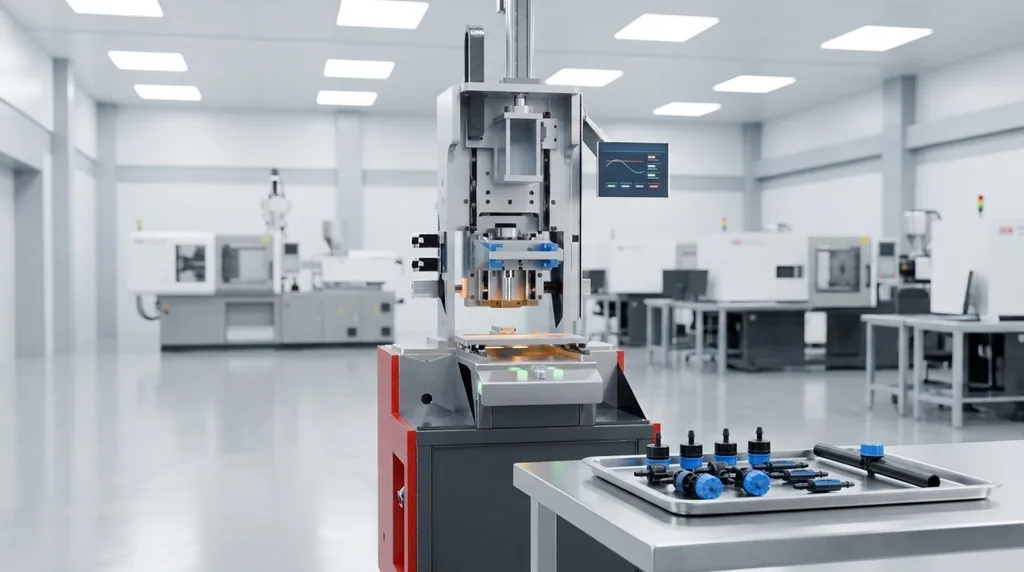
Modern precision agriculture depends on pressure-compensating (PC) drip irrigation emitters, micro-sprinkler heads, and button drippers that meter uniform water and fertilizer flow rates across kilometer-long orchard and greenhouse rows regardless of terrain slope. Applying hot plate welding drip irrigation emitters seals miniature labyrinth flow paths and internal silicone diaphragm chambers in high-cavitation trays without occluding narrow turbulent water channels. SHNEHP engineers 3-axis servo hot plate platforms (XNS2-B, XNS5-B, XNS6-B) built to DVS 2215 displacement control for high-volume irrigation manufacturers.
The part and its welding challenges
Agricultural drip emitters and micro-irrigation drippers are typically molded from UV-stabilized, carbon-black-filled polypropylene (PP), HDPE, LDPE, or POM (acetal) to resist intense outdoor sun exposure and liquid fertilizer chemicals. Welding miniature multi-cavity fluid-metering devices creates five exacting manufacturing hurdles:
- Protecting microscopic turbulent labyrinth channels: Dripper flow rates (typically 1.0–8.0 L/h) rely on molded zig-zag micro-channels often narrower than 0.6–1.2 mm; uncontrolled weld flash overflowing into the labyrinth destroys emitter flow-rate CV (coefficient of variation).
- Consistent internal silicone-diaphragm compression: In pressure-compensating drippers, a tiny elastomer diaphragm sits inside the welded chamber; exact closed-loop weld collapse height is mandatory so diaphragm pre-load remains identical across every cavity.
- High-cavitation uniformity (8-cavity to 32-cavity trays): Irrigation consumables are cost-sensitive high-volume parts requiring multi-cavity fixtures where edge cavities and center cavities experience identical platen temperature and closing force.
- Outdoor UV & chemical stress-crack resistance: Carbon-black PE/PP drippers operate under 1.0–4.0 bar field manifold pressures and acidic fertigation solutions; cold-weld laminations split open after a single summer season.
- Barb & inlet concentricity: Emitter barbed inlet spikes and outlet nipples must remain free of distortion so automated insertion machines punch drippers cleanly into PE lateral tubing.
Why hot plate welding (vs. alternatives)
| Process | Fit for drip irrigation emitters & PC drippers | Labyrinth cleanliness & diaphragm safety | Typical cycle time | Engineering boundary |
|---|---|---|---|---|
| Multi-cavity servo hot plate welding (XNS2-B / XNS5-B / XNS6-B) | Strong choice for PP, HDPE, and LDPE button drippers, multi-outlet manifolds, and diaphragm PC emitters | Uniform low-stress closing preserves silicone diaphragm seating; multi-cavity nests (8–32 up) deliver high hourly output | ~16–28 s per multi-cavity tray | Requires balanced multi-zone PID platens and micron-accurate closed-loop servo meltdown stops |
| Ultrasonic welding (XNC-400 / XN-5) | Small rigid POM/ABS micro-sprinkler nozzles or compact rigid drippers with energy directors | Rapid sub-second single/multi-cavity cycle | ~0.2–1.2 s | Soft semi-crystalline LDPE/HDPE absorbs ultrasonic energy poorly, yielding lower burst consistency on pressurized PE drippers |
| Spin welding (XNX-100) | Larger purely circular inline irrigation filters or round micro-sprinkler bodies | Fast circular seam (0.5–3 s) | ~0.5–3 s | Cannot weld multi-cavity emitter trays simultaneously or join non-circular diaphragm chambers |
| Snap-fit assembly | Low-pressure budget garden emitters | No welder required | Fast mechanical press | Weeps water under 2–4 bar pressure surges and pops open during main-line flushing |
Typical process window (industry ranges)
Multi-cavity PE/PP drip emitters require gentle, ultra-consistent melt depth so internal flow passages stay wide open. The conservative DVS 2215 baselines below are confirmed during a SHNEHP part-specific weld trial.
| Parameter | Typical industry range (PP / HDPE / LDPE) | Engineering guidance |
|---|---|---|
| Platen face temperature | LDPE/HDPE: 215–245 °C; PP: 240–270 °C | Multi-zone PID heating keeps 8-to-32-cavity trays within tight edge-to-center uniformity |
| Bead-up / leveling (Stage 1) | 0.2–0.5 mm displacement | Levels cavity-to-cavity molding tolerance gently before soak |
| Melt / soak phase (Stage 2) | 4–10 s at 0.04–0.08 N/mm² | Shallow controlled melt prevents flash spillover into sub-millimeter labyrinth grooves |
| Changeover time (Stage 3) | ≤1.5–2.2 s | Fast 3-axis servo retraction stops surface skinning on tiny thin-walled emitter rims |
| Joining & collapse (Stage 4) | 0.12–0.22 N/mm² to closed-loop servo hard stop (0.5–1.0 mm) | Hard servo stop guarantees uniform PC diaphragm chamber depth and flow CV |
| Cooling / hold (Stage 5) | 4–9 s | Stabilizes PE/PP seams before rapid multi-cavity pneumatic ejection |
Recommended SHNEHP machine and fixture setup
SHNEHP applies our +60 mm clearance rule across our compact and mid-size servo hot plate welding machines for agricultural irrigation lines:
- Pilot & 8–16 cavity emitter lines: XNS2-B and XNS5-B 3-axis full-servo hot plate welders offer micron-class closed-loop collapse stops, multi-zone PID stability, and compact automated-cell footprints.
- High-output 16–32 cavity emitter trays: XNS6-B servo platform combines wide, rigid parallel guidance with balanced four-post clamping so every cavity hits identical meltdown depth.
- Multi-cavity quick-load trays & automated cells: Custom welding and testing fixtures pair vacuum-assisted multi-cavity emitter nests with vibratory bowl feeding and inline multi-channel flow/leak testing via customized machines.
Quality and leak testing
Drip emitter quality control verifies both external housing burst tightness and precise internal hydraulic metering:
- Inline pressure-decay & flow-rate (CV) verification: Automated multi-channel test fixtures check external seam airtightness at 100–300 kPa (1.0–3.0 bar) and simultaneously sample air/water flow rates to verify zero labyrinth flash occlusion and uniform pressure-compensation performance.
- Diaphragm seating & burst audits: Periodic batch samples undergo hydrostatic pressure burst testing (typically 4–8+ bar depending on irrigation standard ISO 9261) and cross-section microscopy confirming zero melt intrusion into flow channels.
FAQ
How do you stop molten plastic from clogging tiny drip-irrigation labyrinth channels during hot plate welding? Use shallow, tightly controlled melt soak times, design a dedicated recessed flash-catch lip outside the labyrinth wall, and terminate joining on a closed-loop 3-axis servo displacement hard stop so displaced melt volume never varies.
Why choose hot plate welding over ultrasonic welding for PE and PP drip irrigation emitters? Semi-crystalline LDPE, HDPE, and PP strongly attenuate ultrasonic vibrations, leading to inconsistent sealing under 2–4 bar irrigation pressure. Multi-cavity servo hot plate welding creates uniform, chemical-resistant molecular seals across 8 to 32 PE/PP emitters per cycle.
Can hot plate welding seal pressure-compensating (PC) emitters that hold an internal silicone diaphragm? Yes. Contoured heating platens melt only the outer emitter shell perimeter while keeping the central diaphragm pocket thermally shielded; precision servo collapse control guarantees repeatable diaphragm pre-compression.
How many drip emitters can one SHNEHP servo hot plate machine weld per cycle? Depending on emitter diameter and machine platen size (XNS2-B / XNS5-B / XNS6-B), multi-cavity tooling commonly welds 8 to 32 emitters per cycle in ~16–28 seconds, delivering high hourly throughput.
What files should we send for a drip emitter weld trial? Share 3D STEP/X_T models showing internal labyrinth dimensions and diaphragm seat clearances, exact PE/PP/POM resin grade, target hourly output (UPH), and ISO 9261 pressure/CV requirements.
Get a free weld trial
Share your drip irrigation emitter CAD models with SHNEHP engineering to design multi-cavity servo tooling and verify zero-occlusion labyrinth sealing on a physical weld trial:
- 3D STEP / X_T / IGES models of emitter body, cover, and labyrinth geometry
- Polymer grade & UV/carbon-black spec (PP, HDPE, LDPE, POM)
- Target hourly output (UPH) and operating/burst pressure criteria
Email yy@nbxiaoneng.com or connect through our contact page.
Request a Technical Consultation & Free Weld Trial
Send your 3D STEP/X_T drawing, resin grade, target cycle time, and leak-test specification. Our engineers will evaluate the joint and recommend a practical SHNEHP machine and fixture setup.