
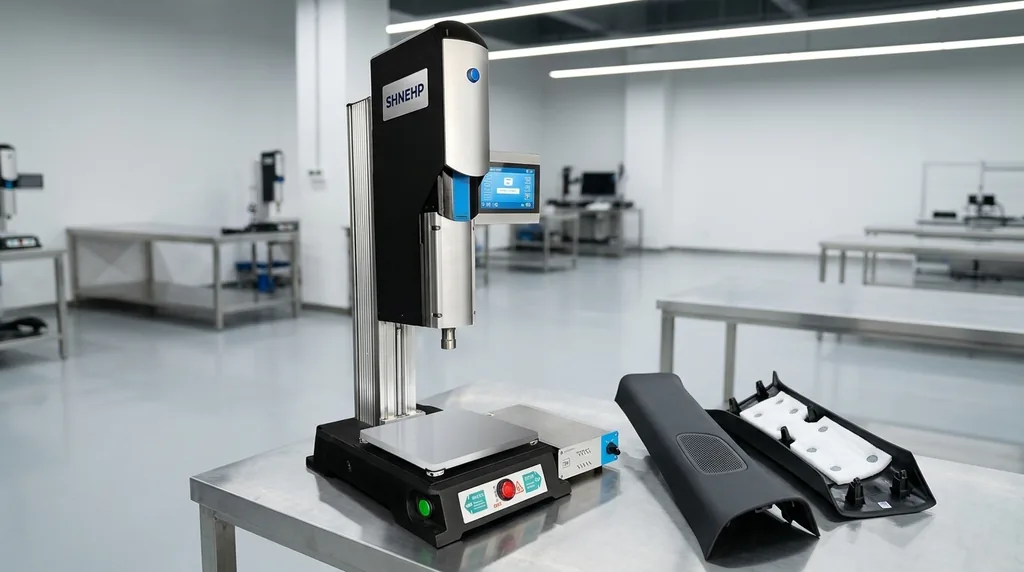
Interior automotive A-, B-, C-, and D-pillar cover trims integrate discrete rear clip towers, tweeter speaker grilles, seat-belt height-adjuster bezels, grab-handle reinforcement sleeves, and acoustic non-woven felt absorption pads onto textured PP-T20, ABS, or PC/ABS substrate shells. When individual attachment pads, mesh grilles, or acoustic fleece mats require rapid, localized joining without heating an entire 1-meter pillar molding, ultrasonic welding pillar cover trim delivers crisp 0.2–0.8 second bonds per point with minimal energy draw and ultra-fast multi-head cell cycles. SHNEHP supplies rigid 20–35 kHz digital ultrasonic welding machines (XNC-400, XN-3, XN-5) and multi-head acoustic trim welding cells built for Tier-1 automotive interior plants.
The part and its welding challenges
Joining rear clips, tweeter grilles, and acoustic pads onto slender interior pillar trim covers poses five ultrasonic engineering challenges:
- Preventing Class-A grain flattening or circular witness marks: Textured PP-T20 and ABS pillar skins are typically 2.2–2.8 mm thick; excessive static clamp force, oversized 20 kHz amplitude, or over-welding transmits heat and vibration through the wall, creating shiny spots or dimples on the cabin-facing grain.
- Acoustic fleece & felt attachment without melting through thin backing ribs: Many A- and B-pillar trims bond sound-absorbing PET/PP acoustic fleece pads onto the rear face using multi-point ultrasonic spot-welding/riveting tips that anchor porous fibers cleanly without scorching the shell.
- Clear boundary between ultrasonic trim work and hot plate / hot-air staking: Ultrasonic welding excels on raw grained PP-T20/ABS/PC-ABS discrete clip towers, tweeter grilles, and felt pads within near-field distance (≤6 mm); however, piano-black high-gloss exterior B-pillar PMMA appliqués or continuous 3D structural ribs are safer on low-pressure servo hot plate / IR welding, and fabric-wrapped pillars often prefer hot-air cold staking.
- Synchronizing 6 to 16 discrete 3D points across curved pillars: Individual clip brackets and acoustic-pad welds sit at varied compound angles along a 700–1,100 mm pillar; multi-head 30–35 kHz pneumatic slide units or robotic ultrasonic guns prevent slow manual repositioning.
- Consistent curtain-airbag deployment clip retention: Pillar clip towers near side curtain airbags require repeatable pull-off strength backed by 100% energy and collapse-distance gating.
Why ultrasonic welding (vs. alternatives)
| Process | Fit for pillar cover trim clips, tweeter grilles & acoustic felt | Speed, footprint & energy | Typical cycle time | Engineering boundary |
|---|---|---|---|---|
| Multi-head / robotic 20–35 kHz ultrasonic welding (SHNEHP) | Top high-speed choice for discrete rear clip towers, tweeter speaker grilles, grab-handle inserts, and PET/PP acoustic felt pads on grained PP-T20/ABS pillars | Instant 0.2–0.8 s cold weld per point; zero thermal standby power; welds porous acoustic fleece cleanly | ~8–16 s full multi-point pillar | Keep within ≤6 mm near-field; avoid high-amplitude 20 kHz directly behind ultra-thin high-gloss piano-black skins |
| Servo hot plate / IR welding (XNS6-B / XNS8-B) | Piano-black glossy exterior B-pillar appliqués and long continuous 3D structural pillar ribs | Ultra-gentle low clamping force protects mirror-gloss surfaces | ~18–32 s (L+R pair) | Slower cycle and cannot spot-tack fibrous acoustic fleece pads |
| Hot-air cold staking | Multi-point staking on fabric/leather-wrapped A-pillars or dissimilar metal brackets | Zero vibration and zero wrap-adhesive disturbance | ~10–18 s | Requires protruding bosses through mating holes; slower on discrete flat clip pads |
| Hot-melt glue / adhesive clips | Low-volume felt pad tacking | No ultrasonic tooling | ~20–45 s + glue cost | Glue odor/VOC fogging in hot cabins, inconsistent summer peel strength, and ongoing adhesive expense |
Typical process window (industry ranges)
Pillar cover trim ultrasonic welding relies on 30–35 kHz compact low-amplitude horns for thin Class-A zones and 20 kHz horns for heavier structural clip towers, terminated strictly in energy mode with collapse ceilings. Exact settings are validated on customer grained pillars during a SHNEHP trial.
| Parameter | Typical industry range (PP-T20 / ABS / PC-ABS + Acoustic Felt) | Engineering guidance |
|---|---|---|
| Operating frequency | 30–35 kHz (thin-wall clips, tweeter bezels, acoustic felt) or 20 kHz (thicker structural grab-handle brackets) | 30–35 kHz cuts physical amplitude nearly in half, preventing Class-A grain witness marks |
| Joint / horn tip geometry | Shallow energy director (0.3–0.5 mm) for clip towers; stepped spot-weld pin tips for acoustic fleece; hollow dome tips for tweeter grille staking | Rear-side hidden contact only; FEA-tuned titanium/aluminum horns reach tight 3D pillar angles |
| Weld time & control mode | 0.2–0.8 s per point in energy mode with strict collapse-distance ceiling | Stops ultrasonic energy instantly before thermal soak telegraphs to the visible grain |
| Class-A nest support | Precision contoured cast-urethane/aluminum nest with non-marring felt/elastomer liner | Rigid acoustic support right opposite each weld point without crushing surface texture |
| Hold time | 0.25–0.5 s | Locks semi-crystalline PP-T20 and ABS clip pads solidly against buzz-squeak-rattle (BSR) |
Recommended SHNEHP machine and fixture setup
SHNEHP supplies both standalone presses and turnkey multi-head interior trim cells from our ultrasonic welding machine and customized machines portfolios:
- Pilot & sub-component stations: XNC-400, XN-3, and XN-5 digital auto-tuning ultrasonic presses with micron-scale collapse encoders and upper/lower energy/depth reject windows.
- Full-pillar multi-head 35 kHz welding & acoustic-felt cells: Custom dual-cavity L+R fixtures integrating 6 to 16 angled 30–35 kHz pneumatic ultrasonic modules (or a 6-axis robot with a compact ultrasonic weld head) that finish both left and right pillars cleanly inside one sound-insulated light-curtain station.
- Poka-yoke Class-A nests: Custom welding and testing fixtures integrate clip-tower and tweeter-grille presence switches, vacuum hold-downs, and barcode MES serialization.
Quality and leak testing
Interior pillar ultrasonic trim lines enforce 100% weld-window verification and cosmetic appearance audits:
- Per-point energy & collapse telemetry: Every single clip tower, tweeter stake, and acoustic-felt tack logs exact energy (J), peak power (W), and final depth (mm); any under- or over-limit weld locks the fixture and highlights the exact point ID on the HMI.
- Raking-light Class-A & pull-off audits: Operators inspect visible grain zones under angled lighting for zero shininess or dimpling, backed by periodic clip-tower pull-off strength tests and -40 °C to +90 °C thermal-aging BSR checks.
FAQ
When should automotive pillar trim use ultrasonic welding versus hot plate welding? Use 30–35 kHz ultrasonic welding for discrete rear clip towers, tweeter speaker grilles, grab-handle sleeves, and sound-deadening acoustic felt pads on grained PP-T20/ABS interior pillars. Use low-pressure servo hot plate or non-contact IR welding for long continuous structural ribs or thin piano-black glossy exterior B-pillar appliqués.
How do you attach acoustic felt pads onto automotive pillar trims without glue odors? Multi-head 30–35 kHz ultrasonic spot-welding pins melt localized anchor points right through the PET/PP acoustic fleece directly into the PP-T20 pillar substrate in 0.3–0.6 seconds—zero adhesive cost and zero cabin VOC outgassing.
Why prefer 30–35 kHz over 20 kHz for ultrasonic welding behind Class-A grained pillar covers? Higher 30–35 kHz frequencies run at much smaller mechanical amplitudes and use slim, compact transducers that fit densely across curved 3D pillars while dramatically lowering the risk of visible Class-A grain witness marks.
Can one SHNEHP multi-head ultrasonic station weld left-hand and right-hand pillar covers together? Yes. SHNEHP builds mirrored L+R dual-cavity multi-head ultrasonic stations (or robotic ultrasonic cells) that weld a full pair of A-, B-, or C-pillar trims in a single 10–18 second cycle with individual clip poka-yoke checks.
What CAD files are needed for a SHNEHP pillar-trim ultrasonic evaluation? Send 3D STEP/X_T models showing all clip towers, tweeter grilles, acoustic felt zones, and skin wall thickness, resin grade (PP-T20, ABS, PC/ABS), and target L+R hourly output.
Get a free weld trial
Send your A/B/C/D-pillar cover trim CAD models to SHNEHP engineering to validate zero-witness-mark 30–35 kHz ultrasonic clip, grille, and acoustic-felt welding on real grained moldings:
- 3D STEP / X_T / IGES models of pillar trim, clip towers, grilles, and felt zones
- Resin & finish specs (PP-T20, ABS, PC/ABS, grain depth, wall thickness)
- Target L/R cycle time and OEM clip pull-off / airbag deployment requirements
Email yy@nbxiaoneng.com or connect through our contact page.
Request a Technical Consultation & Free Weld Trial
Send your 3D STEP/X_T drawing, resin grade, target cycle time, and leak-test specification. Our engineers will evaluate the joint and recommend a practical SHNEHP machine and fixture setup.