
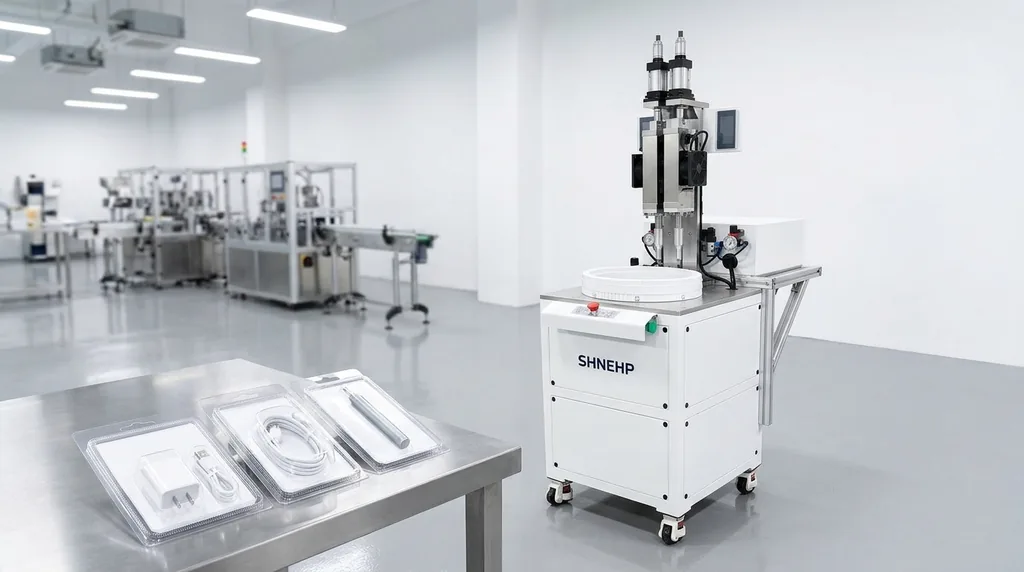
Retail electronics accessories, hardware tools, automotive bulbs, cosmetics, and medical kits rely on crystal-clear thermoformed clamshell blisters that showcase products while preventing retail shoplifting and tampering. Deploying an ultrasonic blister packaging welding machine fuses thin thermoformed plastic flanges in 0.1–0.6 seconds without pre-heating warm-up wait times, continuous energy drain, or RF shielding compliance overhead. SHNEHP engineers digital ultrasonic welding platforms (XNC-400, XN-3, XN-5) and rotary-index sealing cells for high-speed retail and industrial packaging lines.
The part and its welding challenges
Thermoformed clamshell blisters and trays are predominantly formed from clear APET / RPET (recycled PET), PETG, rigid PVC, HIPS, or PP sheet typically 0.25 mm to 1.0 mm thick. Sealing thin, clear thermoformed flanges at high line speeds presents five practical challenges:
- Preventing burn-through & warping on thin 0.3–0.6 mm sheet: Thin thermoformed flanges melt almost instantaneously; uncontrolled time or excessive horn pressure punches holes straight through the flange or wrinkles clear retail display borders.
- Replacing PVC with recyclable APET / RPET: While PVC seals easily on RF dielectric sealers, eco-friendly APET and RPET cannot be RF welded—making ultrasonic welding the clean, energy-saving industrial standard for sustainable mono-material PET clamshells.
- Protecting printed paper insert cards & boxed contents: Retail blisters trap printed cardboard inserts and fragile electronics inside the cavity; localized spot or continuous perimeter knurl welding must keep heat strictly on the outer flange without scorching paper graphics or vibrating product lenses.
- Tamper-evident strength vs. easy consumer tear-open: Retailers want theft-deterrent perimeter tacking (discrete spot welds or crisp knurled perimeter tracks) that clearly shows tampering while allowing controlled tear-strip opening where specified.
- Fast SKU changeover on seasonal packaging lines: Contract packagers swap clamshell sizes weekly, requiring lightweight quick-change aluminum anvils and modular multi-point or perimeter horns.
Why ultrasonic welding (vs. alternatives)
| Process | Fit for thermoformed blister & clamshell packaging | Speed, sustainability & energy | Typical cycle time | Engineering boundary |
|---|---|---|---|---|
| Digital ultrasonic welding (15–20 kHz: XNC-400 / XN-3 / XN-5) | Primary choice for recyclable APET / RPET, PETG, PVC, HIPS, and PP clamshells (spot tacking or full perimeter knurl) | Zero warm-up, seals APET/RPET cleanly without RF emissions, uses energy only during 0.1–0.5 s pulse | ~0.1–0.6 s weld + hold | Requires crisp knurled anvil/horn pattern to focus energy on thin sheet without molded energy directors |
| RF (high-frequency) dielectric welding | Legacy thick PVC clamshells requiring wide glassy-clear perimeter seals | Smooth clear seal on polar PVC | ~2–5 s | Cannot weld APET, RPET, PP, or HIPS; high standby power, RF shielding compliance, and tooling arc-burn maintenance |
| Thermal heat sealing | Blister-to-coated-paperboard card heat sealing | Simple coated-card bonding | ~1.5–4 s | Continuous heater power draw, warm-up lag, and slower cooling distortion on thick plastic-to-plastic clamshells |
| Staples / tape / adhesive | Low-volume manual fulfillment | No machinery | Slow manual labor | Poor shelf appearance, easily tampered with, and slow labor cost |
Typical process window (industry ranges)
Thin thermoformed sheets lack thick molded energy directors, so precision knurled steel/aluminum anvils (diamond or dashed-line textures) concentrate ultrasonic shear cleanly at the flange interface. Exact settings are verified during a SHNEHP part-specific weld trial.
| Parameter | Typical industry range (APET / RPET / PETG / PVC / PP) | Engineering guidance |
|---|---|---|
| Sheet thickness | 0.25–1.0 mm per half | Match knurl tooth height (typically 0.3–0.6 mm) to sheet gauge so teeth fuse both layers without cutting through |
| Ultrasonic frequency | 20 kHz for standard retail clamshells & spot-tack arrays; 15 kHz for oversized hardware/tool clamshells | 20 kHz delivers crisp, low-noise sealing; 15 kHz covers larger single-shot perimeter horns |
| Weld pattern | Discrete tamper-evident spot welds (4–12 spots) or continuous dashed/knurled perimeter | Spot welds cycle fastest and cut horn cost; continuous knurl seals dust-tight for medical/electronics kits |
| Trigger & weld force | Low-to-moderate precision pneumatic force | Prevents flattening the knurl teeth into the flange before ultrasonic oscillation begins |
| Weld / Hold duration | 0.15–0.50 s weld / 0.20–0.60 s hold | Brief hold locks molten APET/PETG flat with crisp embossed retail finish |
| Control mode | Weld-by-energy or Weld-by-time with peak-power guardrails | Automatically catches doubled-up sheets or misaligned clamshell flanges |
Recommended SHNEHP machine and fixture setup
SHNEHP configures standalone and rotary-index ultrasonic welding machines for contract packaging and OEM fulfillment lines:
- Single-station & modular multi-spot sealing: XNC-400 and XN-3 (20 kHz) digital ultrasonic welders offer instant startup, programmable energy/power windows, and crisp repeat performance on APET/RPET and PVC clamshells.
- Large hardware/automotive retail clamshells: XN-5 (15 kHz) high-power ultrasonic platform drives wide rectangular perimeter horns or multi-point bar horns cleanly in one stroke.
- Rotary-index blister packaging tables: For high-speed retail production, customized machines pair 4-to-8 station rotary indexing dials with automatic blister de-nesting, ultrasonic perimeter/spot sealing, and automatic unloading—paired with quick-change knurled anvils (welding and testing fixtures).
Quality inspection and process control
Blister and clamshell packaging quality focuses on tamper-evident peel strength, visual clarity, and high-speed zero-burn consistency:
- 100% per-cycle ultrasonic envelope monitoring: PLC checks energy, peak power, and weld duration on every stroke to catch pinched paper cards or missing lids automatically.
- Peel-strength & tamper-evidence audit: Lot checks verify that attempting to open the clamshell tears the sheet cleanly around the knurled weld rather than peeling apart intact, while ensuring zero cloudy haze or scorching on retail display windows.
FAQ
Can an ultrasonic blister packaging welding machine seal eco-friendly APET and RPET clamshells? Yes. Unlike RF dielectric sealers (which only work on PVC), 15–20 kHz ultrasonic welding seals recyclable APET, RPET, PETG, PVC, HIPS, and PP clamshells cleanly in under half a second with zero warm-up power waste.
How do you weld flat thermoformed clamshell flanges that have no molded energy director? Machine a crisp diamond or dashed-line knurl pattern directly onto the lower anvil (or horn face). The raised knurl points concentrate ultrasonic friction precisely along the flange contact line, creating strong tamper-evident welds without cutting through thin sheet.
Should we choose discrete spot welds or a full perimeter weld for retail clamshell packaging? Choose multi-point spot welding (4–10 discrete spots) for lower tooling cost, faster SKU changeover, and theft-deterrent retail packaging; choose a continuous perimeter knurl seal for dust-tight industrial kits or sealed medical trays.
Does ultrasonic welding damage electronics or printed insert cards inside the blister? No. Because ultrasonic energy is applied strictly to the flat outer flange outside the central product cavity for just 0.15–0.5 seconds, inner printed paperboard cards and boxed products stay untouched when the anvil properly supports the flange rim.
What should we send for a SHNEHP blister packaging weld trial? Share clamshell flange dimensions (or physical empty clamshell samples), exact sheet material and thickness (e.g., 0.5 mm APET or PVC), spot vs. perimeter seal preference, and target hourly output (UPH).
Get a free weld trial
Send your clamshell drawings or sample trays to SHNEHP engineering to optimize knurl pattern geometry, spot vs. perimeter horn layout, and rotary-table throughput on a free weld trial:
- Clamshell dimensions / STEP files (or sample thermoformed shells)
- Sheet polymer & thickness (APET, RPET, PETG, PVC, PP; 0.25–1.0 mm)
- Seal style (spot vs. continuous perimeter) and target hourly output (UPH)
Email yy@nbxiaoneng.com or reach our team on our contact page.
Request a Technical Consultation & Free Weld Trial
Send your 3D STEP/X_T drawing, resin grade, target cycle time, and leak-test specification. Our engineers will evaluate the joint and recommend a practical SHNEHP machine and fixture setup.