
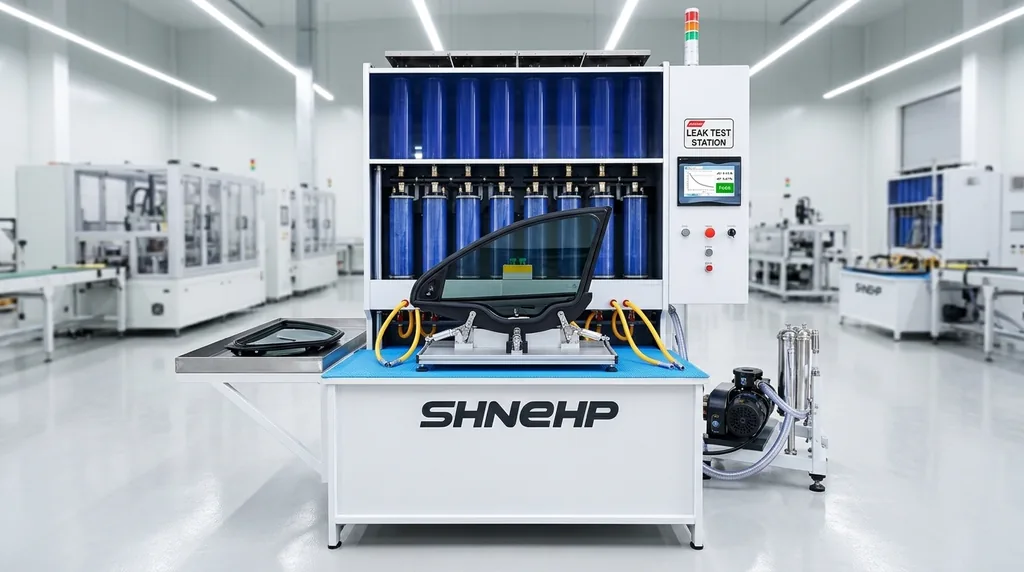
Automotive quarter-window TPE/PVC glass encapsulations, frameless EV door sealing modules, integrated door wet-side/dry-side carrier plates, and sunroof/window-frame drainage channels protect vehicle cabins against high-pressure car-wash intrusion, monsoon rainfall, and highway wind-noise whistling. Whenever thermoplastic mounting frames, mirror-triangle corner seals, or molded drainage housings are joined to encapsulated glass assemblies via hot plate, ultrasonic, or hot-staking processes, even a subtle corner seam gap ruins cabin NVH and causes floor-carpet water leaks. Custom leak testing fixture automotive door glass stations verify 100% of perimeter seal integrity inline using clean, repeatable dry-air differential pressure decay or controlled vacuum testing—without slow, messy water spray booths. SHNEHP engineers precision welding and testing fixtures built for Tier-1 automotive glazing and door-module plants.
The part and its welding challenges
Door glass encapsulations, fixed quarter-windows, and door carrier water-barrier modules combine brittle tempered/laminated glazing with flexible elastomer lips and multi-plane 3D frames, presenting five testing challenges:
- Zero glass chipping or cosmetic scratching during pneumatic clamping: Tempered side windows and acoustic laminated glass cannot tolerate point-contact metal clamps; fixtures require contoured elastomer-lined datum pads and calibrated low-force pneumatic hold-downs distributed evenly along the encapsulated polymer border.
- Forming a repeatable perimeter test seal along 3D curved glass profiles: Unlike a closed plastic tank with simple round ports, a door glass frame or door wet-side carrier requires a custom contoured perimeter sealing channel (silicone inflatable bladder or dual-durometer lip gasket) to create a repeatable test chamber against the weld seam or seal lip.
- High-sensitivity low-pressure detection without flexing soft TPE/EPDM seals: Excess test pressure pushes soft weatherstrips open and triggers false leaks; low-pressure 5–20 kPa differential pressure decay or vacuum testing (1 Pa resolution) detects pinpoint gaps while mimicking real-world wind-driven rain pressure.
- Verifying integrated mirror-triangle clips and corner weld joints: Molded corner brackets and mirror-gusset seals welded onto quarter-glass carriers are prime leak paths that require focused multi-zone test pockets or flow-continuity checks.
- Balancing fast L+R vehicle-set takt times: Door glass and carrier lines typically ship in mirrored left-hand and right-hand pairs, demanding dual-station parallel fixtures or quick-change multi-model beds with full barcode MES traceability.
Why custom dry-air leak testing fixtures (vs. alternatives)
| Method | Fit for automotive door glass encapsulations & door seal carriers | Speed, cleanliness & repeatability | Typical cycle time | Engineering boundary |
|---|---|---|---|---|
| SHNEHP custom contoured dry-air differential / vacuum fixture | Top inline OEM choice for 100% testing of welded quarter-window frames, mirror-gusset housings, and wet-side door modules | Clean, dry, zero water spots on glass; 1 Pa differential repeatability; automated MES pass/fail logging | ~12–22 s (incl. 3–5 s stabilize) | Requires precision CNC-contoured elastomer sealing tracks matched to exact 3D glazing curvature |
| Ultrasonic acoustic leak scanning | Full-vehicle cabin door-seal gap diagnostics on final assembly lines | Pinpoints wind-noise leak sites rapidly on complete doors | ~25–45 s | Best for full-door BIW checks rather than quantitative component weld-seam testing |
| Water spray / monsoon booth | Vehicle-level final audit or offline failure reproduction | Directly visualizes water intrusion paths | ~60–180 s + drying | Unsuitable for high-speed Tier-1 sub-assembly lines due to drying time, mineral water spotting, and wet packaging |
| Manual soap-bubble / feeler checks | Prototype validation | Minimal fixture outlay | ~45–90 s | Subjective operator dependence and zero Gage R&R audit trail |
Typical process window (industry ranges)
Door glazing frames, mirror-gusset housings, and door wet-side carriers test at gentle low pressures calibrated to prevent seal-lip lift while maintaining 1 Pa leak resolution. Exact recipes are validated on molded customer glass assemblies during SHNEHP fixture commissioning.
| Parameter | Typical industry range (Door Glass Frames & Seal Modules) | Engineering guidance |
|---|---|---|
| Test pressure / vacuum | 5–25 kPa (positive differential or controlled vacuum) | Gentle pressure avoids lifting soft TPE/EPDM lips while exposing weld pinholes and corner gaps |
| Allowable leak-rate window | 0.2–2.0 mL/min (or OEM-defined Pa/s per perimeter length) | Verified at shift start with an onboard calibrated master leak orifice |
| Sensor resolution | 1 Pa differential transducer or laminar mass-flow sensor | Isolates ambient plant draft and supply fluctuations using a rigid matched reference volume |
| Fill, stabilize & measure | Fill 2–4 s; stabilize 3–5 s; measure 3–6 s | Allows elastomer gasket seating compliance to settle before quantitative measurement |
| Glass & trim safety | Soft-touch urethane datum cradles + controlled low-pressure clamp regulators | Zero glass edge chipping; automatic poka-yoke lock on failed assemblies |
Recommended SHNEHP machine and fixture setup
SHNEHP designs turnkey welding and testing fixtures standalone or directly integrated downstream of our door-module welders:
- Dual-nest L+R parallel testing benches: Test mirrored left and right quarter-window frames or door carrier modules concurrently inside one ergonomic light-curtain-guarded frame, doubling hourly throughput.
- Quick-change contoured sealing cartridges: Tool-less pneumatic quick-disconnects and RFID fixture identification allow Tier-1 glazing suppliers to swap between sedan, SUV, and EV door profiles in minutes.
- Integrated presence, clip & MES verification: Built-in optical/inductive poka-yoke sensors confirm all welded mounting clips, foam pads, and drainage grommets are present in the same cycle before laser-marking or printing the MES pass label via customized machines.
Quality and leak testing
To sustain strict OEM Gage R&R across multi-shift glazing and door-module plants, SHNEHP test benches include built-in diagnostic safeguards:
- Automated shift-start master leak & gasket-wear checks: HMI prompts guide operators through a golden-master zero-leak check and certified master-orifice check, automatically alerting maintenance if perimeter silicone seal bladders begin wearing.
- Zero-escape reject handling: Failed door-glass carriers lock inside the nest until acknowledged by a supervisor badge or divert onto an inspection rack with the exact failed zone highlighted on the HMI.
FAQ
How can a dry-air leak fixture test an open-sided automotive door glass encapsulation or door seal frame? SHNEHP machines a precision 3D contoured fixture bed lined with soft silicone perimeter bladders or dual-durometer lip seals that close tightly against the glass border or weld flange, forming an isolated local test cavity along the sealed perimeter.
What pressure range is safe for leak-testing tempered automotive door glass and TPE seals? Low differential pressures or vacuum levels of 5–25 kPa reliably detect corner weld pinholes and seal-lip discontinuities without over-stressing tempered glass edges or blowing open soft TPE/EPDM weatherstrips.
Can one SHNEHP leak-testing station inspect both left-hand and right-hand door modules? Yes. Dual-channel parallel stations test mirrored L+R door glass frames or wet-side carrier modules simultaneously, each with independent 1 Pa differential instrumentation and individual MES barcode records.
Can the leak fixture also verify welded mounting clips and locator pins in the same cycle? Yes. SHNEHP routinely integrates optical, inductive, and mechanical go/no-go poka-yoke probes directly into the leak-test nest so dimensional fit, clip presence, and airtightness are verified in one 15-second station.
What CAD data should we send for a door glass or seal leak-testing fixture quote? Provide 3D STEP/X_T models of the glass encapsulation or door carrier assembly, exact weld/seal paths to inspect, OEM leak-rate acceptance criteria, and target L+R hourly volume.
Get a free weld trial
Share your door glass encapsulation, quarter-window frame, or door water-barrier CAD assemblies with SHNEHP engineering to design a zero-scratch, Gage-R&R-verified leak-testing fixture:
- 3D STEP / X_T / IGES models of glazing frame, seal lips, and welded brackets
- OEM leak spec (test pressure kPa, allowable mL/min, clip poka-yoke list)
- Target hourly output (UPH) and MES traceability standards
Email yy@nbxiaoneng.com or connect through our contact page.
Request a Technical Consultation & Free Weld Trial
Send your 3D STEP/X_T drawing, resin grade, target cycle time, and leak-test specification. Our engineers will evaluate the joint and recommend a practical SHNEHP machine and fixture setup.