
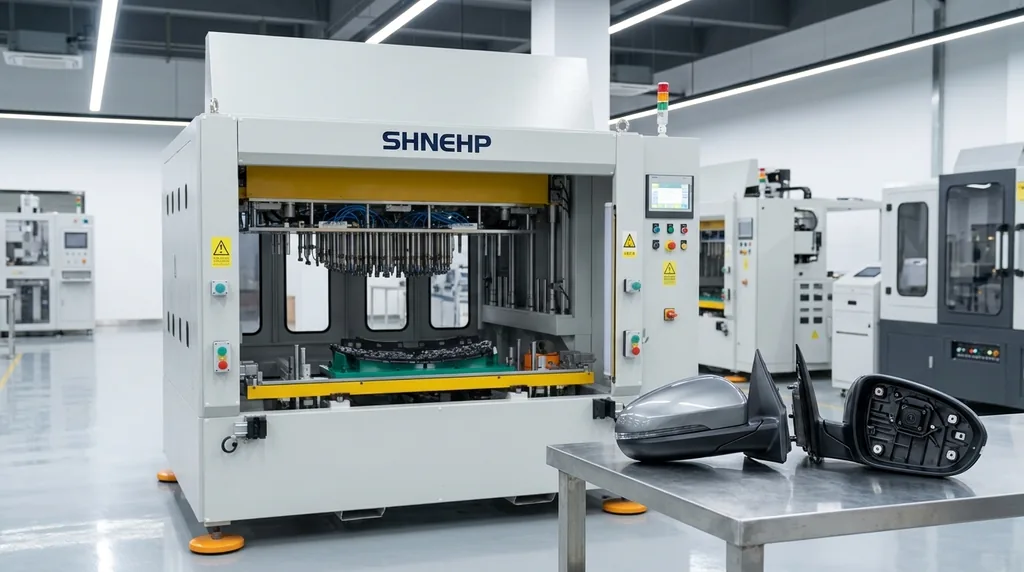
Modern automotive exterior side mirrors (wing mirrors) pack high-value electronics inside a compact aerodynamic shell: power-folding actuators, 360° surround-view cameras, blind-spot warning LEDs, sequential turn-signal light blades, puddle lamps, and painted or high-gloss black outer caps. Joining dissimilar ASA, ABS, PC/ABS, PBT-GF, or PA6-GF30 brackets, camera bezels, and structural sub-frames onto painted Class-A mirror skulls—without cracking brittle glass-filled bosses, inducing paint sink marks, or shaking delicate camera/LED modules—is a classic multi-material assembly problem. Applying hot staking door mirror housings (using hot-air cold staking or impulse/thermal staking) forms tight, zero-rattle mushroom/rosette rivets across 4 to 14 discrete bosses simultaneously with zero mechanical vibration. SHNEHP engineers multi-point thermal and hot-air cold hot staking machines tailored to automotive exterior mirror Tier-1 suppliers.
The part and its welding challenges
Exterior side-mirror housings endure highway wind buffeting, automatic car-wash brushes, road-salt spray, and -40 °C to +90 °C thermal shock while maintaining pinpoint camera aiming tolerances. Five engineering realities shape mirror staking quality:
- Joining dissimilar plastic and metal sub-components: Mirror assemblies routinely lock a glass-filled PA6-GF30 or die-cast aluminum internal skeleton, a PC/PMMA turn-signal lamp, or a metal camera bracket onto an ASA or painted ABS/PC-ABS outer housing—materials that cannot melt-fuse directly and require mechanical boss staking.
- Zero vibration near 360° surround-view cameras and blind-spot LEDs: Ultrasonic staking transmits 20 kHz high-G shock directly through rigid mirror shells, risking camera lens-focus drift, solder-joint cracking, or loose optical dust inside LED repeater lamps; thermal and hot-air cold staking apply strictly zero mechanical vibration.
- Zero painted-surface read-through on high-gloss mirror caps: Exterior mirror caps carry automotive basecoat/clearcoat or piano-black PMMA finishes; localized hot-air heating softens only the upper tip of the molded boss (keeping base heat away from the show skin), eliminating front-side dimples.
- Eliminating stringing and radial cracking on glass-filled PA6-GF / PBT-GF bosses: Contact-heated metal staking tips often stick to semi-crystalline nylon or crack brittle glass-filled bosses during cool-down; hot-air cold staking heats bosses radiatively/convectively with precision superheated air and forms them cleanly under a room-temperature cold punch—delivering zero sticking, zero stringing, and tight zero-gap pull-down.
- 3D compound angles across mirrored L+R mirror pairs: Bosses on curved mirror skulls sit on tilted planes requiring multi-axis pneumatic/servo staking heads and mirrored dual-cavity L+R fixtures for balanced vehicle-set output.
Why hot staking / hot-air cold staking (vs. alternatives)
| Process | Fit for side-mirror housings, camera & turn-signal brackets | Electronics safety & dissimilar-material fit | Typical cycle time | Engineering boundary |
|---|---|---|---|---|
| Hot-air cold staking (SHNEHP multi-point) | Premier choice for dissimilar brackets (PA-GF, PBT-GF, aluminum, PC lamps) on painted ASA/ABS mirror housings containing cameras & LEDs | Zero vibration, zero sticking/stringing on PA-GF/PBT-GF, zero-gap cooled rivet preload, zero paint read-through | ~10–18 s (all 4–14 bosses at once) | Requires molded staking bosses protruding cleanly through mating bracket holes |
| Constant-heat / impulse thermal staking | Amorphous ABS, ASA, and PC/ABS mirror bezels and non-glass-filled clips | Compact simple tooling, zero vibration, tight rosette/dome head profiles | ~8–16 s | Contact tips need PTFE coating and careful release timing on sticky semi-crystalline PA/PP grades |
| Ultrasonic staking (20–35 kHz) | Rigid unpainted lower mirror shells with zero fragile cameras/optics nearby | Sub-second discrete stake | ~0.3–1.0 s/point | High vibration shock threatens 360° cameras and LED PCBs; high risk of clearcoat witness rings on painted caps |
| Self-tapping screws & metal fasteners | Serviceable mirror actuator mounts | Removable joint | ~15–35 s + screw BOM | Higher weight, screw-boss cracking under thermal cycling, and extra automated screw-feeder upkeep |
Typical process window (industry ranges)
Mirror-housing hot-air cold staking separates controlled boss softening from rigid ambient-temperature forming, preventing spring-back rattles and glass-fiber sticking. Exact airflow temperatures and boss diameters are validated during a SHNEHP trial.
| Parameter | Typical industry range (ASA / ABS / PC-ABS / PA6-GF / PBT-GF) | Engineering guidance |
|---|---|---|
| Boss geometry | Solid Ø2.5–5.0 mm or hollow Ø5.0–8.0 mm bosses (protrusion ~1.5–2.0× boss diameter) | Hollow bosses minimize base-wall sink marks on painted Class-A mirror caps |
| Hot-air nozzle temperature | Amorphous ASA/ABS/PC-ABS: 320–420 °C; semi-crystalline PA6-GF/PBT-GF: 400–520 °C | Targeted laminar hot-air jets melt only the protruding boss tip—zero radiant scorching of surrounding mirror skin |
| Heating duration | 3–8 s (simultaneous across all nozzles) | All 4–14 bosses reach uniform melt state in parallel regardless of 3D angle |
| Cold-punch forming & hold | Ambient water/air-cooled staking punch forms rosette/dome head in 0.5 s; hold 2–5 s | Cold metal punch freezes plastic instantaneously with zero sticking and zero-clearance mechanical clamping |
Recommended SHNEHP machine and fixture setup
SHNEHP engineers compact and multi-axis hot staking welding machines purpose-built for Tier-1 automotive mirror suppliers:
- Dedicated L+R dual-cavity mirror staking stations: Compact enclosed presses integrate 4 to 24 independent hot-air nozzles (with individual PID closed-loop thermocouple control) paired with synchronized servo/pneumatic cold-forming punches—finishing matched left and right mirrors in one 12–18 second cycle.
- Zero-scratch painted mirror cradles: Custom welding and testing fixtures feature felt/urethane-lined Class-A nests, pneumatic angled staking slides for compound mirror curvatures, and optical poka-yoke sensors verifying camera, turn-signal, and puddle-lamp presence prior to cycle start.
- Quick-change multi-trim tooling: Standardized quick-disconnect air/thermocouple manifolds and stored HMI recipes switch effortlessly between base mirrors, blind-spot-monitor (BSM) trims, and 360° camera variants.
Quality and leak testing
Side-mirror staking cells verify mechanical retention, camera aiming precision, and cosmetic perfection:
- 100% temperature, stroke & poka-yoke monitoring: Every hot-air channel and punch stroke is continuously verified against recipe windows; any clogged nozzle, under-heated boss, or missing sub-bracket locks the nest and alerts the operator on the HMI.
- Pull-off, camera-aim & environmental audits: Batch destructive pull tests confirm tight rattle-free stake retention across -40 °C to +90 °C thermal-shock cycling and high-G vibration shaker testing, alongside raking-light cosmetic checks on painted caps.
FAQ
Why choose hot-air cold staking over ultrasonic staking for automotive door mirrors? Side mirrors contain sensitive 360° surround-view cameras, folding actuators, and LED turn-signal boards that can be damaged by ultrasonic vibration, plus painted Class-A outer caps that easily show ultrasonic witness marks. Hot-air cold staking delivers zero vibration, zero paint read-through, and clean non-stick rivets even on PA6-GF and PBT-GF bosses.
Can hot staking join dissimilar materials like an aluminum or PA6-GF30 mirror frame to an ASA outer shell? Yes. Because hot staking reforms molded plastic bosses mechanically over mating through-holes rather than relying on polymer-to-polymer chemical fusion, it cleanly locks dissimilar plastics, painted shells, PCBs, and metal brackets together.
How do you prevent sink marks on painted exterior mirror caps directly opposite staking bosses? Design thin-walled hollow bosses (rather than thick solid studs), keep hot-air heating concentrated strictly on the protruding boss tip, and support the painted outer cap on a cooled soft-touch urethane nest.
Can one SHNEHP hot staking machine assemble both left-hand and right-hand side mirrors? Yes. Dual-cavity mirrored L+R machines stake both left and right door mirrors simultaneously in a single 12–18 second cycle—or use quick-change sliding tooling cartridges for multi-model exterior mirror lines.
What CAD files are needed for a SHNEHP door-mirror hot staking trial? Send 3D STEP/X_T models showing all boss locations, diameters, 3D angles, and mating bracket clearances, resin grades (ASA, ABS, PC/ABS, PA6-GF), and target L+R hourly volume.
Get a free weld trial
Share your automotive door-mirror housing and internal bracket CAD files with SHNEHP engineering to optimize boss geometry, configure multi-angle hot-air cold staking heads, and verify zero-rattle retention on physical moldings:
- 3D STEP / X_T / IGES models of mirror shell, camera/lamp bezels, and bosses
- Polymer grades & Class-A finish notes (painted ASA/ABS, PC/ABS, PA6-GF, metal brackets)
- Target hourly output (UPH) and OEM pull-force / vibration standards
Email yy@nbxiaoneng.com or connect through our contact page.
Request a Technical Consultation & Free Weld Trial
Send your 3D STEP/X_T drawing, resin grade, target cycle time, and leak-test specification. Our engineers will evaluate the joint and recommend a practical SHNEHP machine and fixture setup.