
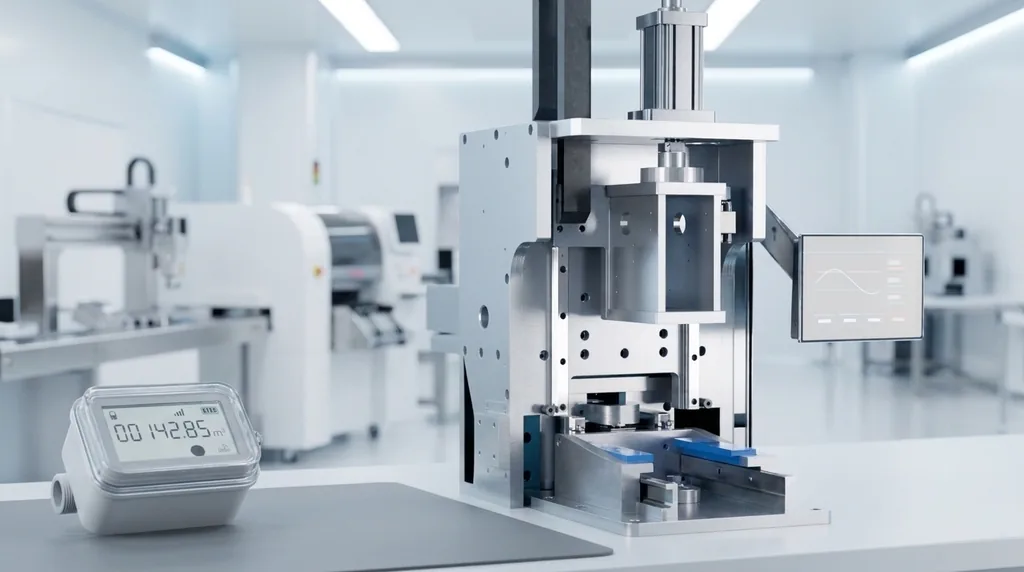
Smart ultrasonic water meters, residential AMI electricity meters, IoT gas-meter telemetry modules, and outdoor district-heating registers operate unattended for 10 to 15 years in flooded underground meter pits, freezing outdoor cabinets, and humid coastal climates. Applying hot plate welding smart meters fuses transparent polycarbonate display covers and flame-retardant housings into a permanently tamper-evident, IP67/IP68 waterproof enclosure with zero high-frequency vibration near sensitive metering PCBs, LCD screens, and lithium batteries. SHNEHP engineers 3-axis servo hot plate welders (XNS2-B, XNS5-B, XNS6-B) with optional non-contact infrared (IR) heating built to DVS 2215 precision for utility OEMs.
The part and its welding challenges
Smart utility meter enclosures are typically molded from UV-stabilized polycarbonate (PC), PC/ABS, UL94 V-0 flame-retardant PC-GF10/20, PBT, or PA-GF (often joining a crystal-clear PC optical display lens to an opaque PC or PC/ABS terminal base). Sealing populated smart utility meters introduces five strict engineering challenges:
- Protecting populated metering PCBs, LCDs & lithium batteries: Ultrasonic or vibration welding transmits intense mechanical shock that can crack LCD glass, detach solder joints on NB-IoT/LoRaWAN radio modules, or damage acoustic flow-sensor crystals—making vibration-free thermal hot plate fusion vastly safer.
- 10–15 year IP67 / IP68 submersion & anti-tamper security: Underground water meters sit fully submerged in muddy pit water, while electric/gas utilities require permanent tamper-evident seams that show obvious destruction if pried open for utility theft.
- Optical display clarity over LCD & barcode windows: Clear polycarbonate meter covers must stay completely free of hazing, clamp scratches, or polymer stringing that obscures automated optical meter-reading scanners.
- Hygroscopic PC & PBT moisture discipline: Un-dried polycarbonate or PBT housings release steam micro-bubbles during melting, creating microscopic capillary channels that slowly admit moisture and fog the LCD display months into field service.
- High-volume utility tender throughput: National utility rollouts require multi-cavity tooling (2-up or 4-up) with barcode-linked weld and leak-test traceability on every serialized meter.
Why hot plate welding (vs. alternatives)
| Process | Fit for smart water, gas & electric meter housings | PCB safety & tamper-proof IP68 seal | Typical cycle time | Engineering boundary |
|---|---|---|---|---|
| Servo hot plate — contact & non-contact IR (XNS2-B / XNS5-B / XNS6-B) | Primary choice for populated PC, PC/ABS, and PBT smart meters, clear optical covers, and submerged IP68 water-meter registers | Zero mechanical vibration near PCBs/LCDs; permanent tamper-evident fusion; non-contact IR eliminates PTFE wear and stringing on PC/GF grades | ~20–38 s (2-cavity or 4-cavity tooling scales UPH) | Mandatory pre-drying (PC 100–120 °C); switch to non-contact IR above ~270 °C PTFE ceiling or GF≥40% |
| Ultrasonic welding (XNC-400 / XN-5) | Empty sub-housings or small non-populated optical trim bezels | Fast local cycle | ~0.2–1.5 s | High-frequency energy risks damaging LCD glass, quartz oscillators, SMD capacitors, and sealed battery packs |
| Linear vibration friction (XN-35) | Large empty heavy-duty PA-GF utility junction boxes | Strong mechanical weld | ~5–15 s total | Linear acceleration and particulate dust threaten populated metering electronics and clear LCD optics |
| Rubber gaskets + tamper-evident screws / potting | Serviceable commercial meter terminal covers | Field-openable | Manual labor / curing time | Elastomer gaskets age over 10+ years, screws invite tampering, and epoxy potting adds weight, cost, and VOC cure lines |
Typical process window (industry ranges)
The conservative DVS 2215 five-stage baselines below cover UV-PC, PC/ABS, and PBT smart utility meters. Exact heating profiles, IR emitter gaps, and collapse stops are confirmed during a SHNEHP part-specific weld trial.
| Parameter | Typical industry range (PC / PC-ABS / PBT) | Engineering guidance |
|---|---|---|
| Pre-drying before welding | PC & PC/ABS: 100–120 °C; PBT: 100–120 °C | Mandatory to prevent steam micro-porosity and long-term LCD fogging |
| Heating mode & temperature | Contact platen: PC/ABS 265–290 °C, PC/PBT 275–305 °C; Non-contact IR: 300–480 °C | Non-contact IR is strongly recommended for optical PC (>270 °C PTFE ceiling) and populated PCB assemblies |
| Bead-up / leveling (Stage 1) | 0.4–0.7 mm (contact) or 1–2 mm emitter standoff (IR) | Levels rectangular/round meter rim flatness without stressing clear LCD covers |
| Melt / soak phase (Stage 2) | 5–16 s at 0.05–0.09 N/mm² | Localizes thermal energy strictly to the perimeter rib while heat baffles shield internal PCBs and batteries |
| Changeover time (Stage 3) | ≤1.4–1.8 s | Fast 3-axis servo retraction avoids cold-weld lines on fast-freezing PC and PBT |
| Joining & collapse (Stage 4) | 0.15–0.25 N/mm² to closed-loop servo hard stop (1.0–1.8 mm) | Double flash traps hide exterior beads and block any internal debris over the LCD screen |
| Cooling / hold (Stage 5) | 5–12 s | Locks tamper-proof perimeter flatness before smooth fixture ejection |
Recommended SHNEHP machine and fixture setup
Applying our +60 mm fixture margin rule across our servo hot plate welding machine platforms, SHNEHP configures smart-meter production cells for both single-cavity and multi-cavity utility contracts:
- Compact water/gas telemetry registers: XNS2-B and XNS5-B 3-axis full-servo hot plate welders deliver tight closed-loop collapse stops, ESD-friendly enclosures, and multi-zone PID stability.
- Large 3-phase electricity meters & 2–4 cavity utility lines: XNS6-B and XNS8-B servo platforms accommodate multi-cavity tooling nests with precision parallel guides.
- Non-contact infrared (IR) heating upgrade: Ideal for UV-stabilized PC, PC-GF, and PBT smart meters—eliminating platen contact, PTFE coating buildup, and resin stringing over optical displays and circuit boards.
- ESD-safe optical tooling & integrated IP68 test cells: Custom welding and testing fixtures pair anti-static non-marring optical nests with inline differential leak testing and MES serialization via customized machines.
Quality and leak testing
Smart utility meters undergo 100% serialized airtightness screening to guarantee 10–15 year field reliability:
- 100% inline IP67 / IP68 differential leak testing: Populated smart meters are screened at 10–30 kPa (positive pressure or vacuum; or inside a close-fitting sealed dosing chamber for 100% portless water-meter registers) against strict 0.1–0.5 mL/min leak thresholds using 1 Pa-resolution differential pressure testers and a 3–5 s stabilization stage.
- Optical & tamper-evidence audit: Automated vision or visual inspection confirms zero scratching/hazing across the clear PC display window and continuous 360° perimeter fusion.
- Serialized MES traceability: Every meter barcode links directly to weld zone temperatures, changeover time, servo meltdown depth, and IP68 leak-test pass/fail telemetry for utility tender compliance.
FAQ
Why is hot plate welding preferred over ultrasonic welding for smart meters containing PCBs and LCDs? Hot plate welding uses pure localized thermal fusion and gentle servo closing—transmitting zero high-frequency acoustic shock that could fracture LCD display glass, crack SMD ceramic capacitors, or damage ultrasonic flow sensors and radio crystals.
When should smart meter housings switch from contact hot plate to non-contact infrared (IR) welding? Whenever welding clear polycarbonate (PC), PC-GF, or PBT above the ~270 °C durability limit of PTFE contact coatings—or whenever exposed metering PCBs and optical displays demand zero-contact, zero-stringing cleanliness—non-contact IR is the superior option.
How do you leak-test a smart water meter that is welded 100% shut with no open port? Fully sealed portless water-meter registers are tested inside a close-fitting machined sealed-volume dosing chamber (bomb/accumulation leak fixture) at 10–30 kPa with 1 Pa differential instrumentation, detecting both micro-leaks and gross open seams without piercing the enclosure.
Do polycarbonate smart meter covers need drying before hot plate welding? Yes. Polycarbonate and PC/ABS absorb ambient moisture quickly; drying parts cleanly (100–120 °C per resin supplier guidance) prevents steam micro-porosity in the weld line that causes field moisture ingress and LCD fogging.
What files should we send for a SHNEHP smart meter weld trial? Provide frozen 3D STEP/X_T models of the meter housing, display cover, and PCB/battery keep-out clearances, exact PC/PC-ABS/PBT grade, target UPH, and IP67/IP68 leak-test criteria.
Get a free weld trial
Share your smart utility meter CAD files with SHNEHP engineering to evaluate contact versus non-contact IR servo hot plate welding and inline IP67/IP68 leak testing:
- Frozen 3D STEP / X_T / IGES models of the base, optical cover, and internal electronics keep-out zones
- Resin & flame-retardant grade (UV-PC, PC/ABS, PC-GF, PBT)
- Target hourly output (UPH) and IP67/IP68 leak-test specification
Email yy@nbxiaoneng.com or connect with our team via our contact page.
Request a Technical Consultation & Free Weld Trial
Send your 3D STEP/X_T drawing, resin grade, target cycle time, and leak-test specification. Our engineers will evaluate the joint and recommend a practical SHNEHP machine and fixture setup.