
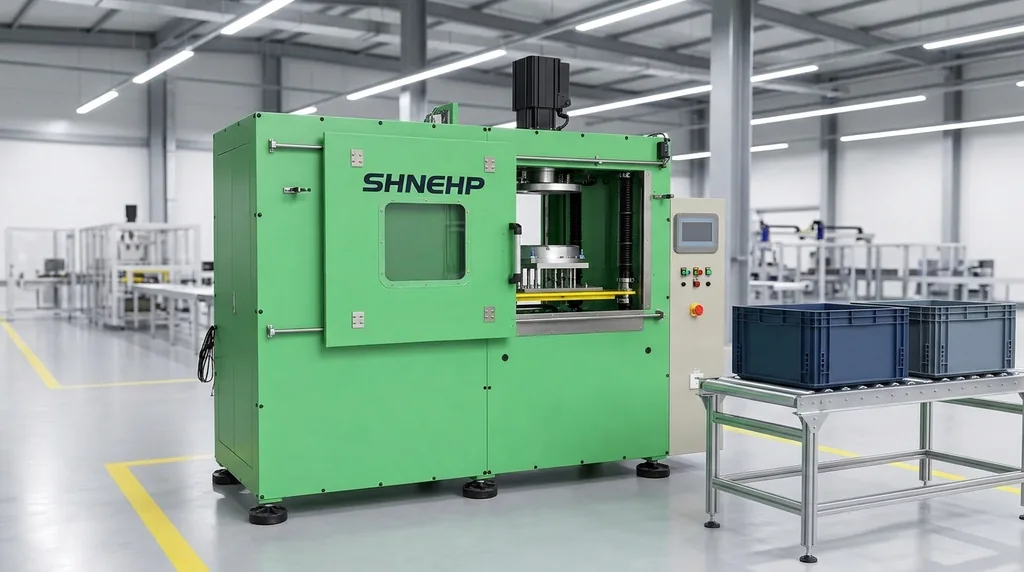
Automated warehouse AS/RS shuttle systems, pharmaceutical cold-chain loops, and automotive returnable-packaging pools rely on closed-base double-wall plastic crates and sanitary totes that combine high stacking stiffness with smooth, crevice-free washdown surfaces. Investing in a plastic crate welding machine fuses injection-molded outer tote walls, closed double-deck bottom bases, and integrated reinforcement runners into a rigid, hygienic unit capable of surviving years of conveyor transfer and forklift handling. SHNEHP engineers heavy-duty 3-axis servo hot plate platforms (XNS6-B, XNS8-B, XNS9-B) and large-format XNTP machines engineered to DVS 2215 precision for returnable packaging manufacturers.
The part and its welding challenges
Industrial logistics crates, Euro-standard KLT totes (400×300 mm, 600×400 mm, 800×600 mm), and hygienic double-wall bins are molded from HDPE or copolymer PP (including virgin food-grade, ESD-conductive, and controlled recycled-content industrial blends). Welding broad, ribbed logistics containers creates five core production challenges:
- Wide perimeter + dense internal grid ribs: Closed-base double-wall totes carry dozens of intersecting structural grid ribs alongside the outer perimeter wall; every internal intersection must melt and fuse simultaneously to prevent base flexing on high-speed AS/RS conveyors.
- Large-part molding warpage & sink: Broad 600×400 mm to 800×600 mm HDPE/PP shells bow after ejection from large injection molds; heavy clamping platens and controlled DVS 2215 bead-up leveling are mandatory to flatten both halves uniformly before soak.
- Recycled / regrind resin viscosity swings: Returnable tote lines often blend recycled HDPE/PP whose melt flow index (MFI) varies lot-to-lot; closed-loop servo displacement stops and staged pressure control prevent over-squeezing soft lots or under-fusing stiffer batches.
- Sanitary smooth exterior & automated-conveyor flatness: Food, pharma, and automated-warehouse totes demand zero protruding bottom flash (which catches conveyor rollers) and tightly sealed base seams that block wash-water pooling inside hollow double walls.
- Drop-impact & cold-storage toughness: Returnable totes experience harsh drops in -20 °C cold-chain facilities; cold welds or rapid brittle cooling shatter at corners under impact.
Why hot plate welding (vs. alternatives)
| Process | Fit for double-wall plastic crates & returnable totes | Rib coverage & conveyor flatness | Typical cycle time | Engineering boundary |
|---|---|---|---|---|
| Servo hot plate welding (XNS6-B / XNS8-B / XNS9-B / XNTP) | Primary choice for 400×300 to 800×600+ mm closed-base HDPE/PP totes, hygienic bins, and insulated boxes | Fuses full perimeter + all internal reinforcement grid ribs simultaneously with zero vibration noise and flat closed-loop base thickness | ~28–50 s (horizontal or vertical loading) | Apply +60 mm fixture clearance rule; keep platen PTFE ≤270 °C for HDPE/PP |
| Linear vibration friction (XN-100 / XN-200) | Very flat thick-walled industrial bases where linear clearance exists | Fast 8–18 s structural fusion | ~8–18 s total | High clamping force and oscillation can deform hollow crate sidewalls; fine dust can lodge inside sanitary double-wall cavities |
| Hot staking / snap-fit assembly | Secondary crate handles, label holders, and lid latches | Fast mechanical fastening | ~6–15 s | Cannot create a continuous watertight double-wall base seal or monolithic stacking stiffness |
| Single-piece open-rib injection molding | Low-cost non-hygienic open-grid crates | No secondary welding step | Injection cycle only | Open bottom grids trap dirt/water, wobble on automated AS/RS conveyors, and lack double-deck torsional stiffness |
Typical process window (industry ranges)
The conservative DVS 2215 five-stage baselines below cover HDPE and copolymer PP industrial crates and totes. Final melt times and collapse depths are established during a SHNEHP part-specific weld trial.
| Parameter | Typical industry range (HDPE / Copolymer PP) | Engineering guidance |
|---|---|---|
| Platen face temperature | HDPE: 225–255 °C; PP: 245–275 °C | Independent multi-zone PID heaters keep broad 600–850 mm platens thermally uniform edge-to-center |
| Bead-up / leveling (Stage 1) | 0.6–1.2 mm displacement | Flattens large molded tote warpage across outer perimeter and center grid ribs |
| Melt / soak phase (Stage 2) | 10–22 s at 0.05–0.12 N/mm² | Deep melt film absorbs lot-to-lot viscosity variation in recycled HDPE/PP blends |
| Changeover time (Stage 3) | ≤2.0–2.5 s | Fast servo platen retraction preserves hot molten interface across dense grid walls |
| Joining & collapse (Stage 4) | 0.15–0.30 N/mm² to closed-loop servo hard stop (1.5–3.0 mm) | Closed-loop stop guarantees flat AS/RS conveyor base geometry and consistent tote stack height |
| Cooling / hold (Stage 5) | 10–20 s under clamping load | Essential for semi-crystalline HDPE/PP totes to solidify flat with high drop-impact toughness |
| Total cycle time | ~28–50 s (pairs directly beside injection-molding press cycle) | Robotic extraction from molding press straight into the welder eliminates intermediate storage |
Recommended SHNEHP machine and fixture setup
Applying our +60 mm fixture clearance rule (effective platen ≥ maximum tote L×W + 60 mm for pneumatic clamps and guide pins), SHNEHP matches hot plate welding machines to Euro/US tote dimensions:
- 400×300 mm to 600×400 mm standard KLT & logistics totes: XNS6-B or XNS8-B 3-axis full-servo hot plate welders with rigid four-post guidance and multi-zone PID thermal platens.
- 800×600 mm heavy totes & oversized bins (up to ~850×800 mm): XNS9-B heavy-duty servo platform; for pallet-box lids and oversized bulk containers (up to 2400×1500 mm), step up to XNTP-90 / XNTP-91 pallet welding machines.
- Quick-change crate fixtures & automated press-side cells: Custom welding and testing fixtures integrate vacuum flat-base clamping, heavy pneumatic sidewall alignment cylinders, and press-side robotic transfer via customized machines.
Quality and leak testing
Closed-base double-wall crates and sanitary totes verify structural drop toughness, flatness, and watertight base sealing:
- Flatness & AS/RS conveyor gauge check: Automated flatness verification confirms welded bases sit within tight millimeter tolerances so totes track cleanly on high-speed warehouse shuttles.
- Double-wall watertightness testing: Hygienic food/pharma closed-deck totes undergo inline low-pressure dry-air decay (10–30 kPa, 3–5 s stabilization) via a small test port (later sealed) or batch vacuum-chamber checks so wash-down water cannot seep inside hollow double walls.
- Cold-storage drop-impact & stacking-load audits: Periodic lot testing drops loaded totes at -20 °C and performs static stacking-compression and peel-apart weld-rib inspections.
FAQ
What SHNEHP hot plate machine size fits standard 600×400 mm and 800×600 mm Euro logistics crates? Following our +60 mm fixture margin rule, 400×300 mm and 600×400 mm crates run cleanly on XNS6-B or XNS8-B 3-axis servo platforms, while 800×600 mm heavy crates fit XNS9-B (effective platen up to ~850×800 mm). Oversized bulk pallet boxes use XNTP-90 / XNTP-91.
Can a hot plate welder fuse recycled HDPE or PP totes reliably despite batch viscosity differences? Yes. Controlled DVS 2215 bead-up leveling, generous melt soak depth, and closed-loop servo meltdown stops compensate smoothly for moderate MFI variation across recycled industrial HDPE/PP batches—provided incompatible resins are not mixed.
Can the hot plate welder run directly beside an injection-molding machine with a robot? Yes. Because a 28–50 s hot plate welding cycle aligns naturally with thick-walled crate injection-molding cycles, robotic press-side cells weld warm, freshly molded totes immediately before heavy cool-down warpage sets in.
How do you keep welded tote bottoms flat enough for automated AS/RS warehouse conveyors? Use full-surface vacuum and mechanical backing plates inside the lower fixture, balance platen temperatures across center and edge zones, and maintain full clamping force through the 10–20 s cooling stage.
What engineering data does SHNEHP need for a plastic crate weld trial? Share 3D STEP/X_T models of the tote body and double-wall base, exact HDPE/PP resin grade (including recycled percentage or ESD additives), overall dimensions, and target hourly output (UPH).
Get a free weld trial
Share your plastic crate or returnable tote CAD drawings with SHNEHP engineering to size the servo hot plate platform (XNS6-B / XNS8-B / XNS9-B), design quick-change fixtures, and verify drop-impact weld strength:
- 3D STEP / X_T / IGES models of the crate body, closed base, and internal rib grid
- Polymer grade (virgin/recycled HDPE, copolymer PP, ESD grade)
- Container footprint, target UPH, and AS/RS flatness or sanitary seal specs
Email yy@nbxiaoneng.com or connect through our contact page.
Request a Technical Consultation & Free Weld Trial
Send your 3D STEP/X_T drawing, resin grade, target cycle time, and leak-test specification. Our engineers will evaluate the joint and recommend a practical SHNEHP machine and fixture setup.