
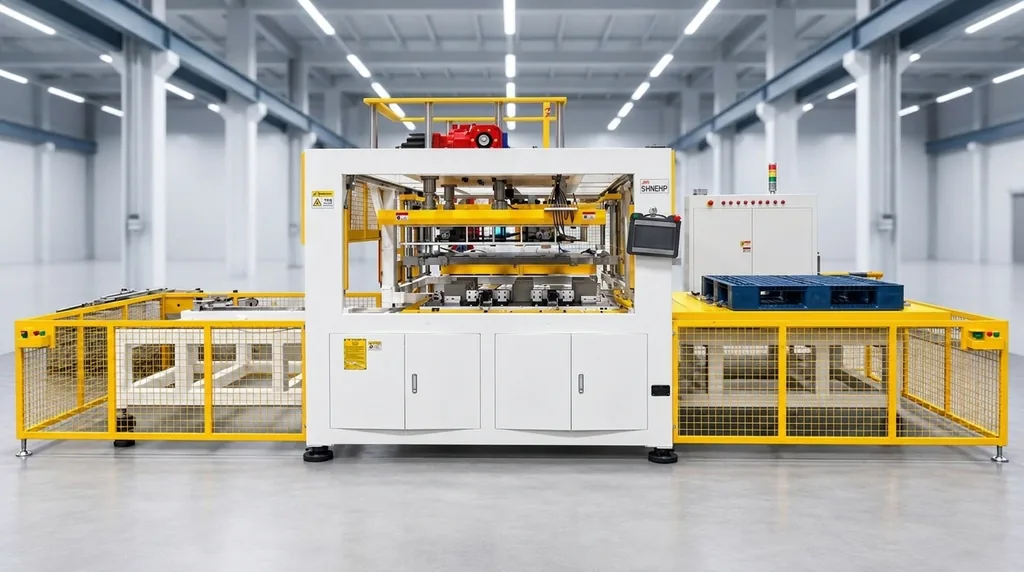
Logistics, cold-chain, pharmaceutical, and automated-warehouse suppliers rely on two-piece welded plastic pallets for hygienic closed-deck surfaces, high racking load capacity, and steel-tube reinforcement integration. Choosing an experienced plastic pallet welding machine manufacturer determines whether your 1200×1000 mm or 1200×1200 mm HDPE and PP pallets survive repeated forklift impacts and drop tests without splitting along the deck-to-runner weld plane. SHNEHP builds dedicated heavy-duty pallet hot plate welders—XNTP-90 (roller/indexing) and XNTP-91 (reciprocating)—capable of scaling up to 2400×1500 mm with multi-zone infrared or contact thermal control.
The part and its welding challenges
Welded industrial pallets join a molded upper deck to a lower runner/skid base—often enclosing internal steel reinforcement bars—using HDPE (virgin or high-grade recycled) or copolymer PP. Standard European, North American, and Asian footprints (1200×800, 1200×1000, 1200×1200, and 1400×1200 mm) create unique large-area joining challenges:
- Massive simultaneous weld area: A single pallet contains dozens of discrete leg-to-deck mating grids spread across more than 1.2 m². Uneven platen temperature across corners vs. center produces weak perimeter legs that fail corner-drop tests.
- Recycled HDPE / PP viscosity swings: Logistics pallet molders frequently blend recycled regrind with virgin HDPE/PP. Melt flow index variations demand wide, stable heating control and closed-loop meltdown stops rather than open-loop timing alone.
- Heavy deck warpage: Large injection-molded pallet halves bow significantly during cooling after molding. High-rigidity platens and sufficient bead-up pressure are required to flatten both halves uniformly before soaking.
- Fast platen retraction across a 1.5 m span: Moving a massive multi-zone heating plate out of a 1200+ mm window in under 2.5 seconds demands high-rigidity linear guideways and synchronized hydraulic or servo actuation.
- Hygienic closed-deck bead quality: Food and pharmaceutical pallets require smooth, sealed seams with no crevices that trap washdown water or bacteria.
Why dedicated pallet hot plate welding (vs. alternatives)
| Process | Fit for industrial plastic pallets | Size & load-bearing strength | Typical cycle time | Engineering boundary |
|---|---|---|---|---|
| Dedicated pallet hot plate (XNTP-90 / XNTP-91) | Industry standard for hygienic closed-deck & heavy-duty HDPE/PP pallets | Handles 1200×1000 mm up to 2400×1500 mm; fuses entire deck-to-runner grid uniformly | ~35–60 s total | Requires multi-zone thermal balance (e.g., 9-zone matrix) and rapid platen changeover (≤2.5 s) |
| Linear vibration friction (XN-200) | Limited to smaller specialty crates/panels | Max weld area ~650 cm²; heavy tooling cost | ~10–20 s | Pallet footprints and multi-leg grids generally exceed economical vibration tooling mass |
| Snap-fit mechanical assembly | Light-duty nestable pallets only | Lower racking and drop-impact strength | Fast | Open crevices trap dirt; snaps loosen under forklift abuse and cold-storage impact |
| Single-piece structural foam / blow molding | Specialized high-capex molding lines | No weld seam | Molding cycle | Higher mold cost; difficult to enclose internal steel tubes cleanly |
Typical process window (industry ranges)
The table below outlines conservative DVS 2215 / heavy-duty hot plate ranges for HDPE and PP industrial pallets. Final temperatures and soak times depend on virgin vs. regrind blend ratio and rib thickness, and are validated during a SHNEHP trial.
| Parameter | Typical industry range (HDPE / PP pallets) | Engineering guidance |
|---|---|---|
| Heating matrix & temperature | Contact face 245–285 °C (HDPE/PP); 9-zone infrared (IR) matrix ~300–500 °C for non-contact or heavily filled blends | Independent multi-zone PID control prevents cold corners across 1.2–2.4 m platens |
| Bead-up (alignment) phase | 0.8–1.5 mm displacement | Flattens post-molding bow across all pallet legs simultaneously |
| Melt / soak time | 12–30 s | Scaled to wall/rib thickness (typically ≥2.5–4.0 mm on heavy pallets) |
| Changeover (platen out) | ≤2.0–2.5 s | Fast motorized retraction prevents molten HDPE/PP from skinning before joining |
| Joining collapse (meltdown) | 2.0–3.5 mm to mechanical/servo hard stop | Guarantees complete fusion without squeezing melt dry |
| Hold / cooling time | 12–25 s | Maintains flatness under clamping force until joints solidify |
| Total machine cycle | ~35–60 s | Automated roller infeed/outfeed (XNTP-90) minimizes non-welding handling time |
Recommended SHNEHP machine and fixture setup
SHNEHP builds dedicated heavy-frame pallet welding machines engineered for continuous 24/7 logistics manufacturing:
- XNTP-90 (roller-conveyor / pass-through pallet welder): Designed for continuous inline pallet production—molded halves index in automatically via powered rollers, weld under high-rigidity clamping, and discharge directly to cooling/stacking conveyors.
- XNTP-91 (reciprocating / shuttle pallet welder): Compact front-loading shuttle architecture suited to factories running multiple pallet sizes or integrating manual steel-bar placement prior to welding.
- Multi-zone thermal architecture: Available with contact PTFE-coated platens or 9-zone independent infrared heating matrices to eliminate sticking on recycled polyolefin blends and deliver uniform corner-to-center fusion.
- Quick-change pallet tooling: Custom welding and testing fixtures feature modular clamping locators for standard 1200×800, 1200×1000, and 1200×1200 mm pallets, steel-tube presence sensors, and light-curtain guarding.
- Turnkey molding-to-welding cells: Connect directly to injection-molding press robots, automated steel-bar loaders, and automatic stackers via customized machines.
Quality and leak testing
Industrial pallets are qualified primarily on structural impact durability and hygienic seam integrity:
- Corner-drop and forklift-impact testing (ISO 8611): Welded pallets undergo loaded corner-drop tests (including cold-room conditioning at −20 °C for cold-chain HDPE pallets) to confirm welds do not delaminate before the parent wall yields.
- Static, dynamic, and racking load tests: Verifies uniform leg-to-deck weld strength across outer corners and center supports.
- Hygienic seal / leak inspection: For closed-deck food and pharma pallets, pressure-decay or immersion checks verify watertight weld perimeters with zero open crevices.
- Thermal uniformity audits: Periodic thermal-camera verification across all heating zones ensures consistent melt depth across the entire pallet footprint.
FAQ
What is the difference between SHNEHP XNTP-90 and XNTP-91 pallet welding machines? The XNTP-90 uses a pass-through roller architecture ideal for continuous high-volume automated lines connected directly to molding presses and stackers. The XNTP-91 uses a reciprocating shuttle layout that saves floor space and suits multi-model changeovers or manual steel-tube insertion.
What maximum pallet size can SHNEHP pallet welders handle? Standard machines cover 1200×800, 1200×1000, and 1200×1200 mm industrial pallets, and SHNEHP builds custom large-format horizontal pallet welders up to 2400×1500 mm.
Can SHNEHP pallet welders run recycled HDPE or PP regrind? Yes. Multi-zone PID temperature control, closed-loop meltdown stops, and optional non-contact infrared heating matrices accommodate melt-viscosity variations common in recycled HDPE and PP blends.
Can one pallet welder handle multiple pallet dimensions? Yes. Modular quick-change fixtures, adjustable locators, and stored PLC/HMI parameter recipes allow switching between standard logistics footprints while maintaining repeatable alignment.
What factory infrastructure is needed before installing a pallet welder? Verify 380V 3-phase power capacity for multi-zone heaters, dry compressed air (0.5–0.7 MPa), forklift/crane rigging height, and door clearance for heavy-frame machine delivery.
Get a free weld trial
Share your pallet specifications with SHNEHP engineering for an XNTP-90 vs. XNTP-91 recommendation, floor-plan layout, and tooling quotation:
- Frozen 3D STEP / X_T models of the upper deck and lower base
- Material specification (virgin vs. recycled HDPE/PP ratio, steel-bar integration)
- Pallet dimensions, target hourly output, and ISO 8611 load / drop-test criteria
Email yy@nbxiaoneng.com or submit your project via our contact page.
Request a Technical Consultation & Free Weld Trial
Send your 3D STEP/X_T drawing, resin grade, target cycle time, and leak-test specification. Our engineers will evaluate the joint and recommend a practical SHNEHP machine and fixture setup.